

In community development, we celebrate small wins.
A $250,000 grant.
A $500,000 investment.
A modest development project that finally gets off the ground.
And those wins matter. In communities that have experienced decades of disinvestment, any investment can feel like progress. When you’re used to seeing money leave your neighborhood instead of flow into it, even a small infusion of capital can feel like a victory.
But after years working in this field, I’ve come to a realization that is uncomfortable to say out loud:
$500,000 won’t save the neighborhood.
The Math of Disinvestment
When we step back and look at the numbers, something becomes clear.
Many historically disinvested neighborhoods lost hundreds of millions—sometimes billions—of dollars in capital over decades. Beginning in the 1930s, redlining policies systematically prevented banks from lending in Black neighborhoods. Urban renewal projects demolished thriving commercial districts. Infrastructure investments bypassed entire communities.
The damage accumulated year after year.
So when we celebrate a $500,000 investment today, we should ask ourselves:
Does it actually repair what was broken?
Does it rebuild what was lost?
Or does it simply help us feel like progress is happening?
Too often, the scale of our solutions does not match the scale of the problem.
The Psychology of Scarcity
Part of the challenge isn’t financial—it’s psychological.
If you’ve spent your career in environments where funding is scarce, your expectations begin to adjust. Over time, you internalize the belief that $500,000 is a lot of money.
And in some contexts, it absolutely is.
But in the world of real estate development, infrastructure investment, and capital markets, $500,000 is often just the predevelopment budget.
Meanwhile, the private sector routinely deploys projects worth $20 million, $50 million, or even $100 million without blinking.
The difference isn’t capability.
It’s mindset—and access to capital systems.
The Work Is Often the Same
One of the biggest revelations for me over the years is this:
It often takes the same amount of work to raise $10 million as it does to raise $500,000.
You still have to:
Build relationships
Develop a compelling vision
Assemble partners
Navigate regulations
Present a credible plan
The meetings are the same.
The strategy is the same.
The preparation is the same.
The difference is simply who you are talking to and how big you allow yourself to think.
If our goal is truly to rebuild communities that experienced generations of disinvestment, we cannot limit ourselves to projects that barely move the needle.
Thinking in Systems, Not Grants
Another challenge is that many nonprofit leaders are trained to think in terms of grants instead of capital stacks.
Grants are important—but they are only one tool in a much larger financial ecosystem.
Large-scale neighborhood revitalization often requires layering multiple forms of capital:
Private equity
Debt financing
Tax credits
Public infrastructure funding
Philanthropic grants
When these tools are combined strategically, projects that once seemed impossible suddenly become feasible.
But if we only think about the next grant cycle, we unintentionally cap our own ambitions.
Matching Vision With Scale
Communities that have endured generations of disinvestment deserve solutions that match the scale of the challenge.
They deserve:
Major housing developments.
Thriving commercial corridors.
Anchor institutions that create jobs.
Business ownership opportunities.
Infrastructure that attracts long-term investment.
Those things rarely happen with $500,000.
They happen when we start thinking in terms of tens of millions of dollars moving strategically into neighborhoods that were once locked out of investment.
Because if we truly believe in the potential of our communities, then the goal cannot simply be to stop the bleeding.
The goal must be to restore wealth, opportunity, and ownership at the scale that was taken away.
And that starts with being honest about something many of us in community development don’t say enough:
$500K won’t save the neighborhood.
But thinking bigger just might.
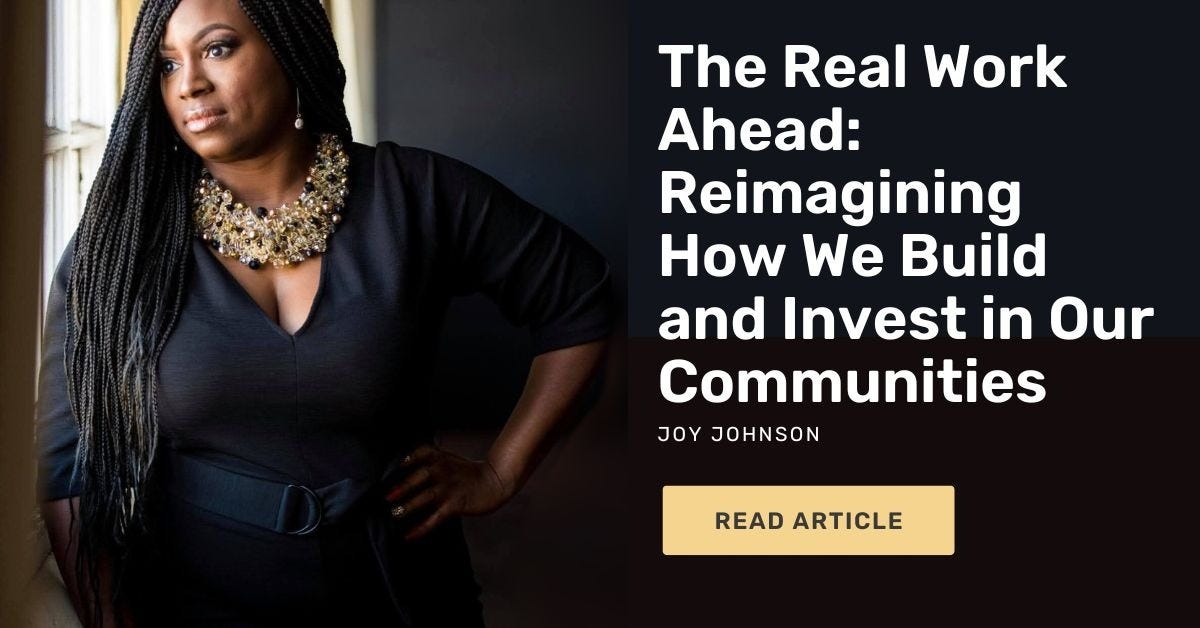
With more than two decades of experience in community development, real estate strategy, and organizational leadership, Joy Johnson brings a seasoned, solutions-focused voice to the field. She is committed to helping communities and institutions avoid systemic pitfalls and build models that truly work. To reach Joy call at (216) 238-2235.