

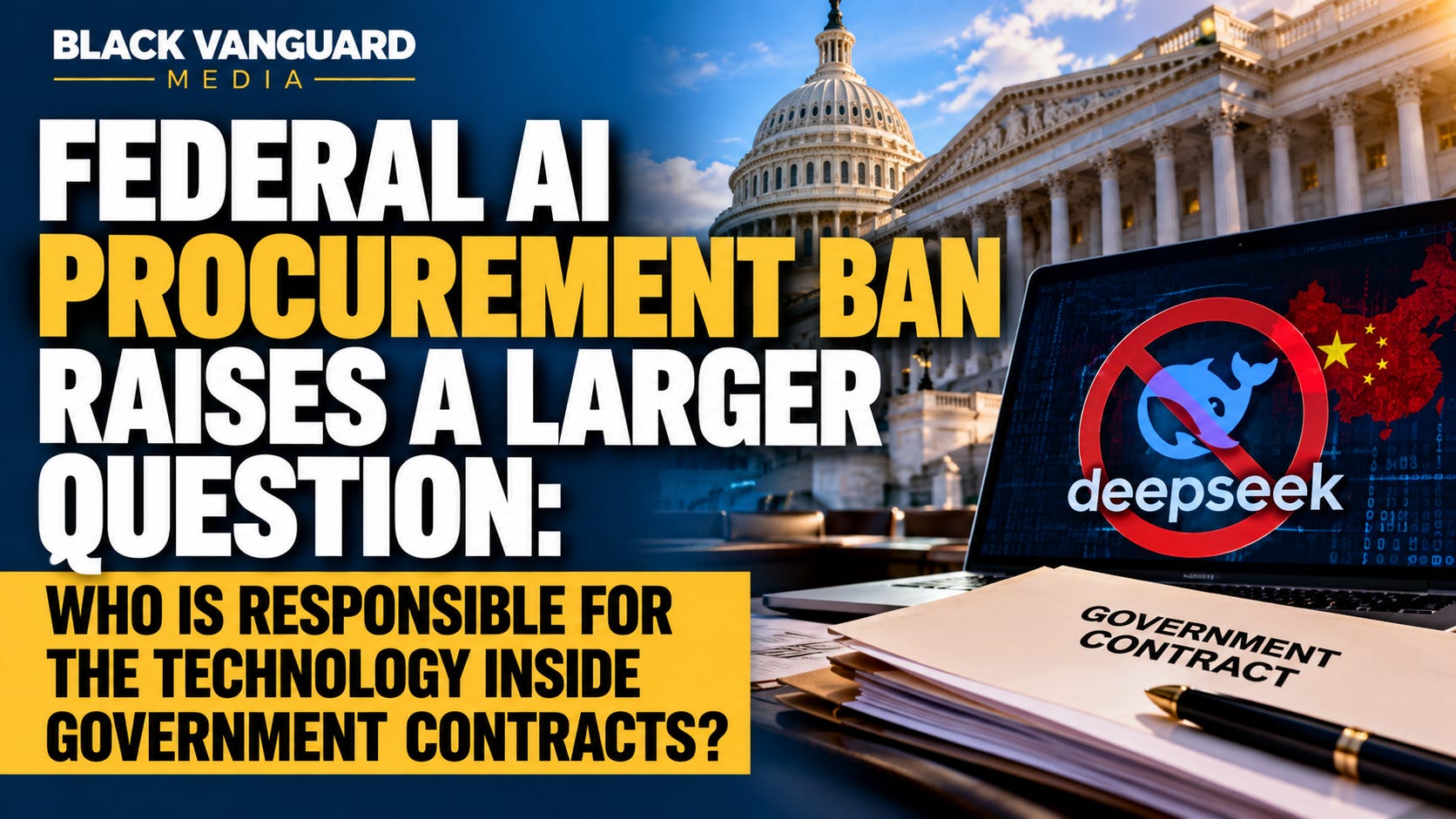
WASHINGTON — A company doing business with the federal government may know which software it purchased without knowing which artificial intelligence system operates behind it.
That distinction is becoming increasingly important following a federal order restricting DeepSeek, the Chinese artificial intelligence developer whose technology has attracted attention for its capabilities and relatively low costs.
The Department of Homeland Security has directed federal civilian agencies to remove covered DeepSeek technology from their systems and exclude it from future procurements. The restriction also reaches certain third-party products incorporating DeepSeek implementations.
For government contractors, the decision raises a question that extends beyond one Chinese technology company: Who is responsible when restricted technology is embedded inside products supplied by another vendor?
Why Washington Is Restricting DeepSeek
The order follows a recommendation from the Federal Acquisition Security Council under legislation designed to protect federal information systems and supply chains.
Federal officials cited concerns about sensitive information, foreign access to data and potential cybersecurity vulnerabilities.
China has criticized American restrictions on Chinese technology, arguing that national security concerns are being used to discriminate against its companies.
The order does not prohibit every American business from using DeepSeek. Its direct requirements concern federal civilian agency systems and procurement, although contractors supplying those agencies may be affected.
The Risk for Smaller Federal Contractors
Artificial intelligence increasingly operates behind ordinary business software, including document-management platforms, customer-service applications and research tools.
A contractor may purchase software from an American company without realizing that part of the service relies on DeepSeek technology.
That creates potential compliance problems when the software is delivered to a federal customer.
Large contractors often employ cybersecurity specialists and compliance attorneys. Smaller businesses may depend on outside vendors and lack the resources to investigate every technology component.
Replacing a restricted system could require additional software purchases, employee training, security testing and changes to project schedules.
For a company operating under a fixed-price contract, those expenses can significantly reduce profitability.
However, the order does not automatically make every contractor legally responsible for undisclosed technology in a vendor’s product. Specific obligations depend on applicable procurement rules and contract requirements.
Cybersecurity Is Becoming a Business Requirement
The National Institute of Standards and Technology’s AI Risk Management Framework emphasizes identifying and managing risks associated with artificial intelligence, including third-party systems.
For federal contractors, that means understanding not only what software does, but also how it handles information and which technologies support it.
Businesses may need to strengthen vendor reviews, maintain accurate software inventories and document compliance with federal requirements.
These responsibilities can create additional expenses, but they may also produce opportunities for smaller technology firms offering cybersecurity assessments, compliant software and system-integration services.
The implications extend beyond government contracting.
Nonprofit organizations, healthcare providers and community institutions increasingly use AI-enabled technology to manage information and deliver services. Although the DeepSeek order does not automatically apply to those organizations, similar questions about data security and vendor accountability remain relevant.
The Larger Business Question
Artificial intelligence promises greater productivity, lower operating costs and new business opportunities.
But those advantages can disappear when organizations cannot identify the technology they rely on or demonstrate that it meets customer requirements.
For small federal contractors, capital readiness is therefore becoming more than access to financing. It also involves cybersecurity, reliable vendors, contract compliance and the ability to manage unexpected technology expenses.
Washington’s DeepSeek restriction illustrates a broader shift in government purchasing.
Federal customers are increasingly concerned with where technology originates, how it handles information and who is accountable when something goes wrong.
For businesses competing for government contracts, understanding those risks may become just as important as offering the lowest price or the best technical solution.