

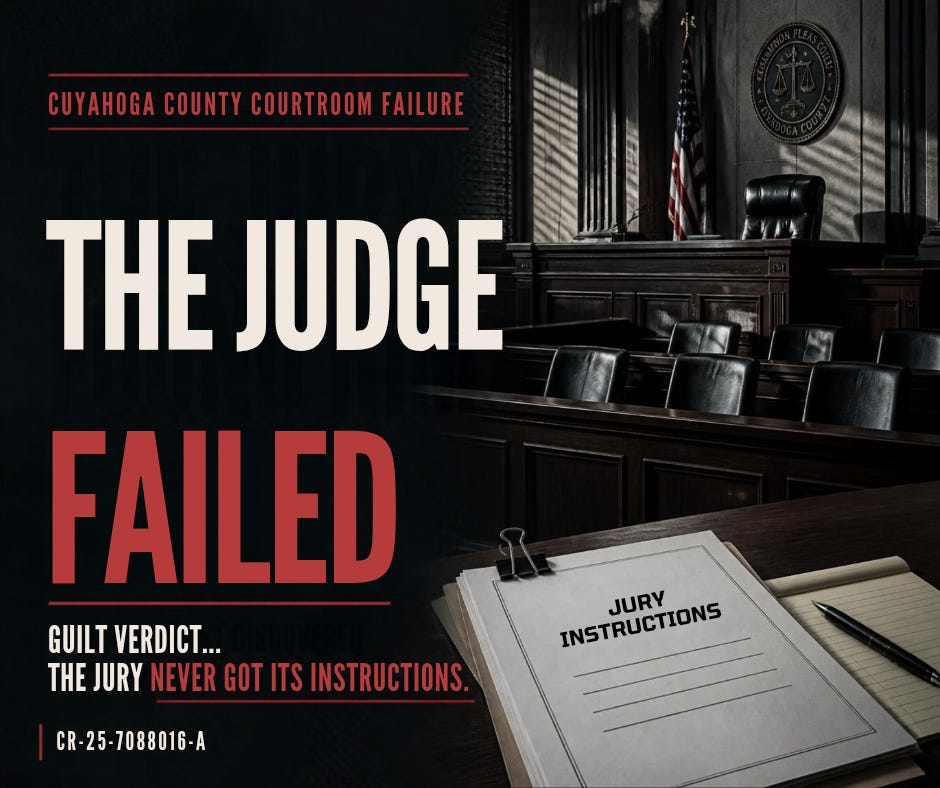
There are mistakes in a courtroom that lawyers can argue about for years.
Was a piece of evidence admissible? Should an objection have been sustained? Was a sentence too harsh?
And then there are mistakes so basic that they should never happen at all.
What happened in Cuyahoga County Common Pleas Case CR-25-708016-A falls into that second category.
This was a rape case.
A jury was selected. Witnesses testified. Lawyers presented evidence. The case went through the machinery of a felony jury trial in Judge Antonio Nicholson’s courtroom.
And the jury reached verdicts.
According to the public docket, jurors found the defendant guilty of multiple serious offenses, including several counts of rape and gross sexual imposition.
Then came the discovery that changed everything.
The jury had not received the jury instructions.
That is not a technicality.
That is not a misplaced document that had nothing to do with the outcome of the case.
The instructions are the law the jury is supposed to use to decide whether a person is guilty.
Jurors are not lawyers. They are not expected to walk into a courtroom already knowing the legal elements of rape, gross sexual imposition, reasonable doubt, the burden of proof or how particular evidence may legally be considered.
That is why the judge instructs them.
It is one of the most basic responsibilities of conducting a jury trial.
Yet the docket in this case states:
“DEFENDANT’S MOTION ORALLY FOR A MISTRIAL DUE TO THE JURY HAVING NOT RECEIVED THE JURY INSTRUCTIONS.”
Think about what that means.
A jury had heard a rape case, deliberated and returned guilty verdicts—without having received the legal instructions it was supposed to use to reach those verdicts.
The defense asked for a mistrial.
A few days later, the State of Ohio joined the defense in asking for one.
The docket records the result plainly:
The joint request for a mistrial was granted.
That is an extraordinary breakdown.
Not because mistrials never happen. They do.
Juries sometimes deadlock. Witnesses say something they should not have said. Evidence problems can arise that no one could reasonably have anticipated.
But that is not what this docket describes.
This jury had reached verdicts.
The problem was that one of the most basic requirements of a jury trial had not been completed correctly.
And the responsibility for the administration of that trial rested with Judge Antonio Nicholson.
There may have been clerks, bailiffs and other court employees involved in physically carrying out different tasks. But judges do not merely sit in a chair and rule on objections. They run the courtroom.
The judge is responsible for making sure the trial is conducted properly.
The judge is responsible for instructing the jury.
The judge is responsible for making certain that the people who are about to decide another person’s liberty actually have the law in front of them before they deliberate.
That responsibility stops at the bench.
Now think about the victim
There is another part of this story that cannot be reduced to court procedure.
This was a rape prosecution.
Anyone who has ever watched a sexual-assault trial understands what that can require of the person at the center of it.
A victim may have to sit in a courtroom and recount some of the most painful events of her life.
She may have to answer questions from prosecutors.
Then she may have to answer questions from defense attorneys whose job is to challenge her testimony.
She may have to do it while the accused sits only feet away.
And she may have to do it in front of strangers.
This victim had already gone through that process.
Then a jury returned guilty verdicts.
And because the jury had not received its instructions, the trial could not stand.
The mistrial created the possibility that the case would have to be tried all over again.
That matters.
Another jury.
Another round of testimony.
Another cross-examination.
Another opportunity for a victim to be forced to relive the experience she had already brought before a court of law.
Ultimately, there was no second jury trial.
The case was resolved through a plea agreement.
We cannot say from the docket alone that prosecutors agreed to that plea specifically because they did not want to put the victim through another trial.
But anyone examining the case should understand the decision prosecutors were facing.
They had already presented their case once.
A jury had already returned multiple guilty verdicts.
Now prosecutors had to decide whether to assemble another jury, call witnesses again, spend additional public resources and potentially ask the victim to endure another trial.
Instead, the case ended in a negotiated plea that produced convictions for serious sexual offenses, while other charges were amended or dismissed.
The mistrial changed the course of the case.
That is undeniable.
There was a public cost too
Trials are expensive.
Jurors have to be summoned.
Courtrooms have to be staffed.
Prosecutors prepare cases.
Public defenders or appointed counsel prepare cases.
Police officers and other witnesses may spend hours or days in court.
Court reporters create the record.
Judges, clerks and bailiffs all spend public time administering the proceeding.
We do not have a dollar figure for what this particular trial cost Cuyahoga County taxpayers, and there is no reason to invent one.
But when a felony jury trial has to be discarded because a fundamental step was missed, public resources have been wasted.
And in this case, those resources were spent on a trial in which the jury had actually reached guilty verdicts.
That makes the failure even harder to dismiss.
This is what competence looks like on the bench
Judicial competence is sometimes discussed as though it means only knowing the law.
It means more than that.
A good trial judge has to be organized.
A good trial judge has to be disciplined.
A good trial judge has to pay attention to details.
A good trial judge has to control the courtroom without allowing the pressure of the job to interfere with careful decision-making.
And a good trial judge has to make sure the basic mechanics of a trial are done correctly.
That is also where judicial temperament enters the conversation.
Temperament is not simply whether a judge smiles enough or whether someone has ever raised his voice.
Judicial temperament is steadiness.
It is patience.
It is self-control.
It is the ability to remain deliberate when a courtroom is stressful.
And it includes the kind of thoroughness necessary to make certain that something as basic as jury instructions is not missed.
Ohio trains judges on jury instructions because they are fundamental.
This is Trial Judge 101.
The jury cannot properly perform its constitutional role if it does not know the law it has been asked to apply.
That is why what happened in CR-25-708016-A Is deserves much more attention than a one-line docket entry.
A rape victim went through a trial.
A jury heard the evidence.
That jury returned multiple guilty verdicts.
Then the court discovered that the jury had not received its jury instructions.
The defense requested a mistrial.
The prosecution ultimately agreed.
The court granted it.
Those verdicts were lost.
The case had to be resolved another way.
And all of it happened in Judge Antonio Nicholson’s courtroom.
That is not gossip.
That is not campaign rhetoric.
That is not somebody whispering about what they heard happened inside the Justice Center.
That is the court record.
And when we give a judge the power to determine bond, sentence people to prison, oversee rape trials and make decisions that can permanently alter someone’s life, we have every right to ask whether that judge is sufficiently careful, sufficiently thorough and sufficiently disciplined to handle that responsibility.
Because in a courtroom, details are not little things.
Sometimes they are the difference between a verdict that stands—
and an entire trial that has to be thrown away.
Judicial temperament is not just about demeanor. It is also about steadiness, discipline, patience, and thoroughness. When a fundamental courtroom safeguard fails in a rape trial and the result is a mistrial, that should matter in any serious assessment of the judge responsible for that courtroom.