

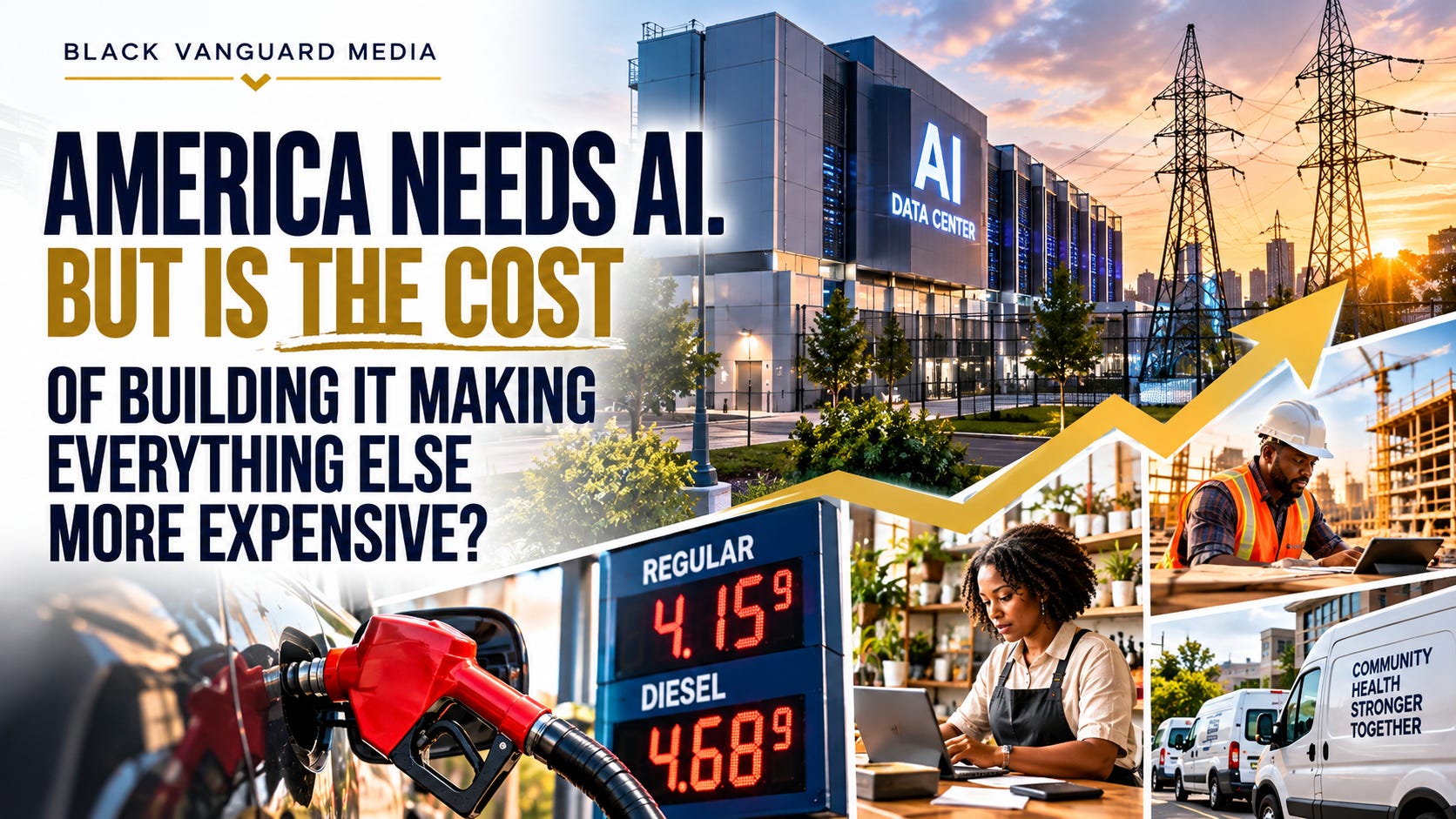
Technology companies are investing heavily in data centers, electricity and computing infrastructure. The expansion could strengthen the economy, but it is also raising questions about who pays for the resources needed to support it.
WASHINGTON — America’s artificial intelligence boom is creating extraordinary investment opportunities. Technology companies are building data centers, utilities are planning new power infrastructure, and investors are committing substantial capital to an industry expected to reshape the economy.
But the rapid expansion is raising a question that extends far beyond Silicon Valley: Could the enormous resources required to build the AI economy make electricity, construction and financing more expensive for everyone else?
For small businesses, nonprofit institutions and community developers, the answer could have significant financial consequences.
Artificial intelligence requires more than advanced software. It depends on enormous computing facilities equipped with specialized processors, cooling systems, electrical equipment and high-capacity connections to the power grid.
Building those facilities requires land, construction workers, transformers, steel, concrete, financing and substantial amounts of electricity.
Many of those same resources are needed to construct housing, expand factories, modernize hospitals and operate ordinary businesses.
As AI investment accelerates, economists and energy regulators are examining whether demand for these resources could create additional cost pressures in markets already experiencing supply constraints.
The International Energy Agency estimated in its 2025 Energy and AI report that data centers consumed approximately 415 terawatt-hours of electricity worldwide in 2024, roughly 1.5% of global electricity consumption.
Under its base-case projections, that demand could more than double by 2030, reaching approximately 945 terawatt-hours.
The United States is expected to account for a substantial portion of that growth.
The Department of Energy’s Lawrence Berkeley National Laboratory estimated that American data centers consumed about 4.4% of U.S. electricity in 2023. Its projections indicated that consumption could reach between 6.7% and 12% by 2028, depending on technology adoption, efficiency improvements and infrastructure development.
Those figures do not mean electricity prices will rise by the same percentages. They do, however, illustrate the scale of new demand utilities must prepare to serve.
Electricity costs are particularly important because businesses and community institutions generally have limited control over utility rates.
A small manufacturer, grocery store, senior-care facility or neighborhood nonprofit cannot easily relocate when its electricity expenses increase.
And unlike major technology companies, smaller organizations typically lack the financial capacity to negotiate large-scale energy supply agreements or invest in dedicated power generation.
Whether AI-related electricity demand increases costs for those customers depends heavily on how utilities finance new infrastructure and how regulators allocate expenses.
New data centers can generate substantial electricity sales and potentially spread certain fixed utility costs across more customers.
But if serving them requires new power plants, transmission lines or substations, the cost of those investments must be recovered.
The central question is whether large electricity users pay an appropriate share of the infrastructure built to accommodate them.
State utility commissions have increasingly confronted that issue as data center development expands.
Some utilities have proposed special tariffs, minimum purchasing commitments and other arrangements intended to reduce the risk that existing customers will subsidize infrastructure built for large new users.
Those policies matter because electricity expenses affect nearly every part of the economy, including businesses that have no direct involvement in artificial intelligence.
The construction industry faces a different potential challenge.
Data centers require specialized electrical contractors, engineers, cooling equipment and large quantities of materials. In regions experiencing concentrated development, those projects can compete with other construction activity for skilled workers and equipment.
Federal Reserve regional economic reports have documented construction labor shortages, rising project costs and uncertainty surrounding commercial development in recent years.
The Fed’s Beige Book reports also provide a mechanism for tracking regional business conditions, including changes in demand associated with data centers and other large investment projects.
Still, construction costs are influenced by numerous factors beyond AI, including interest rates, tariffs, insurance, wages, material availability and local building regulations.
It would be misleading to attribute every increase in construction expenses to technology investment.
The more defensible concern is that unusually large infrastructure projects can intensify existing shortages in particular locations or specialized trades.
A community organization planning a new facility, for example, might face higher electrical installation costs if local contractors are already committed to major commercial projects.
That outcome is possible, but its extent would require evidence from local contractors, bids and project schedules rather than assumptions based solely on national AI investment figures.
Capital markets introduce another layer of complexity.
Technology companies and their partners are spending heavily on computing facilities, equipment and energy infrastructure. Financing those investments can involve corporate borrowing, private credit, project finance and equity capital.
For smaller organizations, the concern is whether such investment increases competition for financing or influences the terms available to other borrowers.
The relationship is not straightforward.
Large technology companies frequently borrow from different investors and through different financial instruments than those used by small businesses or nonprofits.
Strong AI-related investment can also stimulate economic growth, increase demand for financial services and create opportunities for lenders.
There is not sufficient evidence to conclude that every dollar invested in AI infrastructure represents a dollar unavailable to a neighborhood business or affordable housing project.
But large-scale capital spending can influence demand for construction financing, equipment and infrastructure, particularly in markets where lending capacity or specialized resources are constrained.
For organizations already struggling with borrowing costs, those conditions deserve attention.
The economic benefits of AI investment are also substantial.
Data center construction creates demand for contractors, electricians, equipment suppliers and engineering firms. Once operating, the facilities purchase electricity, maintenance, security and other services.
Communities may benefit from new tax revenue, infrastructure investment and business opportunities.
AI technology itself could improve productivity in healthcare, logistics, accounting, research and professional services.
Federal Reserve researchers and other economists have examined the potential for artificial intelligence to increase productivity, while emphasizing uncertainty about how quickly those gains will spread throughout the economy.
For smaller businesses, the opportunity is not limited to supplying data centers. Affordable access to AI tools could reduce administrative expenses, improve customer service and allow employees to complete certain tasks more efficiently.
But economic benefits and financial burdens may not reach the same organizations.
A major technology company might gain from increased computing capacity while a nearby small business experiences higher utility bills.
A construction contractor might win substantial work on a data center while a nonprofit developer struggles to secure specialized labor for an affordable housing project.
Both outcomes could occur within the same regional economy.
That uneven distribution is why the financial consequences of AI infrastructure deserve scrutiny alongside the industry’s potential benefits.
For nonprofit institutions, the issue is especially significant.
Organizations providing senior care, workforce development, housing assistance and community services often operate with restricted funding and limited financial reserves.
They may not be able to raise prices when utility bills, construction expenses or other operating costs increase.
A hypothetical organization spending $250,000 annually on electricity would incur an additional $25,000 in costs following a 10% increase in its effective electricity price, assuming usage remained constant.
That calculation does not establish that AI caused the increase. It demonstrates how sensitive an operating budget can be to changes in essential expenses.
For institutions considering expansion, the combination of higher construction costs, uncertain utility expenses and borrowing obligations can make financial planning more difficult.
Business leaders therefore face two separate decisions: how to take advantage of artificial intelligence and how to protect their organizations against changing operating costs.
Both require an understanding of cash flow, financial reserves, project economics and long-term obligations.
A company may increase revenue through new technology while losing profitability if its electricity, labor, equipment and financing costs rise faster.
Similarly, a nonprofit may secure funding for a new facility without fully accounting for the operating expenses it will face after construction.
The broader economic question is not whether America should invest in artificial intelligence. The technology could generate substantial productivity gains and strengthen the country’s competitiveness.
The question is how the costs of building that infrastructure are distributed, and whether smaller businesses and community institutions can participate in the benefits without disproportionately absorbing the financial pressures.
That will depend partly on utility regulation, infrastructure planning, construction capacity, lending conditions and the ability of smaller organizations to adopt new technologies.
The AI economy is being built at extraordinary speed.
Whether its economic rewards are widely shared will depend not only on how much capital the country invests, but also on who benefits from that investment—and who ultimately pays for it.