

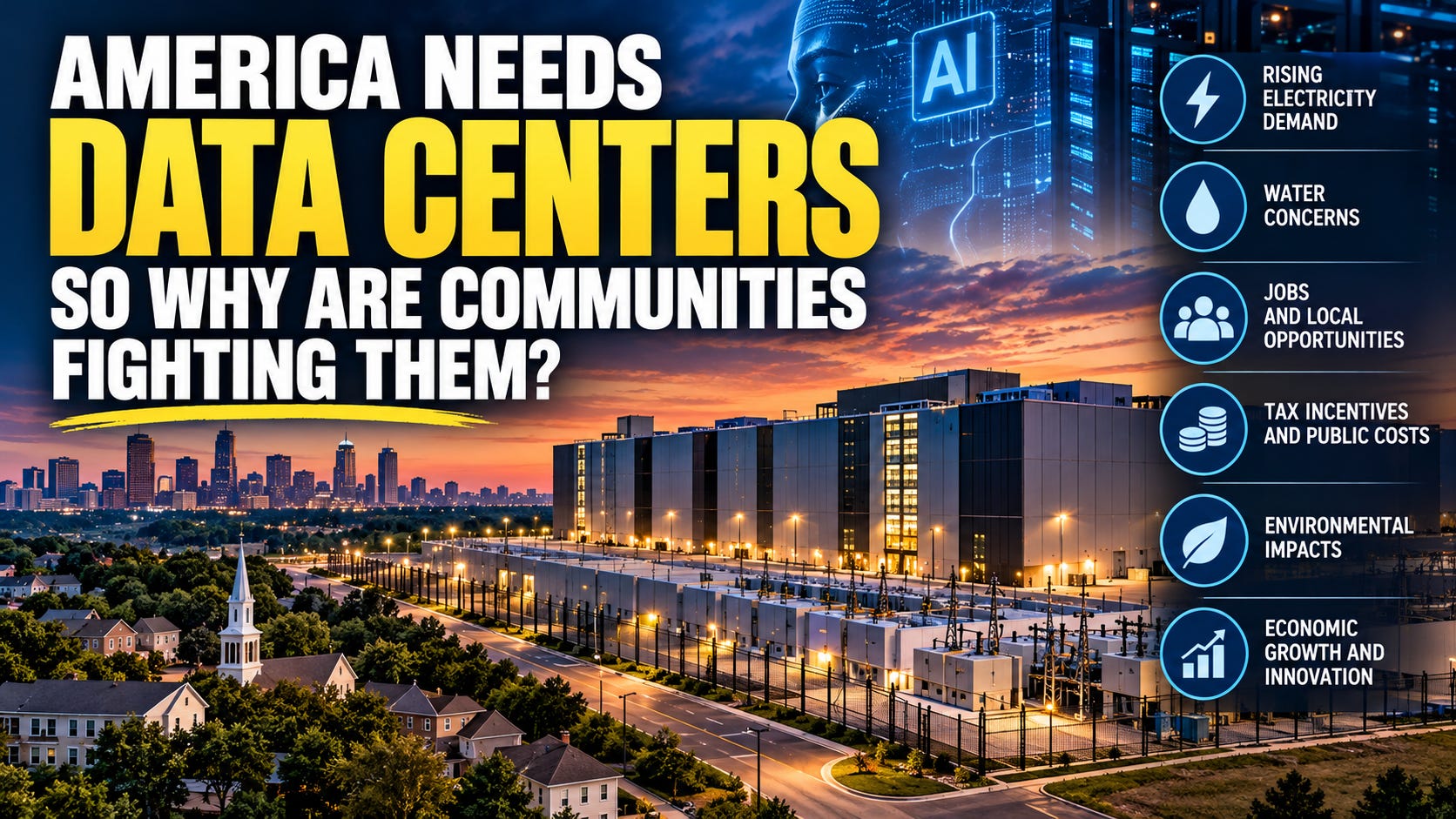
As technology companies invest billions in the infrastructure behind artificial intelligence, communities are questioning whether the promised economic benefits justify rising electricity demand, environmental concerns and public tax incentives.
The rapid expansion of artificial intelligence is creating an unusual economic conflict across the United States. The same technology that promises to transform healthcare, education, business and scientific research is driving demand for massive data centers, and some of the communities being considered for those facilities are pushing back.
The opposition is not necessarily about rejecting technological progress. Increasingly, it is about the price communities may be asked to pay for it.
Technology companies need more computing power to develop and operate artificial intelligence systems. That requires buildings filled with sophisticated processors, cooling equipment and electrical infrastructure. The investment can reach billions of dollars for a single large development.
Supporters see an opportunity to attract private investment, expand the tax base, create construction jobs and strengthen America’s position in a global technological competition.
Critics see a different possibility: enormous facilities consuming electricity and water, receiving generous tax incentives and creating relatively few permanent jobs after construction is completed.
Both arguments have merit. The challenge for local governments is determining whether the long-term economic return justifies the public costs.
Artificial Intelligence Is Changing the Economics of Electricity
Data centers have supported the digital economy for decades. Banking transactions, streaming services, online shopping, cloud-based business software and internet searches all depend on them.
Artificial intelligence is dramatically increasing the demand for computing infrastructure.
Unlike many traditional digital applications, advanced AI systems can require large clusters of specialized processors operating continuously. Training complex models demands substantial computing resources, while serving millions of users creates additional ongoing demand.
The implications for America’s electricity system are significant.
According to a December 2024 report from Lawrence Berkeley National Laboratory, data centers consumed approximately 176 terawatt-hours of electricity in 2023, representing about 4.4% of total U.S. electricity consumption.
The report projected that consumption could increase to between 325 and 580 terawatt-hours annually by 2028, potentially representing 6.7% to 12% of national electricity use.
Those figures help explain why utilities, state governments and energy regulators are paying closer attention to data center development.
A major facility can require electricity comparable to that used by a substantial number of households. Depending on the location, supplying that power may require new transmission lines, substations or generation capacity.
The central dispute is not simply whether the electricity is available. It is who will pay to make it available.
If a utility invests hundreds of millions of dollars to accommodate a new data center, regulators must determine how those costs are divided between the technology company and other electricity customers.
Residents and small businesses have reason to be concerned if infrastructure expenses associated with a private development are passed along through higher utility rates.
Developers, however, argue that large customers can also strengthen utility finances and help support infrastructure improvements when appropriate rates and agreements are established.
The outcome depends heavily on how those agreements are structured.
The Jobs Question Is More Complicated Than It Appears
Economic-development announcements frequently emphasize the billions of dollars associated with data center construction.
Those figures are substantial, but investment and employment are not interchangeable.
Building a large data center can generate considerable demand for electricians, construction workers, engineers, equipment manufacturers and specialized contractors. Development may take several years, providing significant temporary employment.
Once the facility becomes operational, however, its permanent workforce may be relatively small compared with the original investment.
A manufacturing facility requiring a similar amount of land or infrastructure might employ substantially more workers. A data center may instead generate much of its economic value through equipment investment, property taxes and the services it purchases.
That does not automatically make one development preferable to another. It does mean that communities need to look beyond the initial announcement.
How many jobs will remain after construction? What will those positions pay? Will local residents qualify for them? How much spending will reach locally owned businesses?
Those questions become particularly important when public tax incentives are involved.
A company investing billions of dollars may seek exemptions on equipment purchases, property taxes or other business expenses. State and local officials may offer those incentives to compete for projects that could otherwise locate elsewhere.
The public benefit of such arrangements cannot be determined from the investment announcement alone. It requires examining the taxes actually collected, the revenue forgone, the cost of public services and the economic activity generated over time.
Water, Land and the Environmental Debate
Electricity is only part of the controversy.
Data centers generate considerable heat, and that heat must be removed to keep computer equipment operating reliably. Some cooling systems consume significant quantities of water, raising concerns in communities facing water shortages or competing demands from households, agriculture and industry.
Other facilities use different cooling technologies that can substantially reduce direct water consumption, although the trade-offs may include greater electricity use or higher equipment costs.
The environmental impact also depends on how electricity is generated.
If growing data center demand is met through additional fossil-fuel generation, greenhouse gas emissions and local air pollution may increase. If facilities are supplied by additional low-carbon electricity, the emissions consequences can be different.
Backup generators, noise, land conversion and the construction of new electrical infrastructure can also affect nearby neighborhoods.
These concerns vary substantially from one project to another. A facility proposed in a water-stressed area with limited electrical capacity presents different challenges from one built on an existing industrial site with adequate infrastructure.
That is why treating all data centers as environmentally identical can be as misleading as treating every proposed project as economically beneficial.
Why Technology Companies Say the Expansion Is Necessary
Despite the controversy, the economic case for additional computing infrastructure is substantial.
Artificial intelligence is already being incorporated into medical research, manufacturing, financial services, logistics, professional services and scientific discovery.
Smaller businesses are also beginning to use AI systems for research, customer service, accounting, marketing and operational management. Many of those businesses could never afford to build the computing infrastructure themselves.
They depend on technology companies that operate large-scale computing facilities.
Expanding domestic capacity also has national implications. Governments and technology companies are competing to develop advanced AI systems, and access to computing power is increasingly viewed as an important element of economic competitiveness.
Insufficient infrastructure could slow research, limit access to computing services and make it more difficult for American businesses to compete internationally.
There is also an opportunity for industries outside the technology sector.
Construction companies, electrical contractors, engineering firms, security providers, transportation businesses and equipment suppliers may all benefit from data center development.
But whether those opportunities reach smaller local businesses depends on procurement practices, contracting requirements and the willingness of developers to establish relationships with regional suppliers.
Without deliberate efforts to broaden participation, much of the spending can flow to established national contractors and equipment manufacturers.
Communities Are Beginning to Push Back
The controversy is no longer limited to environmental organizations or communities traditionally opposed to industrial development.
In East Fishkill, New York, a community with a history of semiconductor manufacturing, residents have challenged a proposed 1-gigawatt AI data center. Local officials imposed a three-year moratorium on certain large data centers while considering their potential impact. The developer has challenged the restriction.
The debate has also reached Ohio, where data center development is becoming a significant local issue.
In Pataskala, east of Columbus, residents are considering restrictions on data center development amid concerns about land use, electricity costs and environmental consequences. The dispute reflects growing tensions in areas where agricultural land and residential communities are encountering rapid technology-related development.
California offers another perspective. Santa Clara, already home to a substantial concentration of data centers, has benefited from revenue associated with the industry. But city officials are also examining infrastructure capacity and stronger controls on electricity and water consumption.
These examples illustrate why the debate cannot be reduced to a simple choice between economic growth and environmental protection. Communities are reaching different conclusions based on their infrastructure, financial arrangements and development priorities.
Technology May Reduce the Costs, but Demand Continues to Grow
Technology companies are developing more efficient processors, advanced cooling systems and alternative energy arrangements to address some of the industry’s growing resource demands.
More efficient AI models could reduce the electricity required to perform individual tasks. Liquid cooling and other technologies may improve energy efficiency or reduce water consumption, depending on the system.
But efficiency improvements may not translate into lower overall electricity demand.
As AI becomes less expensive and more accessible, businesses and consumers may use it more frequently and for more complex activities.
The International Energy Agency projected in its 2025 Energy and AI report that global data center electricity consumption could more than double by 2030, reaching approximately 945 terawatt-hours annually. In a May 2026 update, the agency reported that electricity use had continued rising even as computing efficiency improved. <Cite refs={[“turn114945search0”,“turn114945search5”]}/>
The industry is also investing in renewable energy, natural gas generation and emerging nuclear and geothermal technologies. Those investments may help meet demand, but new energy facilities and transmission infrastructure can take years to develop.
The pace of technological change is therefore creating a difficult planning challenge for communities and utilities that must make infrastructure decisions lasting decades.
Who Will Benefit From the AI Economy?
Beyond electricity and environmental concerns lies a larger economic question: Who will participate in the wealth generated by artificial intelligence?
A community can host a multibillion-dollar data center without necessarily developing a substantial local technology economy.
Construction contracts may go to national firms. Specialized equipment may be manufactured elsewhere. Permanent employment may be limited, and much of the financial return may flow to corporations headquartered outside the region.
But different arrangements are possible.
Local governments and economic-development organizations can seek workforce training commitments, supplier-development programs, infrastructure investments and measurable community benefits.
Small and medium-sized businesses may find opportunities in electrical contracting, mechanical systems, engineering, security, maintenance and other specialized services. Preparing those businesses to qualify for contracts could become an important part of regional economic-development strategies.
Financial institutions and community-development organizations could also play a role by helping local companies obtain the capital, equipment, certifications and operating capacity needed to compete for major infrastructure contracts.
None of these benefits is automatic. They require planning, investment and agreements that can be measured after construction begins.
That distinction matters because the economic effects of artificial intelligence will extend far beyond the companies developing the technology.
Businesses that successfully adopt AI may become more productive. Companies supplying the physical infrastructure may see growing demand. Communities that develop the skills and business capacity to participate could capture opportunities that others miss.
A Decision With Long-Term Consequences
The debate over data centers is likely to intensify as artificial intelligence becomes more deeply integrated into the American economy.
The infrastructure is necessary to support expanding digital services, but its costs are not evenly distributed. A development that strengthens national computing capacity may simultaneously create financial or environmental challenges for the community hosting it.
Neither the size of a proposed investment nor the intensity of local opposition establishes whether a project is worthwhile.
That determination requires independent examination of electricity costs, water availability, tax incentives, employment projections, environmental consequences and the economic benefits that will remain in the community.
For public officials, the challenge is to negotiate arrangements that protect existing residents and businesses while allowing productive investment. For technology companies, it is to demonstrate that their facilities can operate without shifting unreasonable costs onto the public.
And for communities, the question extends beyond whether a data center should be built.
As artificial intelligence transforms the economy, will they simply provide the land, electricity and infrastructure that make the technology possible, or will they secure a meaningful share of the economic opportunities it creates?
The answer may determine whether the data center boom becomes a lasting source of local prosperity or another example of economic growth whose benefits are concentrated elsewhere.