

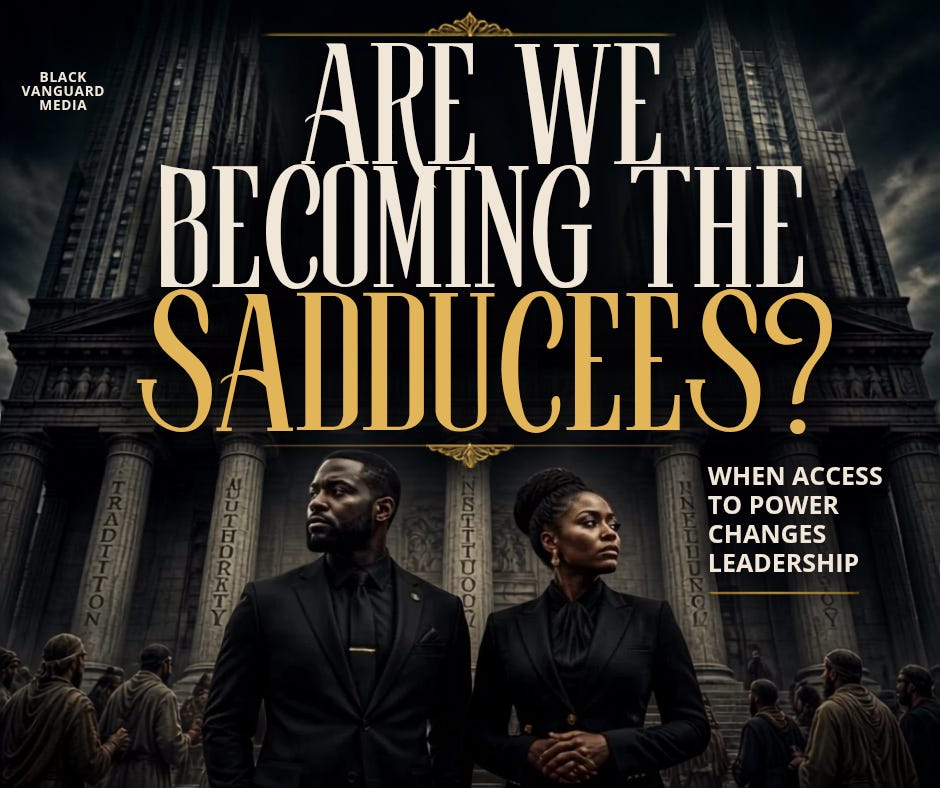
Black leadership has more access to power than at almost any point in American history. The harder question is whether that access has strengthened our communities—or slowly changed the way some leaders see them.
Every oppressed community eventually has to confront an uncomfortable question: What happens when some of its leaders begin to benefit from the very system they were expected to challenge?
It is not a new problem.
In the New Testament, the Sadducees occupied a complicated place inside Jewish society. They were not foreigners. They were not outside agitators. They were part of the Jewish community, but many were also closely tied to the Temple establishment, the priestly class and the political order that existed under Roman occupation.
That position gave them influence. It also gave them something to protect.
That is what makes their story worth revisiting today.
The comparison is not that modern Black leaders are literally Sadducees. History does not work that neatly. The more useful question is whether a similar mindset can develop whenever leaders become deeply connected to institutions that reward access, stability and loyalty.
Black America has fought for generations to get into rooms that once excluded us.
That fight mattered.
We needed Black mayors, judges, legislators, nonprofit executives, pastors with institutional influence, corporate leaders, university administrators and people who could pick up the phone and reach decision-makers.
Representation matters. Access matters. Relationships matter.
But none of those things are the same as power.
And they are certainly not the same as progress.
A seat at the table is valuable only if something is being brought back from the table.
The danger begins when maintaining the relationship becomes more important than challenging the institution.
That is when access can become a trap.
A leader may begin with the intention of using relationships for the benefit of the community. Over time, however, the relationship itself can become valuable. The invitation matters. The appointment matters. The grant matters. The contract matters. The board seat matters. The photograph with the governor or mayor matters.
Soon, the cost of telling the truth gets higher.
That does not automatically mean corruption.
Sometimes the shift is much more subtle.
A leader may begin explaining the system to the community more often than explaining the community to the system.
People are told to be patient.
They are told change takes time.
They are told this is the best deal available.
They are told relationships must be preserved.
They are told not to embarrass partners.
Sometimes those arguments are legitimate.
But sometimes they become a language for protecting the status quo.
That is where the Sadducee comparison becomes uncomfortable.
In the Gospel of John, religious leaders became increasingly concerned about the growing influence of Jesus. Their concern was not simply theological. They worried that Rome might intervene and that they could lose their position inside the existing order.
That concern reveals something fundamental about leadership.
Once a person has a place inside power, losing that place can begin to feel like losing the mission itself.
Those are not the same thing.
Black America should be mature enough to examine that distinction.
We should be willing to ask whether some of our institutions have become more invested in being recognized by power than in forcing power to produce better outcomes.
We should ask whether access has become the measure of success.
We should ask whether some organizations have become so financially dependent on foundations, corporations, government agencies or political parties that confronting those institutions has become almost impossible.
We should ask whether leadership has become too comfortable.
Those questions are not attacks.
They are accountability.
And accountability becomes especially important when the gap between representation and outcomes remains wide.
Black faces can be present in government while Black businesses still struggle to win contracts.
Black executives can sit on influential boards while Black neighborhoods remain undercapitalized.
Black nonprofit leaders can administer major programs while families remain unable to build wealth.
Black political organizations can celebrate access while ownership, income and economic mobility remain stubbornly unequal.
At some point, we have to stop confusing visibility with victory.
Representation is important. But representation without measurable change can become symbolism with a salary attached to it.
The question is not whether Black leaders should work with institutions.
Of course they should.
The question is whether they still have the freedom to challenge those institutions when necessary.
Martin Luther King Jr. had access to presidents. He met with political leaders. He worked with major institutions and national organizations.
But access did not silence him.
When he believed the federal government was wrong, he said so.
When economic injustice demanded confrontation, he confronted it.
When war contradicted his moral convictions, he publicly challenged the government despite warnings that doing so could damage his standing.
King understood the difference between access and surrender.
That distinction deserves more attention today.
Leadership cannot simply mean being close enough to power to receive the phone call.
Leadership also has to mean being willing to make the phone call uncomfortable.
That is where the real test begins.
If a corporation funds your organization but harms the community, can you say so?
If a political party gives you access but repeatedly ignores Black economic interests, can you challenge it publicly?
If an elected official is your friend but supports policies that damage the neighborhood, can you oppose those policies?
If a foundation supports your work but refuses to fund the kinds of structural changes your community actually needs, can you say that?
If the answer is always no, then eventually we have to ask what the relationship is really producing.
This is not only about politicians.
Pastors should ask these questions.
Nonprofit executives should ask them.
Business leaders should ask them.
Consultants should ask them.
Civil-rights organizations should ask them.
Media leaders should ask them.
Anyone who claims to represent people should be willing to examine whether their relationships have begun to influence their judgment.
And perhaps the most difficult part of this conversation is that the question should not begin with someone else.
It should begin with us.
Have I become more concerned with protecting my access than protecting my people?
Do I define success by the number of powerful people who know my name, or by whether conditions improved for the people I say I serve?
Do I speak differently behind closed doors than I do publicly?
Have I become reluctant to challenge institutions because I enjoy being welcomed by them?
Would I risk a relationship if the interests of my community required it?
Those are not comfortable questions.
They are not supposed to be.
Leadership without self-examination eventually becomes performance.
The Sadducees offer a warning because they remind us that someone can belong to an oppressed community and still become deeply invested in an arrangement that preserves their own position.
That does not make every person with influence compromised.
It simply means influence comes with temptation.
The temptation to belong.
The temptation to remain invited.
The temptation to preserve the relationship.
The temptation to mistake proximity to power for power itself.
Black America fought too hard to enter these rooms to allow the rooms to redefine why we entered them.
We should have people everywhere decisions are being made.
But those people must never forget who sent them there.
The ultimate measure of leadership is not the access we acquire.
It is what happens to the people because we had it.
The Sadducee mindset is easiest to see in someone else. Leadership begins when we are willing to look for it in ourselves.