

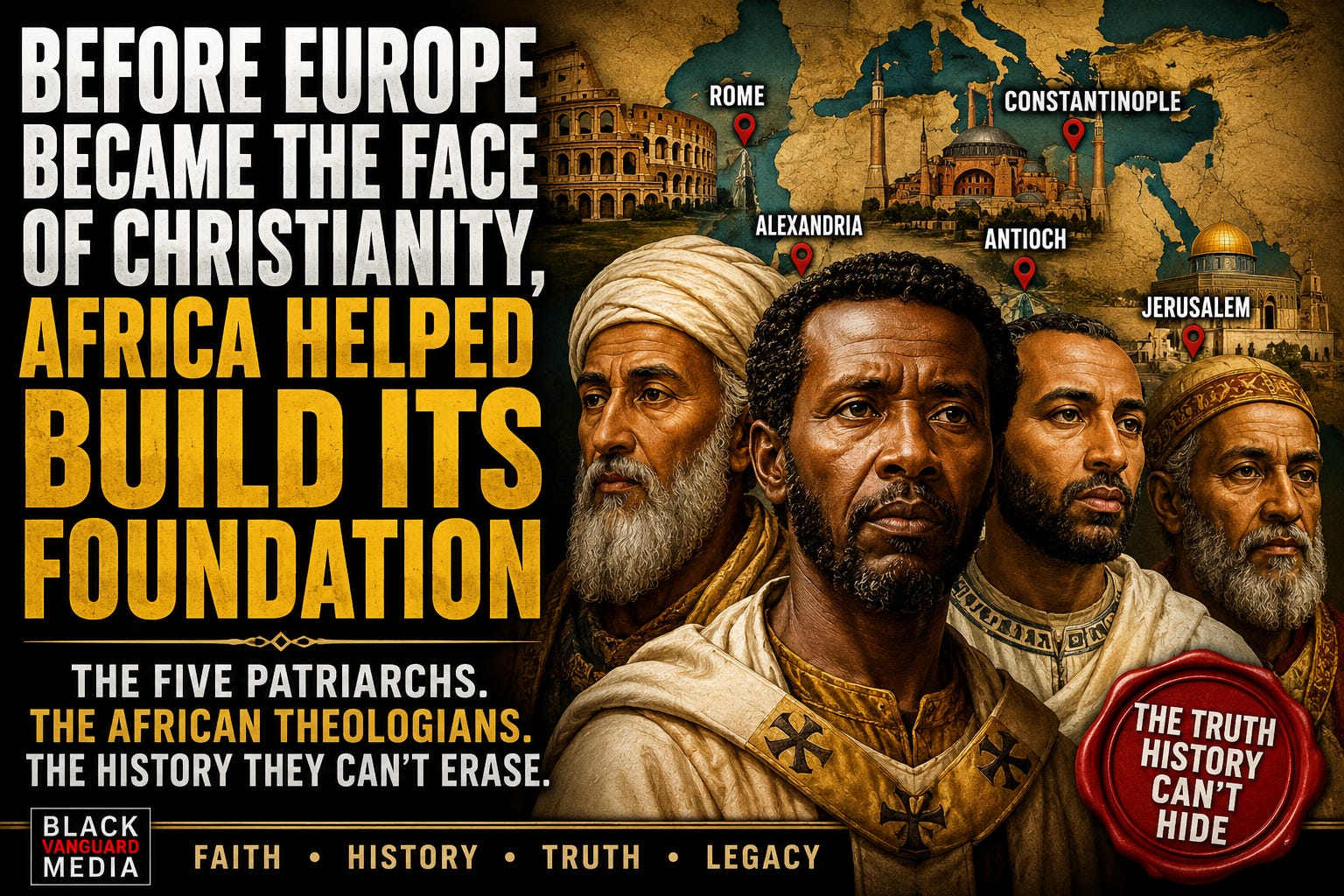
For many people today, Christianity is visually and culturally associated with Europe — towering cathedrals, Roman imagery, Renaissance paintings, and centuries of Western theological influence. But long before Christianity became deeply rooted in Europe, some of the most important centers of Christian thought, scholarship, and leadership were in Africa and the Middle East.
That is not ideology. It is history.
One of the clearest examples of this reality is what historians call the Pentarchy — the five major patriarchates, or leadership centers, of the early Christian Church:
Rome
Constantinople
Alexandria
Antioch
Jerusalem
While Rome eventually became the dominant center of Western Christianity, two of the earliest and most intellectually influential centers of Christianity were located in Africa and the Near East — particularly Alexandria, Egypt.
Africa Was Not on the Edge of Early Christianity — It Was Near the Center
Long before Christianity spread widely across northern Europe, African theologians were helping define core Christian doctrine, preserving scripture, debating theology, and shaping how Christians understood the nature of Jesus, salvation, and the Church itself.
The city of Alexandria became one of the most important intellectual centers in the ancient world. Its theological school helped produce some of Christianity’s most influential thinkers, including:
Origen
Athanasius of Alexandria
Cyril of Alexandria
These were not fringe figures. Their writings and arguments helped shape doctrines that many Christians across denominations still accept today.
Athanasius, for example, played a central role in defending the doctrine of the Trinity during one of Christianity’s most consequential theological conflicts in the 4th century.
North Africa Produced Some of Christianity’s Most Influential Minds
One of the most influential theologians in Christian history was Augustine of Hippo, who lived in Roman North Africa in what is now Algeria.
Augustine’s writings on sin, grace, free will, government, and human nature profoundly influenced both Catholic and Protestant traditions centuries later.
Another major figure was Tertullian of Carthage, a North African theologian often credited with helping develop early Christian terminology in Latin theology.
These scholars emerged from African intellectual traditions during a time when Europe itself was still politically unstable and, in many regions, not yet predominantly Christian.
Christianity Reached Africa Extremely Early
Many people are surprised to learn that Christianity existed in parts of Africa almost from the beginning of the faith itself.
According to longstanding Christian tradition:
Christianity reached Egypt during the first century through Saint Mark
Ethiopia developed one of the world’s oldest continuous Christian traditions
North African churches became deeply established during the Roman era
The Coptic Orthodox Church in Egypt and the Ethiopian Orthodox Tewahedo Church both trace their histories back to the earliest centuries of Christianity.
This matters because it challenges the modern assumption that Christianity was originally a European religion that later spread elsewhere. Historically, Christianity emerged in the Middle East, expanded heavily into Africa, and only later became dominant across much of Europe.
Why This History Matters Today
Understanding this history is not about replacing one narrative with another or engaging in revisionism. It is about historical completeness.
For generations, many educational systems, films, and cultural depictions minimized or overlooked the African and Middle Eastern roots of early Christianity. As a result, many people grew up unaware that African theologians helped shape some of the foundational doctrines of the faith itself.
That omission matters because representation in history influences how communities understand their relationship to civilization, scholarship, faith, and intellectual leadership.
The historical record shows that Africa was not merely a recipient of Christianity. In many ways, Africa helped preserve, define, defend, and intellectually develop Christianity during its formative centuries.
That is not opinion.
That is part of the documented history of the early Church.