

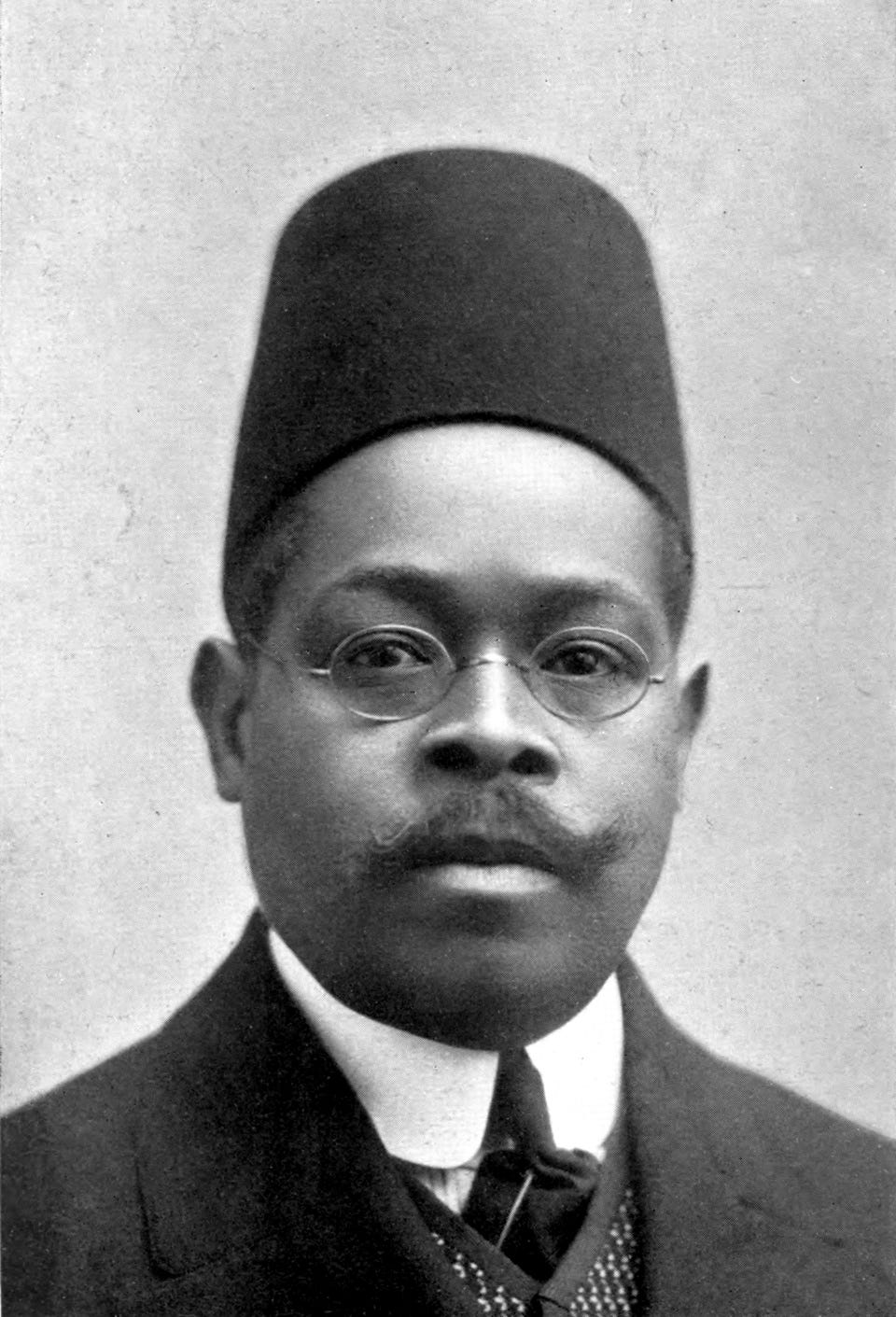
More than a century ago, Ali was building an international Black media network, connecting Africa, the Caribbean and Black America—and helping shape the thinking of a young Marcus Garvey.
Before Marcus Garvey built one of the largest Black political movements of the twentieth century, before millions of Black people across the world knew his name, and before Garveyism became an international force, Garvey was a young Jamaican still developing his understanding of race, empire, economics and Black power.
In London, he encountered a man who helped expand that understanding.
His name was Dusé Mohamed Ali.
Ali was a journalist, publisher, writer and Pan-African thinker who understood something more than a century ago that remains relevant today: a people who do not control the institutions that tell their story will eventually find themselves living inside someone else’s version of it.
Ali did not simply believe Black people needed better coverage.
He understood that Black people needed their own media institutions.
That distinction matters.
His influence on Marcus Garvey is important, but his larger contribution may have been demonstrating what independent Black media could become when it stopped treating the experiences of Black people as isolated events and began connecting those experiences across cities, countries and continents.
Long before the internet made a global Black conversation possible, Dusé Mohamed Ali was attempting to build one with ink, paper and a printing press.
A Newspaper at the Center of the Empire
In 1912, Ali helped launch the African Times and Orient Review in London.
The location mattered.
London was not simply another European city. It was the political, economic and administrative center of the British Empire. Decisions made there affected millions of people throughout Africa, the Caribbean, India and other parts of the world.
Ali chose to publish from inside the center of that power.
The African Times and Orient Review covered events in Africa, the Caribbean, the United States, Egypt, India and other parts of the colonized world.
It created a place where African, Caribbean, Asian and other anti-colonial voices could speak to one another.
More importantly, readers could begin to see relationships between things that appeared, on the surface, to be separate.
A person in Jamaica could read about what was happening in Africa.
An African reader could learn about racial conditions in the United States.
Someone living under British rule in India could recognize similarities between the political and economic systems operating there and those operating elsewhere in the empire.
Ali was doing something that remains one of the most important responsibilities of independent media.
He was connecting dots that powerful institutions had little interest in connecting.
That was not simply journalism.
It was political education.
And British authorities noticed.
During World War I, colonial officials restricted circulation of the publication in parts of the empire because of concerns about its political influence.
Think about what that means.
The British Empire was concerned about colonized people reading information about one another.
Because information can become recognition.
Recognition can become organization.
And organization can become power.
Then Marcus Garvey Walked Into His World
Marcus Garvey arrived in London in 1912.
He already understood printing and newspapers. He had worked in the printing trade and had experience with journalism in Jamaica and Central America.
But London exposed him to something larger.
There, Garvey encountered African intellectuals, Caribbean activists, anti-colonial thinkers and people discussing race and empire on an international scale.
Dusé Mohamed Ali was part of that world.
Garvey spent time around Ali and the African Times and Orient Review. Ali became an important influence on the younger man, helping expose him to a broader Pan-African understanding of the world.
In 1913, Ali’s publication carried an article by the 26-year-old Garvey titled “The British West Indies in the Mirror of Civilization.”
The article examined the conditions facing Black people in the Caribbean and placed those conditions within a much larger conversation about race and empire.
That way of thinking would eventually become central to Garveyism.
The condition of Jamaicans could not be separated from the condition of Black Americans.
The condition of Black Americans could not be separated from Africa.
And Africa could not be understood apart from the political and economic systems that were extracting its resources and controlling its people.
A year later, Garvey returned to Jamaica and founded the Universal Negro Improvement Association and African Communities League.
The UNIA would eventually grow into one of the largest Black organizations the world had ever seen.
Ali did not create Marcus Garvey.
Garvey brought his own experiences, ambitions, personality and intellect to the movement he eventually built.
But Ali helped introduce him to an international framework that allowed Garvey to see Black struggle beyond the boundaries of one island, one country or one community.
And Garvey also saw something else while working in Ali’s orbit.
He saw what a newspaper could do.
Garvey Didn’t Just Build a Movement. He Built Media.
When Garvey’s movement exploded in the United States, one of its most powerful institutions was not a political office.
It was not a government agency.
It was not a university.
It was a newspaper.
The Negro World became the voice of the UNIA and one of the most influential Black publications of its generation.
It published news, history, political commentary, literature and reports from across the African diaspora.
Its pages carried the work and ideas of some of the most important Black thinkers of the period.
But what made the Negro World powerful was not simply who wrote for it.
It was the way the newspaper looked at the world.
It examined world events through Black interests.
That is different from simply having Black reporters inside an existing media structure.
The Negro World told Black people what was happening to other Black people.
It challenged the prevailing European narrative about Africa.
It documented racial violence.
It discussed Black business and economics.
It celebrated Black achievement.
It taught history.
It spread political ideas.
And it gave Black people separated by thousands of miles the sense that they were participating in the same struggle.
Eventually, the relationship between Ali and Garvey came full circle.
Ali came to the United States and became associated with Garvey’s movement. He also contributed to the Negro World.
The younger man who had once written for Ali now controlled an international media institution of his own.
That is one of the most overlooked connections in the history of Black media.
Black Media Was Never Supposed to Be Decoration
Ali’s story raises a larger question about the purpose of Black media.
Independent Black media was never supposed to exist simply so Black people could see themselves represented inside the same narratives produced elsewhere.
Representation matters.
But ownership of perspective matters more.
There is a difference between reporting that a Black neighborhood lost businesses and asking who acquired the property after those businesses disappeared.
There is a difference between reporting that government funding was cut and asking where the money went instead.
There is a difference between reporting that a Black institution is struggling and examining the banking, contracting, political and economic systems surrounding that institution.
One form of journalism tells you what happened.
The other helps you understand why it happened.
Ali’s journalism was built around the second idea.
He helped readers understand that events taking place in different countries could be symptoms of the same larger political and economic system.
That is what independent journalism can do when it is operating at its highest level.
It provides more than information.
It provides context.
And context changes how people understand power.
A people who only know what happened, but never understand why it happened, will always be vulnerable to having it happen again.
From London to Lagos
Ali’s work did not end with Marcus Garvey.
He eventually moved to Nigeria and continued publishing.
In 1933, he established The Comet in Lagos.
Once again, Ali refused to treat local events as though they existed in isolation.
The newspaper covered African politics alongside developments in Europe and the United States.
It examined fascism, colonialism, the Italian invasion of Ethiopia, international politics and racial conditions abroad as matters relevant to African readers.
Ali understood that something happening thousands of miles away could eventually affect the political and economic future of people at home.
That worldview would become increasingly important as African independence movements grew.
The Comet became part of the broader intellectual environment surrounding Nigerian nationalism and the generation that would eventually challenge British colonial rule.
Consider the historical journey.
Ali publishes in London.
Marcus Garvey enters his orbit.
Garvey goes on to build the UNIA and the Negro World.
Ali later contributes to Garvey’s newspaper.
Ali then moves to West Africa and establishes another influential publication.
The journalism moves with the movement.
This was not media standing outside history and taking notes.
The media was helping create history.
There Was a Black Press Before Ali
Dusé Mohamed Ali did not invent Black journalism.
Black Americans had already built a powerful newspaper tradition.
In 1827, Samuel Cornish and John B. Russwurm launched Freedom’s Journal, the first Black-owned and operated newspaper in the United States.
Its opening editorial included a declaration that would define generations of Black journalism:
Black people had been spoken for by others for too long.
They needed to speak for themselves.
That tradition would eventually produce institutions such as the Chicago Defender, the Pittsburgh Courier, the Baltimore Afro-American, the New York Amsterdam News, Ebony, Jet, Black radio and countless local publications.
Ali’s particular contribution was different.
He helped demonstrate the possibilities of an international Black press.
He understood that what happened in Africa mattered in Harlem.
What happened in Harlem mattered in Jamaica.
What happened in London could shape life in Lagos.
And decisions made inside governments, financial institutions and colonial administrations could affect Black communities thousands of miles away.
Those communities needed media capable of seeing the entire board.
The Lesson for Black Media Today
We have more information available to us today than Dusé Mohamed Ali could possibly have imagined.
A story published in Cleveland can be read in Lagos seconds later.
A video recorded in Jamaica can circulate through London, Atlanta, Johannesburg and New York before the day is over.
We have smartphones, podcasts, streaming platforms, social media and instant communication.
Yet access to information is not the same thing as understanding.
In some ways, Ali’s challenge remains ours.
Black communities still receive politics as one story, economics as another, education as another, housing as another, development as another and international affairs as something happening somewhere far away.
But those stories often intersect.
A housing decision is also an economic story.
A banking decision can become a neighborhood-development story.
A contracting decision can become a Black-business story.
A political decision can determine who receives capital.
A decision made in Washington can change what happens in Cleveland.
A financial decision made in London or New York can affect communities in Africa.
Dusé Mohamed Ali understood that interconnectedness more than a century ago.
Marcus Garvey learned something from that worldview and eventually built a communications operation capable of reaching Black people around the world.
That should force those of us working in Black media today to ask ourselves what we believe our role actually is.
Are we simply producing content?
Are we chasing the same stories everyone else is chasing?
Are we measuring success by clicks and shares?
Or are we helping our communities understand the structures shaping their lives?
Because there is a difference between covering Black people and building informed Black people.
Ali understood the difference.
Garvey understood the difference.
And more than a century later, the question remains for Black media:
Will we simply report what happened to us—or will we explain why it happened, who benefited, how it connects to everything else and what our communities need to know before it happens again?
That may be the most important part of Dusé Mohamed Ali’s legacy.