

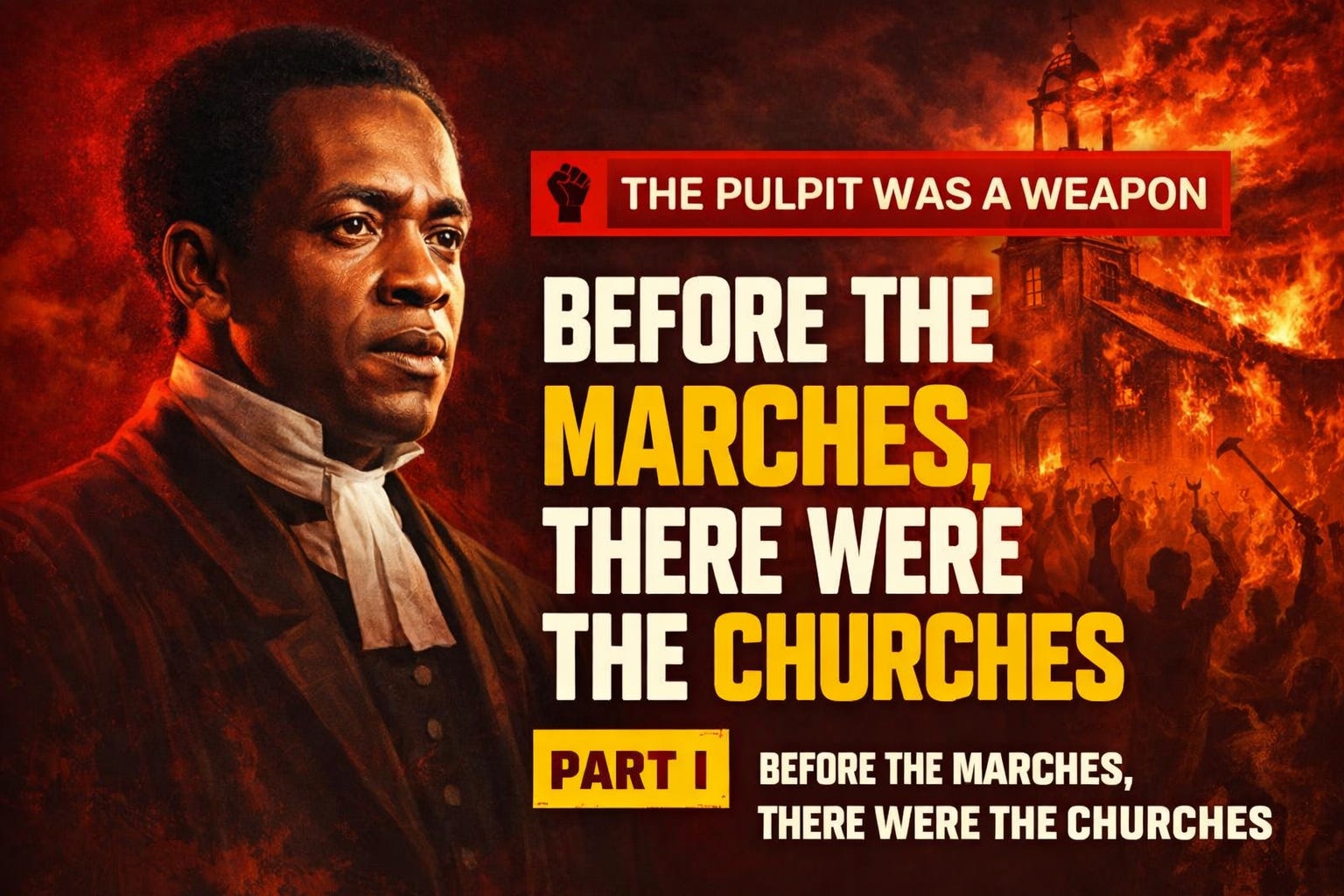
Before hashtags.
Before marches.
Before microphones, cameras, and donor decks.
There were churches.
Not the quiet, compliant churches history books prefer to remember—but dangerous ones.
In slaveholding societies across the Americas, Black churches were not just places of worship. They were the most sophisticated organizing infrastructure Black people had access to. And everyone in power knew it.
That’s why they were surveilled.
That’s why they were infiltrated.
That’s why they were burned.
Because the pulpit was never just a pulpit.
It was a weapon.
Why Slaveholders Feared Black Churches
Slaveholders were not afraid of emotion.
They were afraid of organization.
A Black church meant:
Black people gathering without white supervision
Black people learning to read
Black people interpreting scripture for themselves
Black people building trust networks across plantations
That combination was explosive.
It’s why laws across the American South and the Caribbean restricted Black religious gatherings. It’s why enslaved people needed permission to preach. It’s why certain biblical passages—Exodus, liberation, divine justice—were discouraged or outright banned.
The fear wasn’t theology.
The fear was independent thought.
The First Institutional Break: Richard Allen
In 1787, when Richard Allen and other Black worshippers were pulled from their knees during prayer and forced into segregated seating at a white Methodist church in Philadelphia, Allen made a decision that would echo for centuries.
He left.
Not quietly.
Not temporarily.
And not alone.
Allen went on to found the African Methodist Episcopal (AME) Church—the first independent Black Christian denomination in the United States.
This wasn’t just a spiritual move.
It was an institutional declaration of autonomy.
AME churches became:
Safe spaces for abolitionist organizing
Centers for education and literacy
Early mutual aid societies
Training grounds for Black leadership
Richard Allen understood something many modern leaders avoid:
Freedom requires institutions you control.
When Bible Study Became a Threat: Denmark Vesey
If Allen represented institutional separation, Denmark Vesey represented institutional fear.
Vesey, a formerly enslaved man and leader within Charleston’s AME community, used Bible study meetings as organizing cells. Scripture wasn’t abstract theology—it was a roadmap.
Pharaohs fell.
Captives were freed.
God took sides.
Vesey planned a massive uprising—one that terrified white Charleston so deeply that after it was uncovered, authorities:
Executed Vesey
Burned the church
Outlawed Black religious gatherings
Let that sink in.
The response to Bible study was state violence.
Because the church wasn’t producing hymns.
It was producing political clarity.
The Real Role of the Black Church (That Gets Erased)
We’re often taught that the Black church’s historic role was:
Comfort
Survival
Moral encouragement
That’s incomplete.
The church was also:
A communications network
A leadership incubator
A training ground for resistance
A parallel institution outside white control
It didn’t just help people endure oppression.
It helped them plan how to end it.
The Question We’re Avoiding
If the Black church was once considered so dangerous that it had to be crushed, infiltrated, regulated, and neutralized—
What changed?
Did oppression disappear?
Or did the church’s relationship to power change?
That question makes people uncomfortable for a reason.
Why This Series Exists
This is not a history lesson for nostalgia’s sake.
This series exists to ask something sharper:
What happens when institutions built for liberation forget why they were created?
In the next installment, we’ll examine what happened when the Bible itself stopped being obedient—and why faith-fueled revolts terrified Christian empires more than any army ever could.
Good article!