

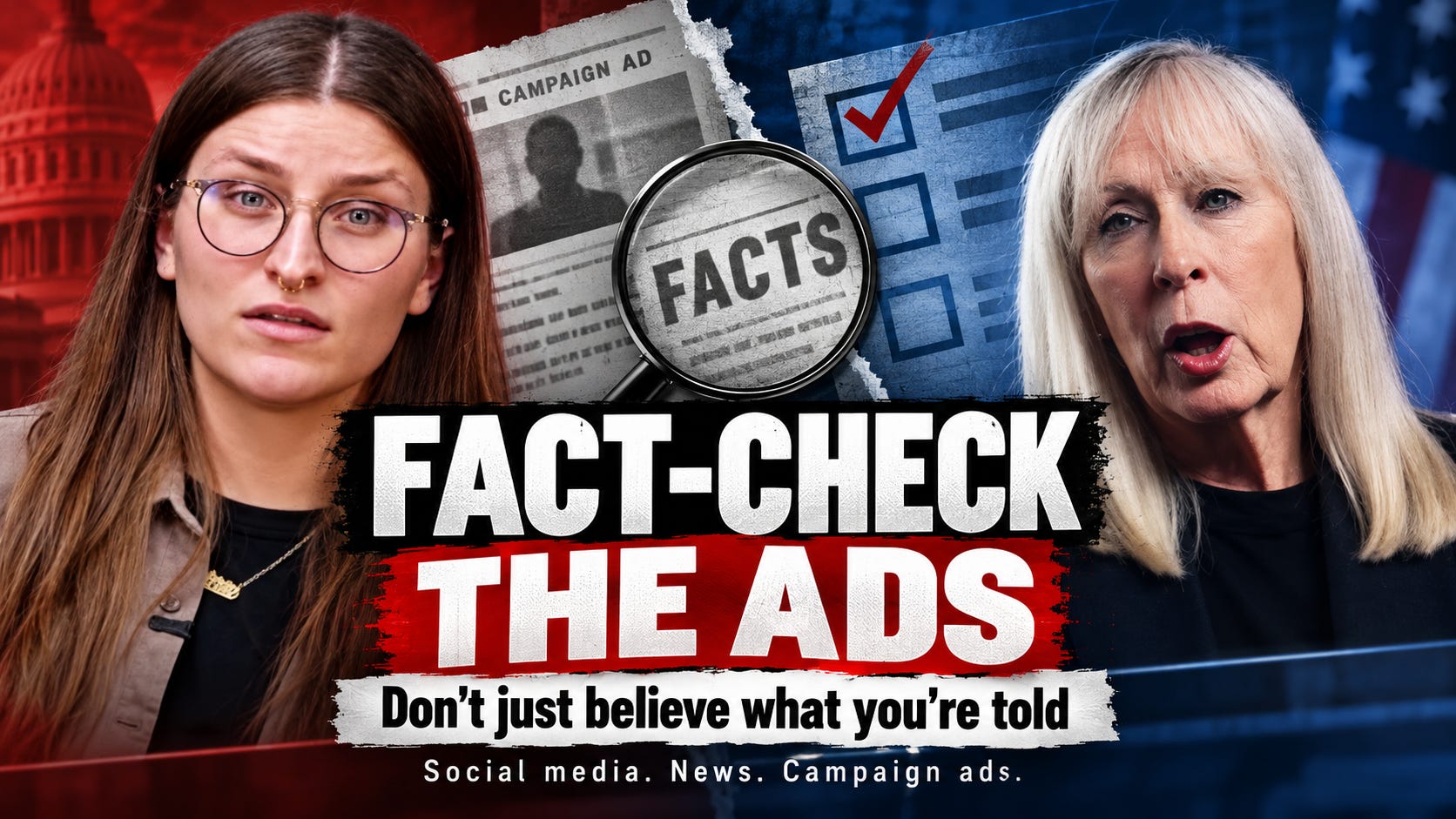
CLEVELAND — Political advertisements are built to persuade. They are not designed to give voters every detail, every piece of context or every side of an argument.
That does not automatically make them false. But it does make them something voters should examine carefully before accepting their message as fact.
Two political advertisements circulating in Ohio this election season provide a useful example.
One targets Democratic U.S. Senate candidate Sherrod Brown over transgender medical treatment for minors. Another targets Democratic gubernatorial candidate Amy Acton over decisions made during the COVID-19 pandemic.
Both use real people telling emotional stories. Both also raise an important question for voters: What happens when you look beyond the commercial?
An advertisement from the Republican-aligned Senate Leadership Fund features Soren Aldaco, a detransitioner from Texas, while criticizing Brown’s position on medical care for transgender minors.
Aldaco has publicly testified that she began hormone treatment at age 17. She later underwent a double mastectomy.
But there is an important detail that can easily be lost in the advertisement.
Aldaco was 19 when the surgery took place.
She was legally an adult.
Her treatment also occurred in Texas, not Ohio.
Ohio law currently prohibits physicians from performing gender-reassignment surgery on minors.
The distinction does not settle the larger political debate over transgender medical treatment. Voters can agree or disagree with Brown’s position. They can also have strong opinions about whether minors should receive hormone treatments.
But voters should know the difference between treatment received at 17 and surgery performed at 19.
The advertisement also portrays Brown as supporting, or even forcing, sex-change surgery on children.
That characterization goes further than Brown’s documented position.
Brown has argued that decisions about medical care should be made by families and physicians rather than politicians. People are free to disagree with that position, but opposing government restrictions is not the same thing as advocating forced surgery.
That difference matters.
Another Ohio campaign advertisement offers a similar lesson.
An ad from Republican gubernatorial candidate Vivek Ramaswamy features Linda Caudill describing the pain her family experienced when they were separated from her elderly mother during the COVID-19 pandemic.
Caudill blames former Ohio Health Director Amy Acton.
The story is emotional, and the pain described by the family should not be dismissed. Families across the country experienced isolation, fear and loss as nursing homes and health facilities restricted visitation during the pandemic.
But there is a significant piece of information viewers may not know.
Caudill’s mother, Dorothy Farrell, lived in Kentucky.
She died in Kentucky.
Acton was Ohio’s health director.
Kentucky had its own pandemic policies, and federal restrictions also affected nursing-home visitation across the country.
Farrell died in July 2020, after Ohio’s statewide stay-at-home order had already been lifted and after Acton had stepped down as state health director.
That does not mean Acton should be protected from criticism for decisions made during Ohio’s pandemic response. She was a central figure in that response.
But geography, timing and authority matter when responsibility is being assigned.
Ohio Gov. Mike DeWine has also repeatedly said the major pandemic decisions made by his administration were ultimately his responsibility.
“The buck stops with the governor,” DeWine has said in defending Acton from claims that she alone controlled Ohio’s COVID response.
Again, voters can still believe those decisions were wrong.
The larger point is that they should know who made them.
And that is the lesson that extends far beyond these two advertisements.
Political advertising has always been selective. Campaigns highlight information that helps their candidate and minimize information that does not.
Social media has made the problem even more complicated.
A claim can move from a political advertisement to Facebook, TikTok, X or Instagram within minutes. Once it is repeated enough times, many people stop asking where it originally came from.
The danger becomes even greater when the information confirms something someone already believes.
A voter who dislikes a candidate may be more likely to accept a negative claim about that candidate without checking it.
The same thing happens across the political spectrum.
That is why voters should fact-check information even when they agree with it.
If a Republican ad makes a devastating claim about a Democrat, check it.
If a Democratic ad makes a devastating claim about a Republican, check it.
If a television commentator says something that sounds outrageous, look for the original source.
If a Facebook post makes you angry enough to immediately share it, that may be the best reason to wait.
Check the dates.
Check the location.
Find the full quote instead of the edited sentence.
Look at the legislation.
Find the court record.
Read the original interview.
See who paid for the advertisement.
Then look for another credible source that confirms what you found.
The most effective political misinformation is not always a completely fabricated story.
Sometimes the individual facts are technically true.
The misleading part is the context that was removed.
A person may really have undergone surgery, but the advertisement may leave out how old that person was.
A family may really have lost a loved one during the pandemic, but the advertisement may leave out which state controlled the facility.
A politician may really have made a statement, but the commercial may remove the sentence before it or after it.
Those details can change the meaning of the entire story.
Political campaigns understand emotion.
Fear moves people.
Anger moves people.
Outrage moves people.
Those emotions can also make people less likely to stop and investigate what they are seeing.
That is why perhaps the most important question a voter can ask after watching a political advertisement is not, “Do I agree with this?”
It is:
“Is this the whole story?”
The same standard should apply to social media, cable news, podcasts, newspapers and online publications.
Including this one.
No voter should accept a claim simply because it came from a source they trust.
Read it.
Question it.
Check it.
Then decide for yourself.
That is not a Republican principle or a Democratic principle.
It is simply what informed citizens are supposed to do.