

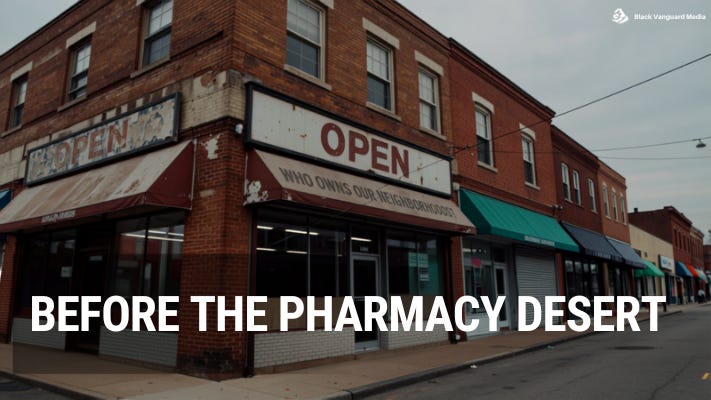
There was a time when many Black neighborhoods did not depend on a single national chain for everyday essentials. Before the term ‘pharmacy desert’ entered the public conversation, neighborhoods like Lee-Harvard were sustained by a network of locally owned businesses that served as more than places to shop. They were part of the community itself.
The neighborhood pharmacy was often one of those anchors. The pharmacist knew families by name, recognized familiar prescriptions, and became another trusted face in the community. Alongside the pharmacy were locally owned grocery stores, hardware stores, cleaners, restaurants, barber shops, beauty salons, and other businesses that helped create a neighborhood ecosystem.
These businesses employed local residents, supported churches and youth sports, donated to community events, and kept a greater share of neighborhood dollars circulating close to home. Their owners attended local meetings, understood local challenges, and often made decisions based on relationships as much as financial statements.
That does not mean everything was perfect. Many independent businesses faced rising costs, changing consumer expectations, and increasing competition. But together they formed an economic web that gave neighborhoods options. If one business struggled, another often stepped in. The community was supported by an ecosystem rather than a single provider.
Over time, that ecosystem changed. National retailers offered convenience, expanded inventories, and recognizable brands. Communities welcomed new investment, and many of those businesses provided valuable services. Few people stopped to ask what might happen if local ownership steadily declined while dependence on larger companies steadily increased.
The change was gradual. One independent pharmacy retired. Another closed. A family-owned grocery disappeared. A neighborhood hardware store shut its doors. None of these events alone transformed a community. Together, however, they altered the local business landscape in ways that were difficult to see in real time.
The result was not simply fewer locally owned businesses. It was fewer locally rooted decision-makers. As neighborhoods became increasingly served by regional or national companies, more decisions affecting essential services were made outside the community.
Today, the announced closure of the Walgreens in Cleveland’s Lee-Harvard neighborhood has forced many residents to confront a difficult reality. The question is no longer only why a pharmacy is leaving. The deeper question is whether the neighborhood still has the local ecosystem capable of replacing what has been lost.
That question extends far beyond one community. Across the country, neighborhoods are discovering that essential services are strongest when they are supported by resilient local ecosystems rather than relying on a single provider. When one piece of that ecosystem disappears, the effects ripple outward—to families, seniors, patients, nearby businesses, and the overall health of the community.
As communities discuss what comes next for Lee-Harvard, this moment also invites reflection. Economic development is not only about attracting new investment. It is also about preserving the capacity of a neighborhood to sustain essential services over time.
This series is not intended to romanticize the past or criticize any one company. It is intended to ask a simple but important question: What must communities do to ensure they never lose the ability to care for themselves?
In Part Three, we will examine how national retail chains expanded so rapidly across America and why access to capital changed the competitive landscape for locally owned businesses.
Questions Worth Asking
How many independently owned pharmacies remain in your community?
What essential businesses has your neighborhood lost over the past 30 years?
Are local businesses still part of your community’s economic ecosystem?
What would happen if another essential service closed tomorrow?