

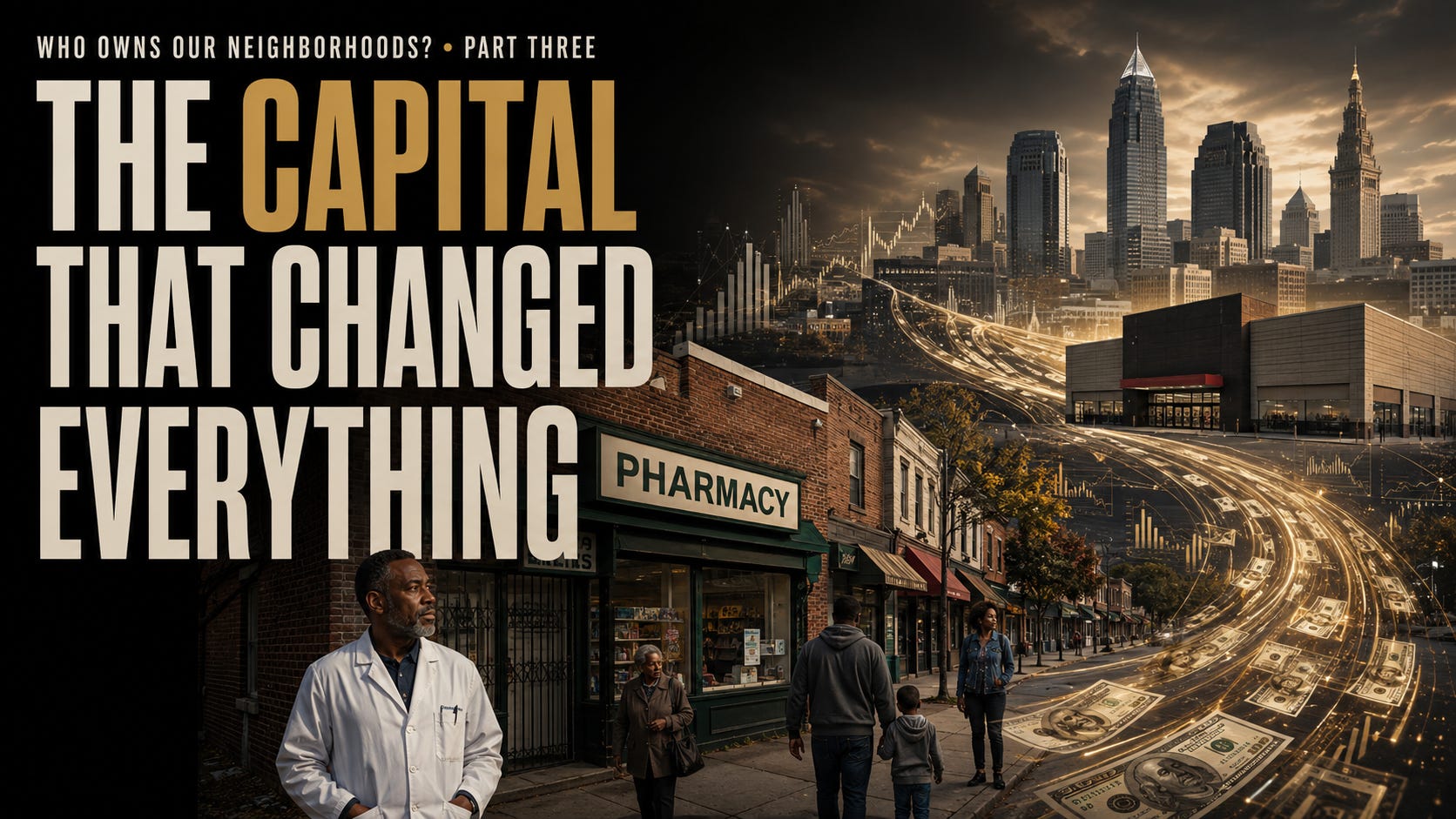
For many people, the decline of neighborhood businesses appears to have happened naturally. Local pharmacies closed. National chains grew. It is often described as simple competition. The reality is more complicated.
The growth of national retailers was supported by something most neighborhood businesses never had access to: large-scale capital. Publicly traded companies could raise money through investors, borrow at favorable rates, build sophisticated distribution systems, purchase prime real estate, and expand into hundreds of communities at once. That access to capital did not guarantee success, but it made rapid expansion possible in ways that independent businesses could rarely match.
Most family-owned pharmacies and neighborhood retailers grew one location at a time, often relying on savings, local bank loans, and years of hard work. Expansion was tied directly to available cash flow. National chains operated under a different model. They could invest today based on expectations of tomorrow’s growth.
Communities welcomed much of that investment. New stores created jobs, offered longer hours, and brought recognizable brands into neighborhoods that had long sought additional retail options. In many cases, those investments met real needs.
Yet the financial advantages enjoyed by large chains also reshaped the marketplace. Companies operating thousands of stores could negotiate lower prices from suppliers, spread administrative costs across large networks, invest heavily in technology, and withstand thinner margins than many independent operators. The competitive landscape changed.
This is not an argument that success should be punished or that investment is unwelcome. Capital plays an essential role in economic development. The question is whether communities also invested in preserving local ownership while welcoming outside investment.
That distinction matters because capital influences more than buildings. It shapes who owns businesses, where profits go, and who ultimately makes decisions affecting a neighborhood. When ownership becomes concentrated outside the community, local residents often have less influence over decisions involving essential services.
The recent Walgreens closure in Cleveland’s Lee-Harvard neighborhood illustrates why this conversation matters. The issue is not simply that one company decided to close a location. The larger issue is whether the surrounding ecosystem still has the resources, relationships, and capital to replace an essential service once it is gone.
Communities that rely exclusively on outside investment can become vulnerable when corporate priorities change. Communities that combine outside investment with strong local ownership are often better positioned to adapt because they retain people, institutions, and businesses capable of responding when markets shift.
Over the past several decades, much of the conversation around economic development has focused on attracting investment. That remains important. But the next generation of community development may require asking a second question: How much locally controlled capacity is being built alongside that investment?
As Black communities continue working toward economic stability, the conversation should move beyond recruitment alone. Sustainable neighborhoods need investment, but they also need ownership, resilience, and the ability to replace essential services when circumstances change.
This series is not about looking backward with regret. It is about understanding how today’s marketplace was built so tomorrow’s decisions can strengthen the communities we hope to leave to the next generation.
In Part Four, we return to Lee-Harvard to examine what happens after capital moves on and why the loss of one essential service can ripple throughout an entire neighborhood.
Questions Worth Asking
Who owns the businesses that provide essential services in your neighborhood?
How much local ownership exists alongside outside investment?
What happens when a national chain leaves and no local replacement is available?
Should economic development include plans for replacing essential services?
Jerry J. Primm is a strategist, civic entrepreneur and leader with CEO 360, Inc., where he helps businesses, developers and community-based organizations understand complex systems, identify overlooked financial tools and build the structure needed to access capital, scale and pursue larger opportunities. His work through Capital Lab™ focuses on translating tax credits, public incentives, partnerships and capital-readiness strategies into practical intelligence leaders can use. To learn more or discuss your organization’s readiness for growth, call (216)-238-3415