

Every generation faces challenges, but today’s young people are navigating a world that often feels increasingly complex and uncertain.
Students are balancing academic expectations, extracurricular activities, family responsibilities, social pressures, and the constant presence of technology. They are exposed to a nonstop stream of information, global events, and social comparison, often without the tools necessary to process what they are experiencing. While schools have traditionally focused on preparing students academically, there is growing recognition that young people also need support in developing the emotional skills necessary to navigate life’s challenges.
The question many educators, parents, and community leaders are asking is simple: How do we prepare young people not only to succeed academically, but also to thrive emotionally?
One answer can be found in mental health literacy.
Why Mental Health Literacy Matters
Most people would agree that students should learn about physical health. We teach nutrition, exercise, disease prevention, and healthy habits because we understand that knowledge helps people make informed decisions about their well-being.
Mental health deserves the same attention.
Mental health literacy is the ability to understand mental health, recognize signs of emotional distress, know how to seek help, and develop skills that promote resilience and well-being. When young people have this knowledge, they are better equipped to manage stress, support peers, and seek assistance when challenges arise.
Unfortunately, many students receive little formal education about mental health. As a result, they may struggle to identify what they are experiencing or may hesitate to ask for help because of stigma, misinformation, or fear.
Programs like FLARE were designed to help address that gap.
What Is FLARE?
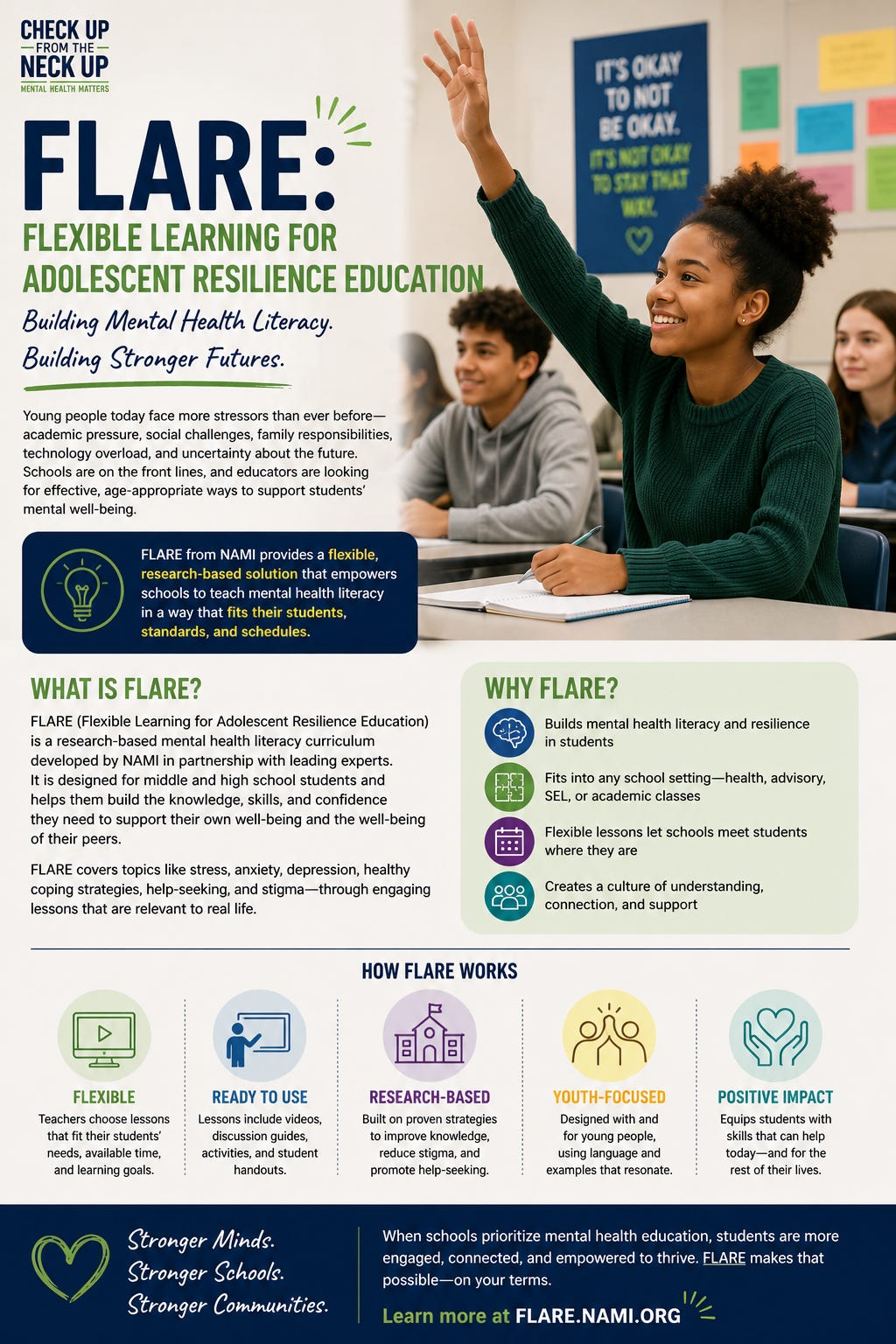
FLARE, which stands for Flexible Learning for Adolescent Resilience Education, is a research-based mental health literacy curriculum developed by the National Alliance on Mental Illness (NAMI) in partnership with mental health and education experts.
Unlike a one-time presentation or awareness campaign, FLARE provides schools with a structured curriculum that can be integrated into existing educational settings. The program is designed specifically for middle and high school students and gives educators the flexibility to select lessons that align with their students’ needs, available instructional time, and state education standards.
This flexibility is one of the program’s greatest strengths. Schools differ widely in their resources, schedules, and student populations. FLARE recognizes that there is no one-size-fits-all approach to mental health education and allows schools to implement lessons in ways that are practical and sustainable.
Teaching Skills That Last a Lifetime
At its core, FLARE is about helping young people build resilience.
Resilience is often misunderstood as simply being “tough” or “pushing through” difficult situations. In reality, resilience is the ability to adapt, recover, and continue moving forward when faced with challenges. It involves recognizing emotions, utilizing healthy coping strategies, seeking support when necessary, and maintaining hope during difficult times.
The curriculum helps students develop these skills while also increasing their understanding of topics such as:
Mental health and emotional well-being
Stress and stress management
Anxiety and depression
Healthy coping strategies
Stigma and mental health misconceptions
Help-seeking behaviors
Peer support and connection
Rather than waiting until a young person is in crisis, FLARE focuses on prevention and early education. It equips students with tools they can use throughout adolescence and into adulthood.
Why Schools Matter
Schools are one of the few institutions that reach nearly every young person in a community. Because students spend a significant portion of their lives in educational settings, schools have a unique opportunity to promote mental wellness alongside academic achievement.
When mental health education becomes part of the learning environment, students begin to understand that emotional well-being is not separate from their success—it is connected to it.
Students who feel supported are more likely to engage in learning. They are more likely to build positive relationships, attend school consistently, and seek help when challenges arise. Educators are also better positioned to identify concerns early and connect students with appropriate support.
Mental health education does not replace counselors, psychologists, or healthcare providers. Instead, it creates a foundation that helps students recognize when additional support may be needed.
What FLARE Means for Our Community
At Check Up From the Neck Up, we believe that prevention is one of the most powerful tools available in mental health promotion.
Too often, conversations about mental health begin only after a crisis has occurred. By that point, young people and families may already be struggling to find answers and resources. Programs like FLARE take a different approach by introducing mental health education before problems become emergencies.
For schools, community organizations, and youth-serving programs throughout Cleveland and beyond, FLARE offers a practical framework for building mental health literacy in a way that is evidence-based, flexible, and accessible.
It helps create environments where students understand that mental health is a normal part of overall health, where asking for help is encouraged, and where resilience is treated as a skill that can be learned and strengthened over time.
Looking Forward
The future of youth mental health will not be shaped solely by treatment programs or crisis services. It will also be shaped by what young people learn before they ever face a significant challenge.
By providing students with knowledge, coping skills, and a deeper understanding of emotional well-being, programs like FLARE help prepare them for life’s inevitable ups and downs.
Strong communities are built when young people have the tools to care for themselves and support one another. Mental health education is not an extra. It is an investment in healthier students, stronger schools, and more resilient communities.
FLARE represents one way to make that investment—one lesson, one classroom, and one student at a time.