

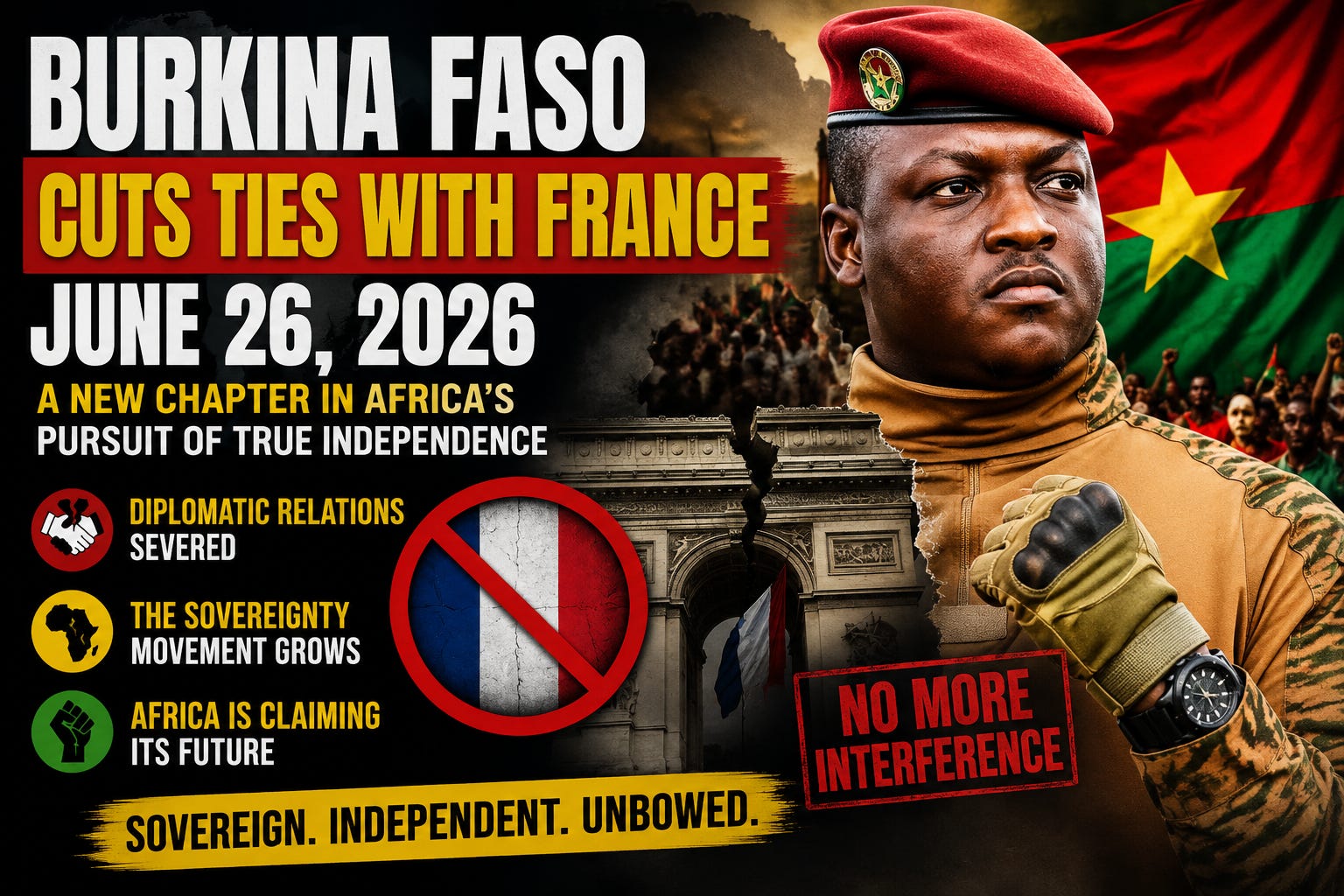
On June 26, 2026, Burkina Faso took one of the most consequential diplomatic steps in modern African history by officially severing diplomatic relations with France, its former colonial ruler, effective immediately.
The Burkinabè government said the decision was based on what it described as France’s failure to respect the nation’s sovereignty and its continued interference in Burkina Faso’s internal affairs. France rejected those accusations and expressed regret over the decision, but the break marked the lowest point in relations between the two nations since Burkina Faso gained independence in 1960.
Whether one agrees with every policy of Burkina Faso’s current government or not, one thing is becoming increasingly clear: the country has pursued a remarkably consistent objective—greater national sovereignty.
Independence Is More Than Raising a Flag
For decades, many African nations were politically independent while remaining economically and strategically tied to their former colonial powers.
Perhaps no symbol has generated more debate than the CFA franc, the currency still used by 14 West and Central African nations.
Originally, CFA stood for “Colonies Françaises d’Afrique” (French Colonies of Africa). Following independence, the meaning was officially changed, but the monetary system remained closely linked to France. Today, the currency remains pegged to the euro, and France historically played a significant role in guaranteeing its convertibility and influencing aspects of the monetary framework.
Critics—including Burkina Faso’s leadership—have long argued that the arrangement limits economic sovereignty by reducing participating countries’ control over monetary policy and exchange rates. Supporters counter that it has provided decades of currency stability and relatively low inflation.
Regardless of where one stands, the debate is fundamentally about who should control a nation’s economic destiny.
The Sahel Is Redefining Its Future
Burkina Faso has not acted alone.
Alongside Mali and Niger, it formed the Alliance of Sahel States (AES)—a regional bloc designed to strengthen security cooperation and deepen political and economic collaboration independent of traditional Western alliances.
Since 2022, French military forces have withdrawn from Burkina Faso, Mali, and Niger, while other countries including Senegal, Chad, and Côte d’Ivoire have also significantly reduced or ended France’s long-standing military presence.
The June 26 diplomatic break should therefore be viewed not as an isolated event, but as another milestone in a broader movement throughout parts of West Africa to redefine relationships with former colonial powers.
Separating Fact From Viral Claims
As Burkina Faso’s announcement spread across social media, several widely shared claims accompanied the news.
One of the most common alleged that France purchased uranium from African countries for 80 cents per kilogram before selling it internationally for 200 euros per kilogram.
The evidence does not support that claim.
Reuters and other fact-checkers have found no credible documentation showing uranium was purchased under those terms. Uranium is traded through long-term commercial contracts and global commodity markets, with prices fluctuating based on market conditions, processing costs, ore quality, transportation, enrichment, and demand. The viral “80 cents versus €200” comparison dramatically oversimplifies—and misrepresents—how the uranium market actually works.
That does not mean there have been no legitimate concerns.
France’s state-owned nuclear company, now known as Orano (formerly Areva), has operated uranium mines in Niger for decades. For years, critics argued that the financial returns to Niger were disproportionately small compared to the strategic importance of its uranium resources and the profits generated throughout the nuclear fuel supply chain.
These concerns helped fuel demands for renegotiated mining agreements and greater national control over natural resources. Since the 2023 coup in Niger, the government has taken increasingly aggressive steps to reclaim control over uranium assets previously operated by Orano.
The important question, therefore, is not whether the viral numbers are accurate—they are not.
The real question is whether African nations should have greater ownership, bargaining power, and value capture from the resources extracted from their own soil.
Increasingly, many governments are answering that question with a resounding “yes.”
A Lesson Beyond Burkina Faso
Burkina Faso’s decision should not simply be viewed through the lens of geopolitics.
It represents a broader principle that resonates around the world:
A nation cannot fully determine its future if critical decisions about its economy, security, finance, or natural resources are largely shaped by outside interests.
Every country must decide how to balance international partnerships with national independence.
Partnership is not the same as dependency.
Cooperation is not the same as control.
History shows that nations are strongest when they can negotiate from a position of confidence, protect their strategic assets, and chart their own course while maintaining respectful relationships abroad.
Whether Burkina Faso’s path ultimately proves successful remains to be seen. The country continues to face enormous security and economic challenges.
But June 26, 2026, will likely be remembered as a day when Burkina Faso declared that, in its view, political independence alone was no longer enough.
It was also pursuing diplomatic independence.
And, perhaps most importantly, the freedom to decide its own future.
Love this A nation cannot fully determine its future if critical decisions about its economy, security, finance, or natural resources are largely shaped by outside interests.