

There’s a moment that happens quietly in too many households.
It doesn’t make the news.
It doesn’t get posted.
It doesn’t get talked about at church, at work, or even at the dinner table.
It sounds like this:
“Something isn’t right.”
A son who used to laugh is now silent.
A daughter who used to show up is now disappearing.
A parent who held everything together is now unraveling.
And the family—strong, resilient, used to figuring things out—does what it has always done:
They try to handle it themselves.
But this is where we have to stop—and check ourselves.
Because not everything is meant to be handled alone.
The Lie We Were Taught About Strength
In many of our communities, strength has been defined one way:
Push through.
Pray on it.
Keep it moving.
Don’t let people in your business.
That mindset helped us survive a lot.
But it’s also quietly hurting us now.
Because mental health challenges don’t respond to silence the way external problems do.
They grow in it.
What starts as stress becomes anxiety.
What starts as sadness becomes depression.
What starts as confusion becomes crisis.
And by the time we acknowledge it, we’re not dealing with a problem—we’re dealing with damage.
A Different Kind of Resource—Right Here in Cleveland
This is why organizations like NAMI Greater Cleveland exist.
Not as a last resort.
But as a first line of support.
Their helpline is simple in concept—but powerful in impact:
It gives families a place to call when they don’t know what to do next.
Not a judgment line.
Not a lecture.
Not a system that makes you feel small.
A real person.
Real guidance.
Real next steps.
Sometimes the hardest part isn’t solving the problem—it’s knowing where to start.
This is a place to start.
What Families Actually Need (But Don’t Always Say)
When someone in your family is struggling mentally or emotionally, the pressure spreads.
You’re not just worried about them—you’re questioning yourself:
“Am I missing something?”
“Did I handle that wrong?”
“What if this gets worse?”
“Who do I even talk to about this?”
That last question is the most important one.
Because too often, the answer becomes:
“No one.”
And that’s where isolation sets in—not just for the person struggling, but for the entire family.
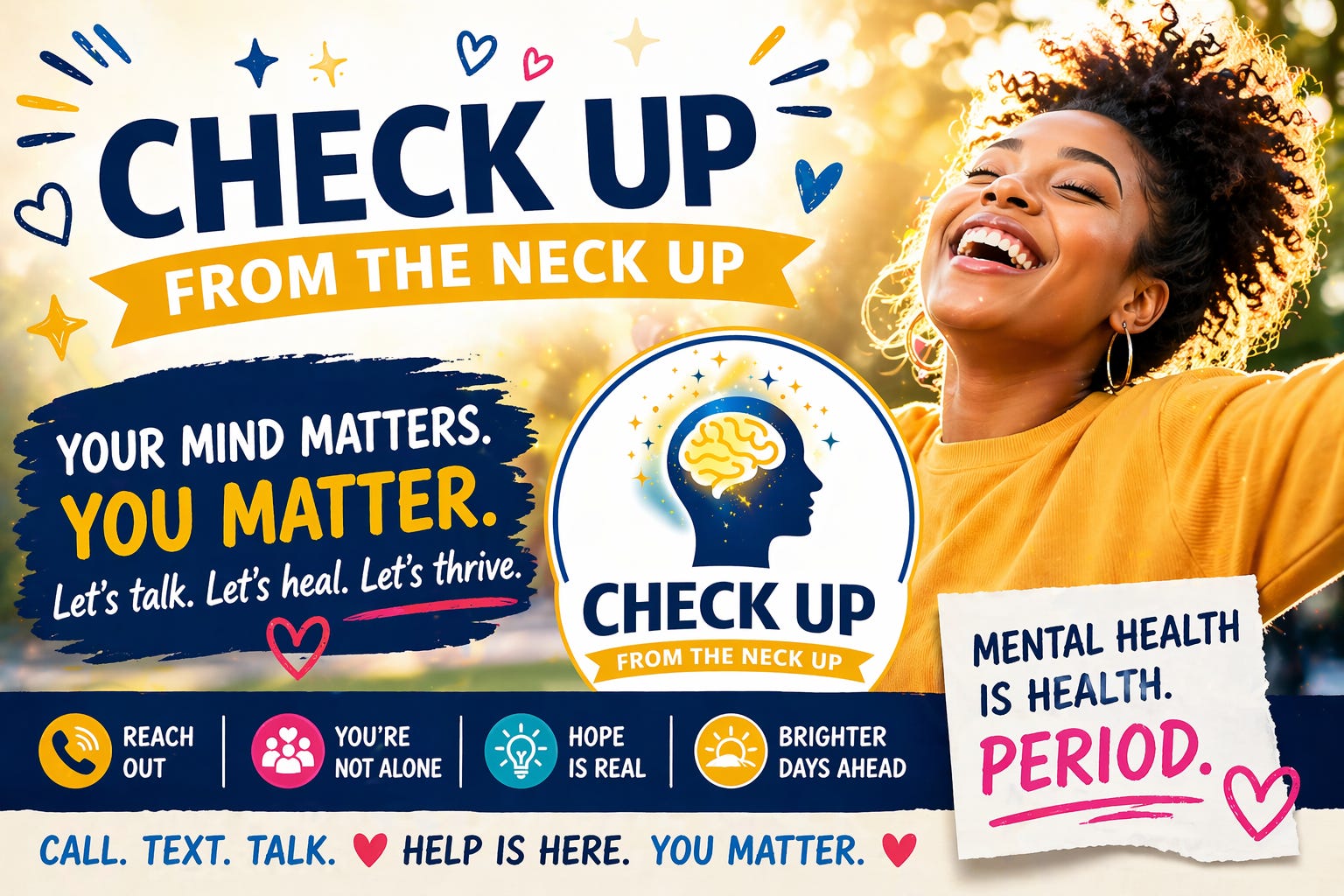
This Is What a “Check Up From the Neck Up” Really Means
We talk about checkups for everything else:
Physicals.
Dental visits.
Blood pressure.
But when it comes to mental health, we wait until something breaks.
A “check up from the neck up” is about changing that pattern.
It means:
Paying attention earlier
Asking questions sooner
Reaching out before things escalate
Accepting that mental health is health
Not weakness. Not failure. Not something to hide.
The Shift We Have to Make as a Community
If we’re serious about protecting our families, we have to evolve how we respond to mental health.
That means:
1. Normalizing the Conversation
Talking about mental health should feel as normal as talking about a cold or a headache.
2. Using Resources Without Shame
Calling a helpline is not an admission of failure—it’s an act of leadership.
3. Supporting the Whole Family
The person struggling isn’t the only one affected. Everyone needs support.
4. Acting Earlier, Not Later
Early action prevents deeper crises.
What You Can Do Right Now
If anything in this article feels familiar—don’t ignore that feeling.
Start here:
Reach out to NAMI Greater Cleveland’s helpline
Have one honest conversation with someone in your family
Pay attention to behavioral changes you may have brushed off
Give yourself permission to not have all the answers
Because you don’t need all the answers.
You just need the next step.
Final Thought
There’s a difference between being strong…
…and being supported.
For too long, we’ve tried to carry both at the same time.
A real “check up from the neck up” is recognizing when it’s time to put some of that weight down—and let someone help you carry it.
And that might be the strongest move you make all year.