

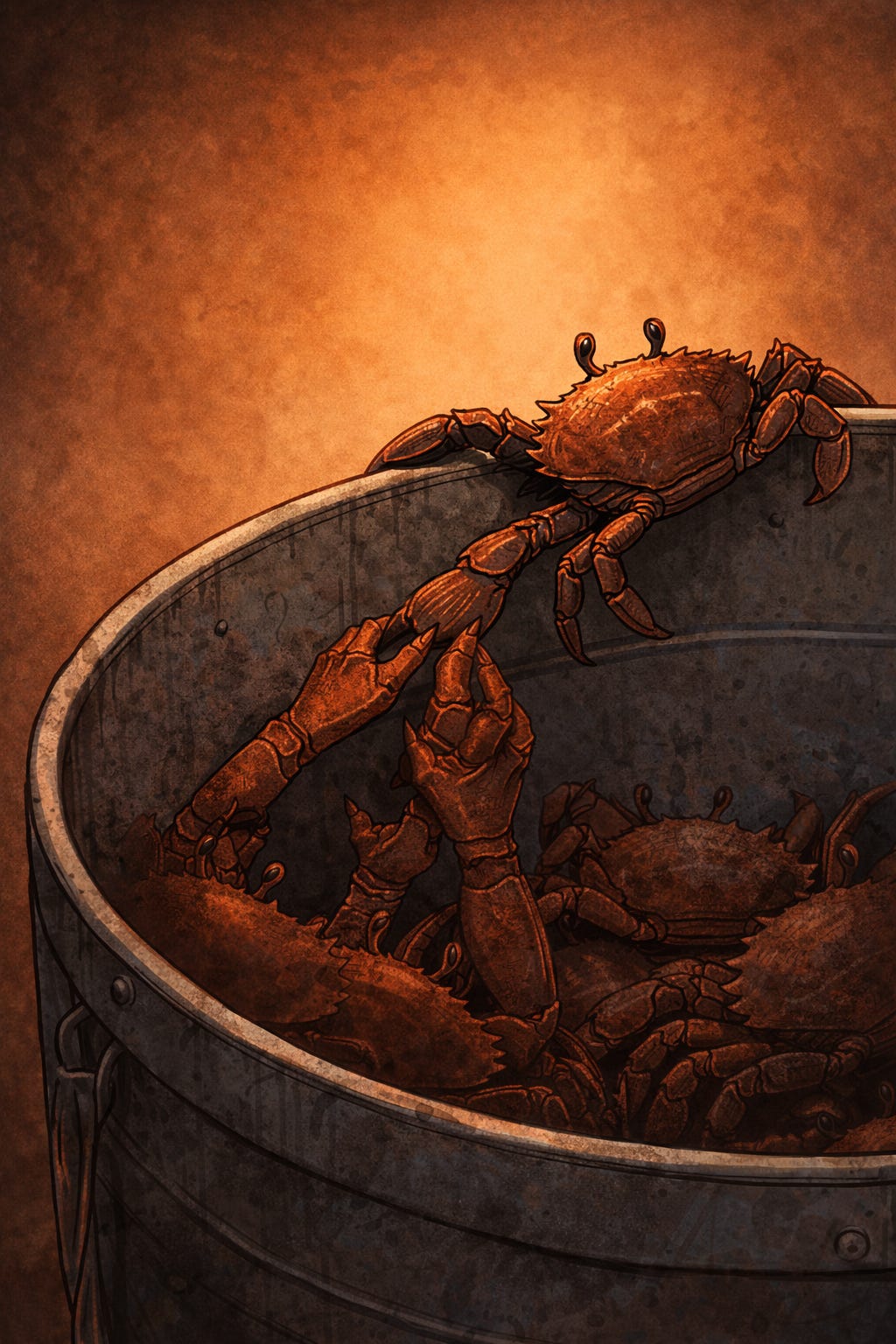
Sometimes the biggest obstacle to progress isn’t the wall in front of us.
Sometimes it’s the hands pulling from below.
Fishermen along the coast tell a curious story about buckets of crabs.
When fishermen catch lobsters, they must put a lid on the bucket. If they don’t, one lobster will eventually climb up the side and escape.
But when they catch crabs, they leave the bucket open.
There is no lid.
A visitor once asked a fisherman why.
The fisherman laughed and said:
“You don’t need one.”
“If one crab starts climbing out, the others will pull it back down.”
And sure enough, whenever a crab reaches the top of the bucket, another crab grabs its leg and drags it back into the pile.
Not because the other crab plans to escape.
But simply because it refuses to let the first one leave.
The Lesson
The story is often used as a metaphor for a painful truth about human behavior.
Sometimes people are less concerned with climbing themselves than they are with making sure no one else climbs either.
Instead of asking, How did you get up there? the instinct becomes:
Come back down here with us.
Over time the entire bucket stays exactly where it is.
Not because escape is impossible.
But because cooperation never happens.
The Mirror
Across the Black community there are always individuals trying to climb.
Entrepreneurs building businesses.
Leaders trying new approaches.
People experimenting with new ways of creating opportunity and wealth.
Some of them begin to rise.
And when they do, two very different reactions can emerge.
One reaction is curiosity.
“How did you do that?”
“What can we learn from it?”
“How can more of us climb?”
Communities that respond this way create ladders.
The other reaction is suspicion.
“Why them?”
“Who do they think they are?”
“They must have done something wrong.”
And if we are honest, this is not something outsiders always do to us.
Sometimes it is something we do to ourselves.
We criticize the person climbing.
We question their motives.
We pull at their legs.
And eventually many people who might have climbed stop trying at all.
Because no one wants to fight both the wall in front of them and the hands pulling from below.
The Question
Healthy communities understand something important.
One person climbing does not block the path for others.
It proves the path exists.
Success should not be something we attack.
It should be something we study.
Because every person who finds a way out of the bucket leaves behind a map.
And communities that learn from those maps eventually build ladders.
But communities that spend their time pulling down those who climb often stay exactly where they started.
Because when everyone is pulling down, no one is climbing.
So the question for the village is simple:
What kind of village do we want to be?
Jerry Primm
Founder, Black Vanguard Media
Black Vanguard Media explores ideas that strengthen the Black community through leadership, economic understanding, and thoughtful dialogue.
FACTS. Since your organization provides 'solutions', I'm looking forward to hearing what strategies you will put forward, to help our communities. This is not a new realization. A movement is welcome.