

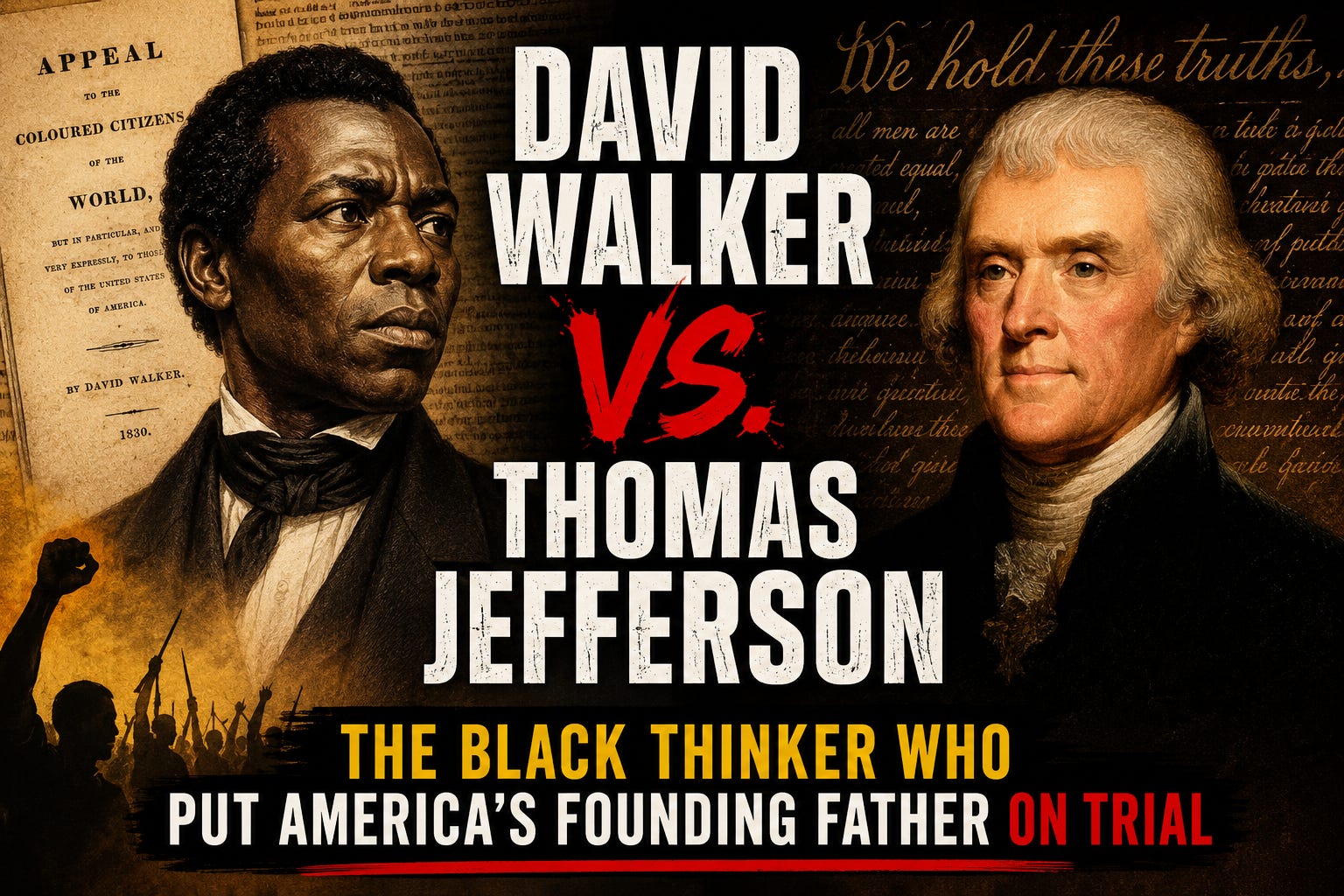
In 1829, a free Black abolitionist in Boston took on Thomas Jefferson’s ideas about race and forced the nation’s founding promises to answer for the reality of slavery.
BLACK VANGUARD MEDIA | HISTORY & IDEAS
A Debate Jefferson Never Lived to See
Thomas Jefferson never met David Walker. By the time Walker published his explosive Appeal to the Coloured Citizens of the World in Boston in 1829, Jefferson had been dead for three years.
Yet Walker made Jefferson one of the most important adversaries in his book.
The dispute was not personal. It was larger than that. Walker was confronting the authority of a founding father whose words had helped define American freedom, but whose writings on race helped give intellectual respectability to the idea of Black inferiority.
Jefferson had written the most famous sentence in the American political tradition: “all men are created equal.” He had also written, in Notes on the State of Virginia, that he suspected Black people were inferior to whites in both body and mind.
Walker saw the contradiction, and he refused to let it stand unchallenged.
More importantly, he understood the danger. Jefferson was not simply another white man expressing a prejudice. He was a former president, author of the Declaration of Independence and one of the most celebrated intellectual figures in the new republic. If Jefferson’s assumptions about Black people went unanswered, Walker believed the prestige of the man could lend prestige to the argument.
The Man Who Refused to Ask Quietly
David Walker was born free in Wilmington, North Carolina, to a free Black mother and an enslaved father. He eventually made his way to Boston, where he operated a used-clothing business and became part of the city’s growing Black activist community. He participated in the Massachusetts General Colored Association, worked with Freedom’s Journal, the nation’s first Black-owned and operated newspaper, and became known as an uncompromising opponent of slavery and colonization.
Walker was deeply religious. He was also impatient with the idea that enslaved people should wait indefinitely for their oppressors to discover a conscience.
That combination gave the Appeal its distinctive voice. It reads at different moments like a sermon, an indictment, a political manifesto and a warning.
Walker attacked slavery as a crime against humanity and Christianity. He attacked American churches that tolerated it. He rejected schemes to remove free Black Americans to Africa. He challenged Black people to pursue education and reject ideas of their own inferiority. And he insisted that enslaved people possessed the same natural right to resist tyranny that white Americans celebrated in their own Revolution.
That last point helped make the pamphlet notorious.
Copies moved into Southern ports, sometimes carried by Black sailors and concealed in clothing. Authorities responded with alarm. The mayor of Savannah contacted Boston officials about Walker. Southern governments tightened restrictions on Black literacy, assembly and the circulation of abolitionist literature.
Walker had managed to do something extraordinary: a Black writer with no elected office, army or fortune had frightened a slaveholding system with a pamphlet.
Jefferson’s Problem
Jefferson’s racial thinking presented Walker with a particularly difficult target because Jefferson’s record contained both an indictment of slavery and assumptions about Black inferiority.
In Notes on the State of Virginia, Jefferson described slavery as morally dangerous and expressed fear that divine justice would eventually reckon with the institution. But he also speculated about racial differences and questioned Black intellectual capacity.
For Walker, the problem was not merely that Jefferson was inconsistent.
It was that Jefferson’s stature could turn speculation into inherited belief.
Walker therefore urged Black readers to study Jefferson rather than ignore him. His approach was strikingly intellectual: understand the argument, confront it and refute it.
Walker warned that if Black people did not answer Jefferson’s claims about them, those claims could harden into accepted truth.
That is what makes this confrontation so significant. Walker was not asking white intellectuals to certify Black humanity. He was insisting that Black people develop the knowledge and confidence to answer one of America’s most respected thinkers themselves.
Using Jefferson Against Jefferson
Walker’s most devastating move was to take Jefferson’s own revolutionary language seriously.
The Declaration of Independence says human beings possess rights that governments do not create and therefore cannot legitimately take away. Americans had used that principle to justify resistance against British rule.
Walker asked the obvious question that the slaveholding republic desperately wanted to avoid:
If resistance to tyranny was legitimate for white colonists, why was it illegitimate for enslaved Black people?
He repeatedly forced Americans to compare the principles they celebrated with the conditions they imposed on Black people. The Declaration became evidence for the prosecution.
This was more than an accusation of hypocrisy. Walker was making a claim about citizenship and ownership of the American idea.
The language of liberty did not belong exclusively to Jefferson. Once Americans announced those principles to the world, Walker argued from them as universal principles. Black Americans could invoke them too.
That move would echo through later Black political thought. Frederick Douglass would famously expose the contradiction between American independence and American slavery. Generations of Black leaders would demand that the country either honor its stated principles or admit that those principles had never been intended to apply universally.
Walker was making that case in 1829.
The Argument Was Also Inside Black America
Walker’s Appeal was addressed to white America, but it was not written primarily for white approval. Its title announced its audience: the “coloured citizens of the world,” and especially those in the United States.
That distinction matters.
Walker believed white supremacy operated not only through chains and laws but through ideas. A people repeatedly told they were naturally inferior could eventually be pressured to see themselves through the eyes of the society oppressing them.
Education therefore became part of liberation.
Walker wanted Black people to read, study history, understand Christianity, know American political principles and challenge the intellectual claims used against them. He did not believe Black humanity needed to be discovered by white America. He believed Black people had to reject the authority of anyone who denied it.
Not every Black leader embraced Walker’s methods or rhetoric. His willingness to defend militant resistance was controversial, including among abolitionists who favored moral persuasion and nonviolence. But the larger questions he raised—Black citizenship, intellectual independence, education, self-determination and the right to resist oppression—would remain at the center of Black political debate for generations.
Christianity in the Witness Box
Walker also placed American Christianity on trial.
For him, slavery was not merely bad public policy. It was sin.
That distinction gave the Appeal much of its intensity. Walker could not reconcile the Christianity preached by slaveholding America with the God described in Scripture. A nation that prayed on Sunday while buying and selling human beings during the week could not, in Walker’s reasoning, escape judgment simply by calling itself Christian.
Here again, he turned America’s own professed beliefs against its practices.
The country claimed Christianity. Walker asked whether its conduct was Christian.
The country claimed liberty. Walker asked whether Black people were included.
The country celebrated resistance to tyranny. Walker asked whether enslaved people possessed the same right.
The country revered Jefferson. Walker asked whether Jefferson’s ideas about Black people could survive serious examination.
Why Walker Still Matters
David Walker died in Boston in 1830, only months after issuing the third edition of the Appeal. Contemporary records attributed his death to consumption, or tuberculosis, although rumors of assassination circulated because of the enemies his writing had made.
He was still a young man.
He did not live to see Nat Turner’s rebellion, the rise of William Lloyd Garrison’s Liberator, Frederick Douglass’s emergence as a national figure, the Civil War, emancipation or the constitutional abolition of slavery.
But he had already identified a struggle that would survive slavery itself.
What happens when racial inequality is defended not simply by force, but by ideas?
Ending slavery could remove the legal ownership of human beings. It could not automatically erase the belief that Black people were intellectually, morally or politically inferior. Walker understood that liberation therefore required more than changing laws. It required challenging the intellectual architecture that made oppression appear reasonable.
That is why Jefferson mattered to him.
Walker was confronting one of the central contradictions in the American story: the nation’s greatest language of equality emerged from a political world that tolerated slavery, and its author himself enslaved people while speculating about Black inferiority.
Walker did not respond by abandoning the language of American freedom.
He seized it.
He took the Declaration’s promise, stripped away the racial limitation America had placed around it and demanded that the nation explain itself.
In that sense, David Walker did something remarkable.
He put Thomas Jefferson on trial without Jefferson ever entering the courtroom.
The witnesses were Jefferson’s own words.
The evidence was American slavery.
And the standard against which America was judged was the promise it had written for itself.
Sources & Further Reading
David Walker, Appeal to the Coloured Citizens of the World. Library of Congress. https://www.loc.gov/item/65012945/
David Walker biography. U.S. National Park Service. https://www.nps.gov/people/david-walker.htm
“We Must and Shall Be Free”: David Walker Held to “Certain Truths”. U.S. National Park Service. https://www.nps.gov/boaf/learn/news/walker.htm
Thomas Jefferson, Notes on the State of Virginia. Library of Congress. https://www.loc.gov/item/03004902/