

How BBC’s Allegations Try to Rewrite the Record
BLACK VANGUARD MEDIA | GOOD TROUBLE | PART V
When an institution loses control of the facts, it often tries to change the subject. That is what Burten, Bell, Carr Development, Inc. appears to be doing.
After BBC suspended First Class Broadcasting Corporation and Urban Voice Public Media from WOVU operations, after the dispute escalated into litigation, after BBC failed to timely respond to the lawsuit, and after BBC had to ask the court for permission to file late, BBC did not simply present a clean legal argument.
It went further. It tried to create a story.
That story attempts to place blame on Joy Johnson, Darvio Morrow, FCB, Urban Voice Public Media, and Jerry Primm. It suggests conflicts, concealment, unauthorized action, financial confusion, improper control, and damage to WOVU.
But when the allegations are placed next to the record, many of them begin to look less like facts and more like damage control.
That is why Part V matters. This article is about the counterclaim. Not as a legal pleading alone, but as a public-relations strategy.
Because BBC’s counterclaim does more than defend BBC in court. It attempts to redirect public attention away from the boardroom, away from financial oversight, away from David Roney’s role, away from Jamie Parker’s suspension of FCB, away from the missed litigation deadline, and away from the fact that many of BBC’s problems became worse after Joy Johnson was removed.
That is deflection. And the record deserves better.
The Counterclaim Is Not the Whole Truth
A counterclaim is not a verdict. It is not a finding of fact. It is not an independent investigation. It is one party’s version of events, filed after being sued.
That distinction matters because BBC’s allegations are being used to create a narrative that could damage reputations before the facts are fully tested.
Black Vanguard Media is not treating BBC’s counterclaim as truth simply because it was filed in court.
The question is not whether BBC has the right to defend itself. It does. The question is whether BBC’s defense matches the record. And on key points, the answer appears to be no.
BBC admits the original Radio Syndication, Affiliation, and Consulting Agreement existed. BBC admits the Agreement was signed by then-Executive Director Joy Johnson. BBC admits that Exhibit 1 to the complaint is a true and accurate copy of the Agreement. BBC’s dispute is largely aimed at the Amendment and the events that followed.
That matters.
Because once BBC admits the original Agreement existed, it cannot pretend FCB appeared out of nowhere.
FCB was not some stranger that wandered into WOVU. FCB had a signed agreement. FCB had a defined role.
FCB had been brought in to provide content, programming, consulting, underwriting support, and digital strategy.
The counterclaim tries to make that relationship look suspicious. The Agreement makes it look planned.
Allegation One: Joy “Gave Away” WOVU
One of BBC’s most emotionally loaded claims is the idea that Joy Johnson “gave away” WOVU. That phrase is designed to inflame. It makes the situation sound reckless, secretive, and irreversible. But the record is more complicated.
WOVU-LP is a Low Power FM station. LPFM licenses exist within an FCC-regulated framework. The Amendment did not instantly move the FCC license from BBC to someone else. It created a conditional process connected to Urban Voice Public Media’s nonprofit status and the required FCC steps.
That distinction matters. BBC wants the public to hear “gave away the station.”
The record points to something different: a disputed amendment that contemplated a future process involving UVPM and FCC-related filings after a triggering event.
Those are not the same thing.
If BBC wants to dispute whether Joy had authority to sign the Amendment, that is a legal argument.
But describing the situation as if Joy simply handed away WOVU in a back room is rhetoric. And rhetoric is not proof.
Allegation Two: The Amendment Had No Value
BBC’s counterclaim tries to suggest that the Amendment involved giving away an asset for no consideration.
That argument ignores the relationship that already existed. FCB was already providing services. Programming. Consulting. Digital strategy. Underwriting support. Operational support. Branding. Station development. Audience growth. Media infrastructure. BBC had received, and was receiving, the benefit of FCB’s work.
The public should not evaluate the Amendment as if FCB had done nothing, brought nothing, built nothing, and contributed nothing.
That is not the record.
WOVU planning documents show a structured strategy to increase audience reach across terrestrial radio, digital streaming, and podcast platforms. The goal was to make WOVU more attractive to underwriters, sponsors, and advertisers. WOVU transformation materials describe expanded digital accessibility, stronger programming identity, and measurable audience growth under FCB.
So when BBC claims no value, the public should ask: No value compared to what? No value compared to WOVU draining BBC’s resources? No value compared to the old model? No value compared to a station without a sustainable media strategy? No value compared to the growth FCB helped produce?
BBC cannot accept services, benefit from strategy, see growth, and then pretend the relationship was valueless when litigation begins.
That is not accountability. That is revision.
Allegation Three: Joy Acted Alone
BBC’s narrative depends heavily on isolating Joy Johnson.
It wants the public to see the WOVU-FCB relationship as something Joy did by herself, for herself, or outside the needs of BBC.
But the record undermines that framing. The board had asked Joy to find a way for WOVU to stop draining BBC resources. That fact changes the entire story. Joy was not inventing a problem. Joy was not creating a rogue project. Joy was not trying to unload a station without organizational purpose. She was responding to a board-recognized problem.
WOVU had mission value, but it was financially burdensome. BBC needed a sustainable model. FCB represented a professional media solution to a real operational issue.
If the board asked Joy to find a solution, then BBC cannot later use the existence of that solution as proof that Joy did something wrong.
A board cannot request relief, accept the work, and then punish the person who pursued the relief.
That is not oversight. That is scapegoating.
Allegation Four: Joy Had No Authority
BBC argues that Joy lacked authority to execute the Amendment. That is one of the central legal questions in the dispute. But the public narrative surrounding that claim deserves scrutiny.
Joy signed the original Agreement as Executive Director. BBC admits the Agreement was executed by Joy. BBC admits that the Agreement itself is real. The original Agreement contained an amendment pathway. FCB’s position is that the Amendment was written and executed pursuant to that pathway.
BBC’s argument requires the public to accept a narrow distinction: Joy had authority to sign the original Agreement, but not the later Amendment. Maybe BBC will try to make that argument legally. But the public should still ask: Did BBC clearly notify FCB before the Amendment that Joy’s authority had been revoked? Did BBC clearly notify Darvio Morrow that Joy could no longer act for BBC?
Did BBC produce a written communication to FCB before the Amendment saying Joy lacked authority?
Did BBC communicate Joy’s termination to FCB before the Amendment was executed? If not, then BBC’s accusation against Darvio becomes much weaker.
A third party cannot be accused of knowingly participating in an unauthorized transaction if the organization never told him the executive’s authority had changed.
BBC may regret what happened. But regret is not proof of deception.
Allegation Five: Darvio Knew Something BBC Had Not Communicated
BBC’s narrative implies that Darvio Morrow knew or should have known that Joy lacked authority.
BBC’s allegation depends on a fiction: That Darvio knew facts BBC had not yet communicated. That is not reasonable.
If BBC changed Joy’s status, BBC had a responsibility to communicate that clearly to outside parties relying on her executive role.
If BBC failed to do that, it cannot turn its own communication failure into Darvio’s misconduct.
That is the pattern throughout the counterclaim: BBC’s internal failures become allegations against someone else. That pattern should concern everyone reading this case.
Allegation Six: Jerry Primm Was Behind UVPM or FCB
BBC’s narrative also tries to pull Jerry Primm into the story. That is one of the clearest examples of deflection.
The record states that Urban Voice Public Media was incorporated by FCB, not Jerry Primm. It states that Jerry was not UVPM’s incorporator, founder, organizer, officer, director, statutory agent, or signatory. It also states that FCB was formed in 2009, long before Darvio Morrow even knew Jerry Primm.
That matters. Because BBC’s theory needs Jerry to be more than he was.
If Jerry had no ownership, founding, officer, director, governance, or signatory role with FCB or UVPM, then BBC’s attempt to use his name looks less like evidence and more like narrative construction.
The public should ask: What document makes Jerry an owner of FCB? What document makes Jerry an officer of UVPM? What filing makes Jerry an incorporator? What signature makes Jerry a party to the Agreement? What board action gives Jerry control? If the answer is none, then the allegation is not evidence. It is a smear.
Allegation Seven: Joy Had a Jerry-Related Conflict
BBC’s conflict theory appears to depend on two ideas. First, that Jerry Primm had a role with FCB or UVPM. Second, that Joy Johnson had a personal relationship with Jerry during the relevant period. If either claim fails, the conflict theory weakens. If both fail, the conflict theory collapses.
The record presented so far does not support BBC’s attempt to make Jerry part of FCB’s ownership or UVPM’s organization. It also does not establish that Joy had a personal relationship with Jerry during FCB’s interaction with BBC.
That matters because “conflict of interest” is a serious phrase. It should not be used casually. It should not be used to manufacture suspicion. It should not be used to damage reputations when the underlying facts do not support it. BBC may want the public to believe there was a conflict. But wanting a conflict to exist is not the same as proving one.
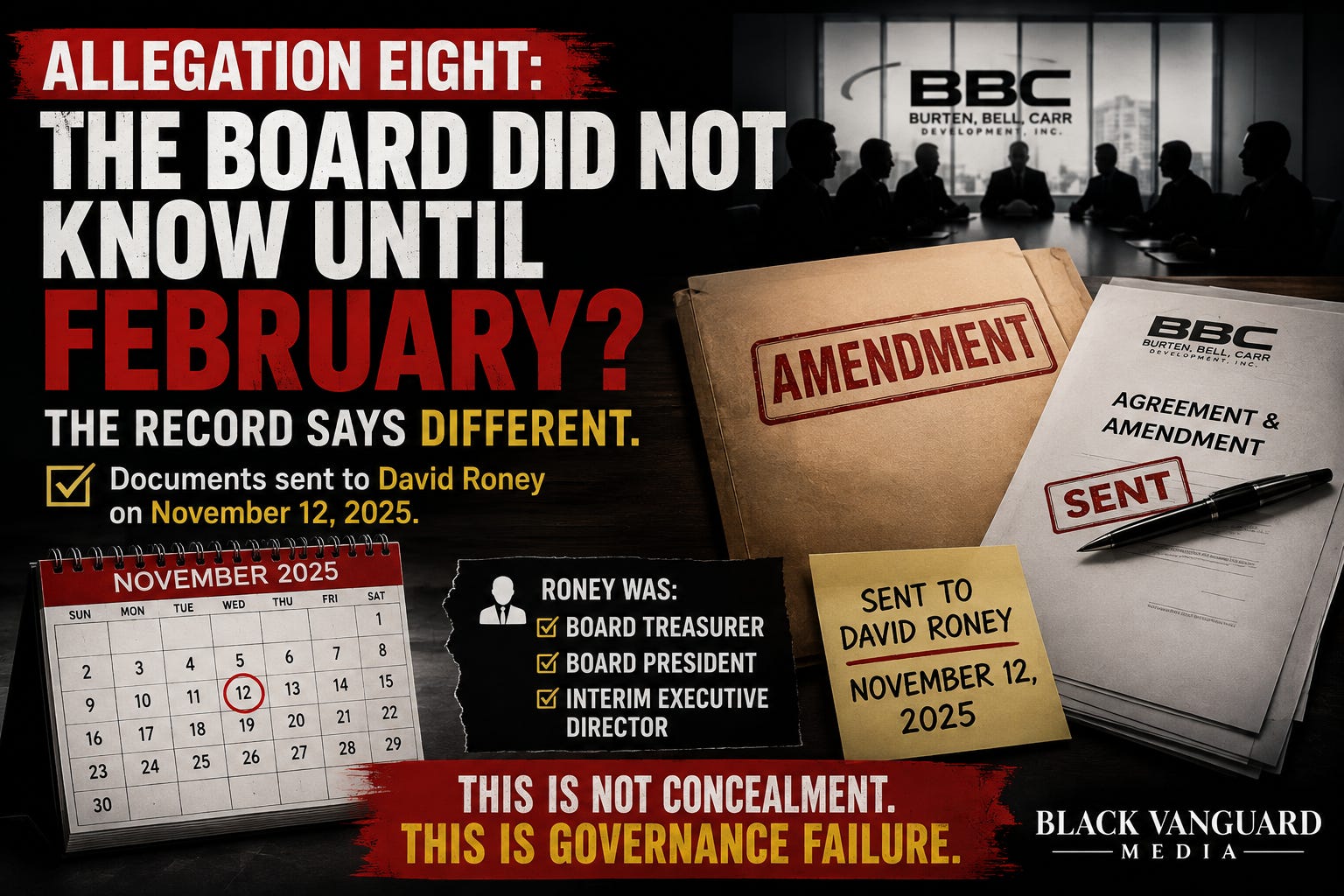
Allegation Eight: The Board Did Not Know About the Amendment Until February
BBC claims the board was unaware of the Amendment until February 2026. That claim deserves careful examination.
Records show that the Agreement and Amendment were sent to David Roney on November 12, 2025.
Roney was not a minor figure.
He was tied to BBC board leadership and financial oversight. He served as Board Treasurer then Board President . He later became Interim Executive Director. He was central enough to BBC’s own litigation story that BBC says the board believed he had counsel handling the lawsuit.
So if Roney had the Agreement and Amendment in November, then BBC has a governance problem. Either Roney received critical documents and failed to circulate them. Or the board failed to ensure that leadership reviewed them. Or BBC’s internal document control was inadequate. Or the February “discovery” story is incomplete. In any scenario, the issue points back to BBC’s own governance. It does not prove concealment by FCB.
BBC cannot claim something was hidden merely because its own leadership failed to manage, review, or distribute the documents it received.
That is the difference between secrecy and dysfunction.
Allegation Nine: Darvio Refused to Communicate
BBC’s narrative tries to make Darvio look evasive.
But the email record shows ongoing communication between Darvio and BBC leadership after Joy’s removal.
David Roney asked Darvio for WOVU budget information. Darvio responded. Roney asked about funding sources. Darvio responded. Roney asked for invoices. Darvio provided them. Roney asked about how funds were received. Darvio explained what he knew and clarified that the money went into BBC accounts. That is not refusal to communicate. That is communication.
What Darvio would not do was surrender contractual rights after BBC denied the Amendment and suspended FCB’s operations.
That is different.
Once BBC took the position that the Amendment was invalid and moved to suspend FCB, the relationship was no longer business as usual. It had become a legal dispute.
A party refusing to abandon its legal position is not the same as a party refusing to communicate.
BBC blurs that line because the blur helps its narrative. The record does not.
Allegation Ten: FCB Controlled the Money
This is one of the most important false impressions in the counterclaim narrative. BBC wants the public to associate FCB with financial confusion around WOVU. But the email record directly undercuts that.
Darvio wrote that all funds raised on behalf of WOVU were deposited directly into BBC accounts. He stated that WOVU did not have a separate bank account. He stated that FCB did not have access to BBC’s accounts, books, or internal financial systems. He stated that reconciliation, tracking of disbursements, and resolution of discrepancies had to occur within BBC’s internal processes as owner of the station.
That is a devastating distinction.
Because if BBC controlled the accounts, BBC controlled the books, BBC controlled the internal systems, and BBC controlled payment processing, then BBC cannot fairly blame FCB for internal accounting confusion.
FCB was not BBC’s bank. FCB was not BBC’s treasurer. FCB was not BBC’s accounting department. FCB was not Bill.com. FCB was the media partner.
The record shows Darvio raising concerns about unpaid staff and delayed payments. It shows Darvio trying to help Roney identify funding documentation. It shows BBC leadership attempting to trace its own deposits and internal records.
That does not prove FCB withheld money. It suggests BBC had internal financial management issues. Again, the counterclaim points outward. The record points inward.
Allegation Eleven: FCB Failed to Pay Staff and Contractors
BBC’s claim that FCB failed to pay operating costs, staff, or contractors is weakened by the same basic fact:
BBC controlled the funds and payment process.
If money was deposited into BBC accounts, if BBC controlled the bank accounts, if BBC controlled its books, if BBC controlled Bill.com, and if BBC controlled disbursements, then the obligation to process payments ran through BBC’s internal systems.
The emails show Darvio complaining that invoices had not been uploaded, staff had not been paid, and payment delays were harming WOVU operations.
That matters. A person documenting unpaid staff is not hiding unpaid staff. A person asking BBC to process payments is not controlling BBC’s payment system.
A person clarifying that money sits inside BBC’s accounts is not the reason BBC’s accounts are not reconciled.
BBC’s allegation tries to make FCB responsible for a payment process FCB did not control. That is not evidence. That is blame-shifting.
Allegation Twelve: FCB Damaged WOVU’s Digital Presence
BBC alleges or implies that FCB damaged WOVU’s digital assets, distribution platforms, website, app, or related infrastructure.
But the record draws key distinctions.
FCB’s relationships with third-party platforms were FCB’s relationships. If BBC suspended FCB’s operations, BBC cannot demand indefinite access to FCB-controlled or FCB-maintained relationships as if those assets belonged automatically to BBC.
The record also shows that FCB did not create, own, manage, or control the WOVU app. It states that FCB did not own or control WOVU.org and did not list it for sale. It states that website disruption resulted from BBC failing to pay the hosting vendor.
Those are factual claims that BBC must answer with proof. Who controlled the app backend? Who controlled the domain registrar? Who controlled hosting payments? Who held credentials? Who received invoices? Who failed to pay? Those questions matter because technical confusion can be weaponized. A website going offline is not automatically sabotage.
A third-party platform relationship ending after a contract dispute is not automatically misconduct.
A station losing access to FCB-created infrastructure after suspending FCB does not prove FCB destroyed BBC property.
It may prove BBC did not understand what FCB had built and what BBC actually controlled.
Allegation Thirteen: FCB Wrongfully Retained BBC Property
BBC’s property narrative must be evaluated against the Agreement.
If the Agreement states that intellectual property created by FCB remains FCB property absent a written assignment, then BBC cannot accuse FCB of retaining property merely because FCB refuses to surrender what it created.
That distinction is important. A logo. A slogan. Brand identity. Creative materials. Digital strategy. Programming concepts. Operational materials.
Those things may have been created as part of FCB’s work. If the contract preserved FCB’s ownership unless assigned, then BBC must show a written assignment before treating everything FCB created as BBC property.
BBC cannot benefit from FCB-created identity, continue using FCB-created work, and then accuse FCB of wrongdoing for asserting rights in its own work.
That is not clean hands. That is another attempt to benefit from the relationship while attacking the partner.
Allegation Fourteen: FCB Breached First
BBC’s overall legal narrative appears to suggest that FCB breached the Agreement. But the timing matters.
According to FCB and UVPM’s complaint and default motion materials, Darvio notified BBC on February 9, 2026, that UVPM had received its IRS determination letter. The next day, BBC’s Board President ceased FCB/UVPM’s operations at the station and prevented access.
That is the break point.
If BBC had a dispute over the Amendment, it could have addressed that dispute through the contract, through counsel, through a court filing, through written notice, through board action, or through an orderly process.
Instead, BBC suspended operations. That action triggered the litigation posture. So the public should ask: Who took the first drastic step? Who ended access? Who refused to proceed? Who turned a contractual dispute into a station shutdown? Who failed to timely respond when sued? BBC wants the public to believe FCB caused the crisis. But the timeline puts the decisive rupture at BBC’s door.
Allegation Fifteen: BBC Was the Victim of Outside Forces
The overall theme of BBC’s counterclaim is that outside forces harmed BBC. Joy. Darvio. FCB. UVPM. Jerry. But that theme ignores the internal facts that keep surfacing. BBC had a board. BBC had officers. BBC had a treasurer. BBC had a board president. BBC had legal sophistication at the board-president level. BBC controlled its own accounts. BBC controlled its own books. BBC controlled its payment systems. BBC received the lawsuit.
BBC failed to timely answer. BBC claims it believed Roney had counsel handling the matter. BBC later found unopened mail. BBC removed Roney. Those are not outside forces. Those are internal governance failures.
The counterclaim functions as a fog machine. It fills the room with names, suspicions, allegations, and insinuations until the simplest truth becomes harder to see:
BBC’s crisis was governed from inside BBC.
The Parker Problem
Jamie Parker’s role makes BBC’s deflection harder to accept.
Parker was BBC’s Board President when FCB and UVPM’s station operations were suspended. She later became Interim Executive Director. Public professional materials identify her as an Ohio attorney with experience in labor and employment law, mediation, human resources, compliance-risk mitigation, policy creation, and leadership-team conflict resolution.
That matters.
Because the suspension of FCB was not made in a vacuum. The missed lawsuit response did not occur in a boardroom with no legal sophistication. The attempt to frame BBC’s late response as excusable neglect must be read against the fact that BBC had leadership with legal training.
The point is not that Parker was BBC’s lawyer.
The point is that BBC’s leadership had enough legal sophistication to know that contracts, deadlines, default motions, court service, and unopened legal mail matter.
That makes the counterclaim’s deflection even more troubling. BBC does not get to present itself as helpless and sophisticated at the same time.
The Roney Problem
David Roney’s role also undermines BBC’s counterclaim.
Roney was tied to financial oversight. He was board leadership. He became Interim Executive Director. BBC’s own filing says the board believed he had counsel handling the lawsuit. BBC’s own filing says unopened mail addressed to Roney included critical default materials. BBC’s own filing says Roney was removed as Executive Director.
Those facts are not peripheral. They are central.
BBC’s counterclaim tries to drag others into the story, but BBC’s own motion points directly back to Roney and the board’s internal handling.
If Roney had the Agreement and Amendment in November, why was the board allegedly unaware until February?
If Roney was responsible for handling legal counsel, why was no timely response filed? If mail addressed to Roney sat unopened, what does that say about BBC’s controls?
If Roney was removed as Executive Director, what were the “other issues” that led to that removal?
Those are not attacks. They are necessary questions. And they are far more relevant to BBC’s governance than insinuations about Jerry Primm.
The leadership turnover is itself part of the record. Within the first year after Joy Johnson’s departure, David Roney — the first interim executive director to succeed her — was removed from the position. BBC then moved to a second interim executive director, Jamie Parker. In less than a year, the organization went from a longtime executive director to two successive interim leaders, adding another layer to the questions about stability, governance and the board’s management of the transition.
The Counterclaim as Strategy
The counterclaim should be read as strategy. Not just legal strategy. Public strategy. Reputation strategy. Damage-control strategy.
By naming Joy Johnson, Darvio Morrow, FCB, UVPM, Jerry Primm, and others, BBC changes the emotional center of the story.
Instead of asking why BBC suspended FCB, readers are invited to wonder whether Darvio did something wrong.
Instead of asking why BBC missed the lawsuit deadline, readers are invited to focus on Joy.
Instead of asking why Roney had critical responsibilities, readers are invited to speculate about Jerry.
Instead of asking why BBC controlled the money but blamed FCB for payment issues, readers are invited to assume confusion means misconduct.
That is how deflection works. It does not need to prove every allegation. It only needs to create enough suspicion to slow down accountability. Black Vanguard Media’s job is to cut through that suspicion and return to the record.
What the Record Shows
The record shows that BBC had a WOVU problem before FCB. The record shows that Joy was asked to find a way to stop WOVU from draining BBC’s resources. The record shows that FCB was brought in under a written Agreement. The record shows that BBC admits the original Agreement existed and was signed by Joy.
The record shows that FCB provided programming, consulting, underwriting, and digital strategy.
The record shows that WOVU had a growth strategy under FCB.
The record shows that after Joy’s removal, Roney communicated with Darvio about WOVU budgets, funding, invoices, staff payments, and revenue tracking.
The record shows Darvio stated funds went directly to BBC accounts and that FCB did not control BBC’s accounts, books, or internal systems.
The record shows BBC suspended FCB/UVPM operations after UVPM’s IRS trigger event. The record shows FCB and UVPM sued. The record shows BBC failed to timely respond.
The record shows BBC blamed its late response on internal assumptions about counsel and Roney-related handling.
The record shows BBC then filed a counterclaim trying to shift attention outward. That sequence matters.
Because when the facts are placed in order, BBC’s counterclaim looks less like a search for truth and more like an effort to survive the record.
What Funders Should Ask Now
Funders, public officials, partners, and community stakeholders should not accept BBC’s counterclaim at face value.
They should ask direct questions.
What evidence proves Jerry Primm had an ownership, officer, director, incorporator, or governance role in FCB or UVPM?
What evidence proves Joy had a conflict during the relevant period? What evidence proves FCB knew Joy lacked authority before BBC informed FCB?
What evidence proves the Amendment instantly transferred the FCC license without required FCC process?
What evidence proves FCB controlled BBC’s bank accounts, books, Bill.com, or payment systems? What evidence proves FCB owned or controlled WOVU.org? What evidence proves FCB created, owned, or controlled the WOVU app? What evidence proves FCB refused ordinary communication before BBC suspended operations? What board vote authorized the February suspension? What legal analysis supported it? Why did BBC fail to answer the lawsuit on time?
Why did the board rely on Roney? Why was mail unopened? Why was Roney removed?
Why does BBC’s counterclaim spend so much energy attacking others instead of explaining its own governance failures?
Those are the questions that matter.
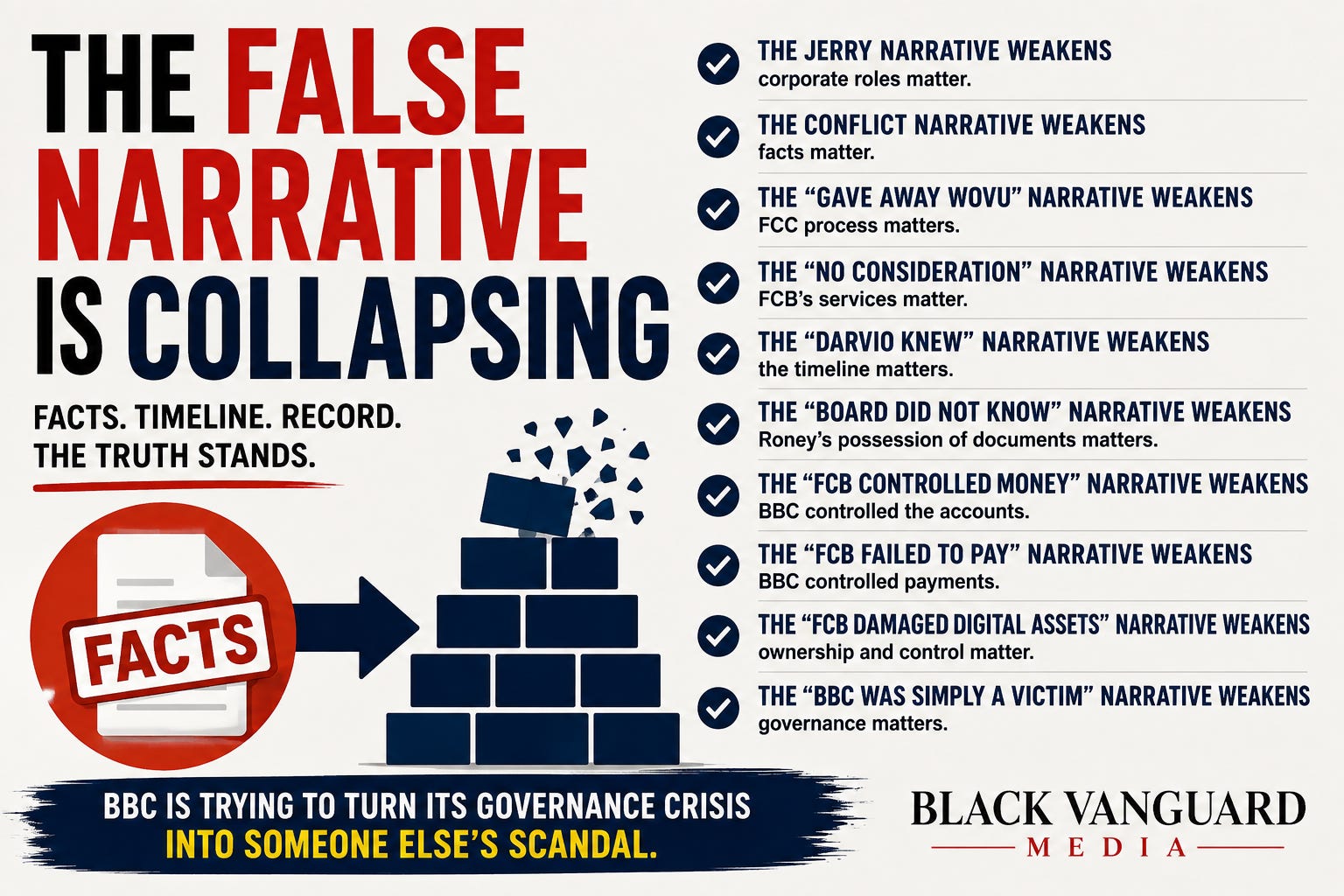
The False Narrative Is Collapsing
The more BBC’s allegations are tested, the more the narrative weakens. The Jerry narrative weakens because corporate roles matter. The conflict narrative weakens because facts matter. The “gave away WOVU” narrative weakens because FCC process matters. The “no consideration” narrative weakens because FCB’s services matter. The “Darvio knew” narrative weakens because the timeline matters. The “board did not know” narrative weakens because Roney’s possession of documents matters.
The “FCB controlled money” narrative weakens because BBC controlled the accounts. The “FCB failed to pay” narrative weakens because BBC controlled payments. The “FCB damaged digital assets” narrative weakens because ownership and control matter. The “BBC was simply a victim” narrative weakens because governance matters. That is why BBC’s counterclaim should not intimidate anyone. It should be examined. And once examined, it reveals the same pattern this series has exposed from the beginning:
BBC is trying to turn its governance crisis into someone else’s scandal.
The Bottom Line
BBC does not have to like the Agreement. BBC does not have to like the Amendment. BBC does not have to like FCB’s position. BBC does not have to like Darvio’s defense. BBC does not have to like Joy Johnson’s record. BBC does not have to like Jerry Primm’s involvement in defending reputations. BBC does not have to like Black Vanguard Media asking questions. But BBC does have to answer the record. And the record does not support a simple story of outside misconduct.
It supports a story of institutional deflection. A board asked for a WOVU solution. Joy pursued one. FCB delivered value. BBC later changed course. Parker suspended operations. Roney was central to internal handling. BBC missed the lawsuit deadline.
BBC then filed a counterclaim that attempted to spread blame across everyone except the people responsible for governing BBC.
That is the real damage-control strategy. And the public should see it for what it is. This is Part V. And by now, the pattern is clear: BBC’s counterclaim is not just a legal filing. It is an attempted rewrite of the truth. The record is the correction.