

For years, Cleveland, Ohio carried an unenviable distinction: national studies routinely cited the city as one of the most digitally divided major cities in the United States, with entire neighborhoods priced out of reliable high-speed internet. That reality shaped everything from education outcomes and workforce participation to healthcare access and entrepreneurship.
Today, that story has materially changed.
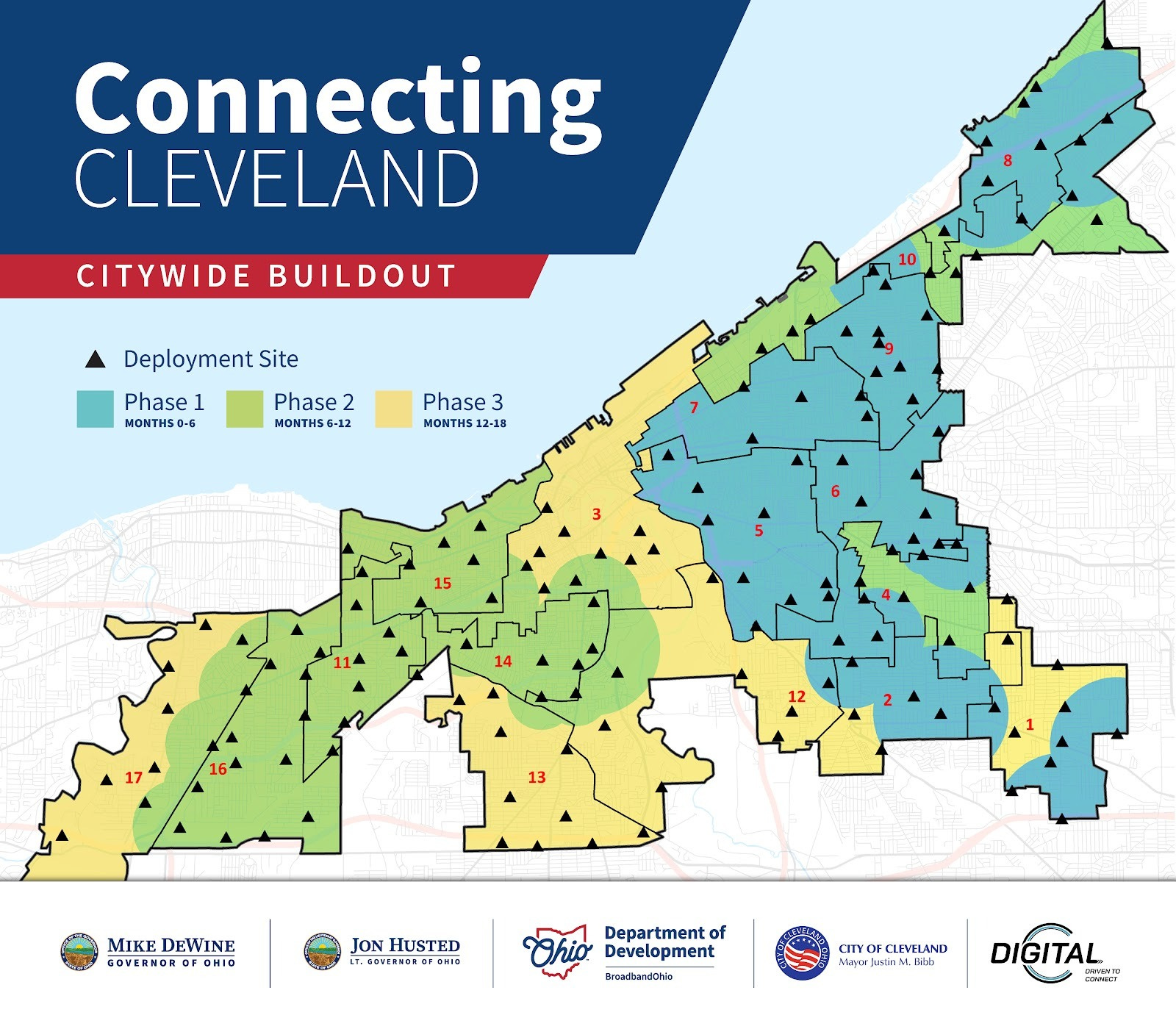
According to recent reporting and year-end announcements, DigitalC has met — and in key areas exceeded — the connectivity goals it set when the city first backed its citywide broadband initiative. More than 7,500 households are now connected to fast, affordable internet through DigitalC’s Canopy network, reaching over 18,000 Cleveland residents in just under two years. Training efforts have expanded in parallel, with tens of thousands of digital skills sessions delivered across the city.
This progress marks a turning point — not just for Cleveland, but for how cities nationwide think about broadband.
A Brief Note on the Utilities Committee Question
The last time DigitalC appeared before Cleveland City Council’s Utilities Committee, members broadly acknowledged that the organization was on track and performing well. One point of discussion, however, centered on access to subscriber data — specifically, why individual councilmembers could not directly receive customer-level sign-up information if the City of Cleveland administration had access.
That question deserves a brief, factual explanation.
Why DigitalC cannot simply share subscriber data with individual councilmembers
DigitalC operates as a broadband service provider. As such, it is governed by federal privacy and consumer-protection rules, including:
FCC Customer Proprietary Network Information (CPNI) protections, which restrict disclosure of personally identifiable subscriber data without proper authorization.
Federal privacy and data-minimization standards, which limit sharing of customer data outside narrowly defined operational and oversight contexts.
Contractual and grant-compliance obligations, which typically allow data sharing with an administering authority (such as the City) in aggregated or anonymized form, but not distribution of raw subscriber records to individual elected officials.
In practical terms:
✔ The City of Cleveland, as the program partner and fund administrator, can receive verified, audited, aggregate data to confirm performance.
✘ Individual councilmembers cannot receive customer-level data directly without triggering serious legal and privacy violations.
This is not a matter of reluctance or secrecy — it is standard practice across telecommunications, utilities, healthcare, and education sectors, and it protects residents’ privacy while still ensuring public accountability.
From “Least Connected” to a National Case Study
Multiple national analyses over the past decade identified Cleveland as lagging behind peer cities in household broadband adoption, affordability, and digital inclusion. That context makes the current moment significant.
Under the leadership of Joshua Edmonds, DigitalC executed one of the fastest citywide broadband builds in the country, completing deployment in under 18 months — a pace that traditional fiber projects often take many years to achieve.
Equally important, this progress was not achieved in isolation. It was made possible by:
The City of Cleveland’s willingness to invest in a new model
City Council’s sustained support and oversight
Mandel and Meyers Foundations without
Cross-sector collaboration with community institutions and residents
Philanthropic leadership from the Mandel and Myers Foundations, whose significant early investments helped make this work possible and provided critical momentum at a time when few were willing to bet on a new broadband model.
The result: a measurable reduction in Cleveland’s digital divide in record time, proving that the investment was not only justified — it was transformative.
A New Way to Think About Internet Access
DigitalC’s success also challenges a long-standing assumption in the broadband industry: that fast, reliable internet must cost $70–$100 per month.
While Cleveland’s $18 per month price point may not be immediately replicable everywhere, the broader lesson is unmistakable:
High-speed internet does not have to be unaffordable to be sustainable.
By leveraging next-generation fixed wireless technology from Tarana, DigitalC demonstrated that urban broadband can be fast, reliable, and dramatically cheaper — without sacrificing quality. Cleveland is now widely recognized as one of the first dense urban cities to deploy Tarana’s technology at full city scale, a milestone that matters because dense cities are traditionally the hardest environments for wireless broadband to serve.
This is not incremental change. It is industry disruption.
Momentum Beyond Cleveland
That disruption is already spreading. DigitalC’s model is now being tested in Detroit, Michigan, where a pilot is underway to connect hundreds of families in public housing — a clear signal that other cities are watching closely and adapting Cleveland’s approach.
Interest has also come from:
Rural and Appalachian communities across Ohio
Regions nationwide struggling with high costs, slow deployment, or both
The takeaway is clear: Cleveland is no longer trailing the national conversation on broadband — it is shaping it.
Meeting the Moment — Even Against Rising Costs
Perhaps most notably, DigitalC met its milestones despite extraordinary external pressures, including tariffs that reportedly caused some network component costs to increase by as much as 700%. Achieving deployment targets under those conditions underscores both operational discipline and strategic foresight.
The Next Milestone
The next phase for DigitalC is ambitious — and consequential. But with:
Proven execution
Strong public-sector partnership
Growing national interest
And hard-won momentum
There is every reason to believe DigitalC will meet it.
Cleveland took a risk on a new broadband model — and it paid off. With the continued support of the City of Cleveland and City Council, the city has moved from one of the least connected major cities in America to one of the most connected in remarkably short order.
That is not just a milestone.
It is a blueprint.