

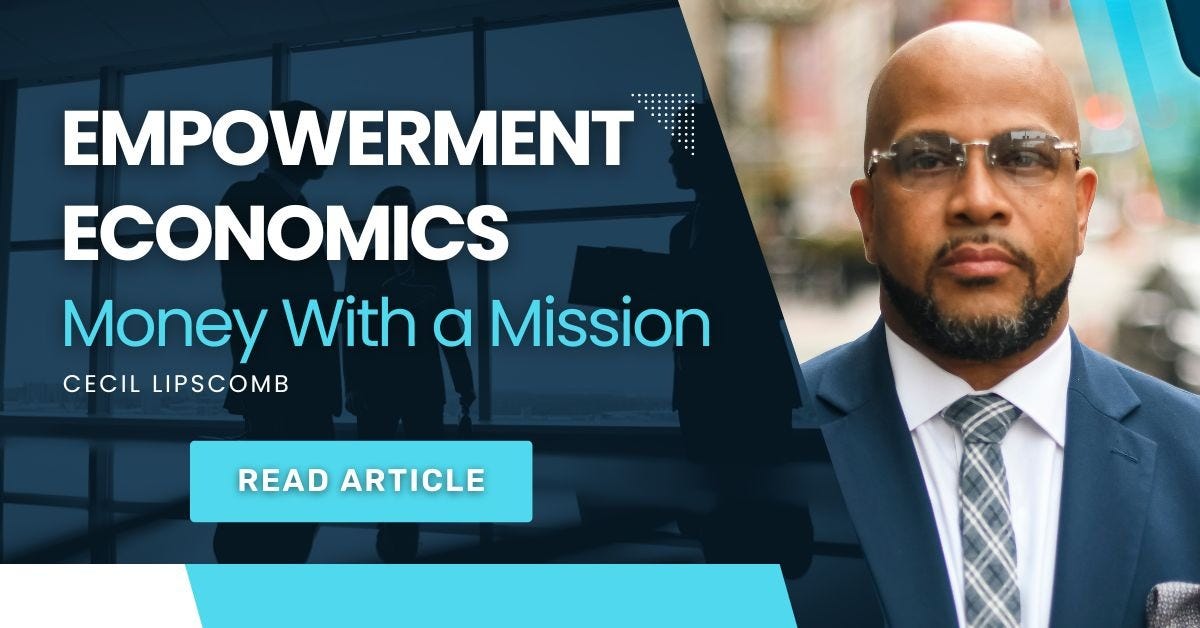
Last time, we named the gap between our creativity and our contracts.
Now, let’s look at how communities are closing it.
From Mindset to Models
In Part 1, we talked about:
How communities on the margins of economic power have led culture, but not always led contracts or capital
Why consumer‑only business models keep us at the thinnest part of the value chain
How nonprofits can be infrastructure, not afterthoughts, when we design them that way
This time, we turn to real‑world strategies communities are already using—and what emerging leaders can learn from them.
1. Cooperative Economics and Buying Power
When you can’t outspend the market, you have to out‑organize it.
Two powerful examples:
The Federation of Southern Cooperatives
For more than 50 years, the Federation of Southern Cooperatives has helped Black farmers and landowners:
Pool resources
Gain leverage with buyers
Defend land ownership
They’ve shown that when small producers cooperate instead of competing alone, they can:
Access bigger markets
Negotiate better prices
Keep more wealth in their communities
Cleveland’s Evergreen Cooperatives
Cleveland’s Evergreen Cooperatives created worker‑owned businesses in:
Commercial laundry
Solar and energy
Urban farming
Instead of relying only on individual customers, Evergreen targeted large anchor institutions like the Cleveland Clinic and University Hospitals.
By doing so, they:
Created stable, living‑wage jobs
Built worker ownership
Kept more dollars circulating in the neighborhoods those anchors serve
The lesson:
They sell to institutions, build shared ownership and bargaining power, and use cooperative structures to reduce costs and stabilize demand. Any community can adapt this playbook.
2. Anchor Institution Contracts
Hospitals, universities, major nonprofits, corporations, and public agencies—our anchor institutions—are often the largest buyers in a region.
They spend millions every year on:
Construction and maintenance
Food and supplies
Professional services
Technology and equipment
Cities have shown what happens when anchors commit to local, inclusive procurement:
In Baltimore, the “BLocal” initiative brought major institutions together to hire, buy from, and invest in local and minority‑owned businesses, opening doors to new contracts and helping neighborhood‑based firms grow.
In New Orleans, after Hurricane Katrina, deliberate efforts expanded the roles of local and minority contractors in rebuilding—helping recovery dollars stay in the communities most affected.
These examples say something simple but powerful:
We don’t have to wait for a national foundation to rescue us.
We can position ourselves to serve the institutions already anchored in our own backyards.
3. Nonprofits as Engines, Not Afterthoughts
In many communities, nonprofits already:
Hold critical contracts
Operate key facilities
Maintain hard‑won trust with residents
But too often they’re financed like fragile side projects.
Across the country, some nonprofits have flipped the script—combining mission with earned income:
Youth organizations that sell workforce training and placement to employers and public systems
Housing nonprofits that establish property management subsidiaries, earning fee income while preserving affordability
Health nonprofits that partner with hospitals to deliver community‑based care, paid through value‑based or managed‑care contracts
The data from the Urban Institute (2023) backs this up:
Only 28% of primarily grant/donation‑funded nonprofits report annual surpluses.
51% of nonprofits with mixed revenue (grants + earned income) report surpluses.
73% of nonprofits with majority earned income / social enterprise activities report surpluses.
The pattern is obvious:
Diversified or earned income isn’t a luxury. It’s a core skill—especially for communities that have historically been on the outside looking in.
4. If Coca‑Cola and Pepsi Can Do It, So Can We
Coca‑Cola and Pepsi are rivals. But they still understand a basic truth:
First, protect the category. Then compete inside it.
At different moments, they have aligned on:
Bottling standards
Distribution practices
Lobbying and regulation
Industry‑wide marketing and messaging
Because they know: the real threat is anything that shrinks the entire category—not just their direct competitor.
In the same way, our “category” includes:
Community‑rooted businesses
Community‑led nonprofits
Local ownership of assets and ideas
If we spend all our energy competing in tiny, low‑margin spaces—while ignoring the bigger fight over contracts, policy, and ownership—we will keep losing together.
So what does “protecting the category” look like at the local level?
Practical Local Strategies
Here are concrete moves any community can explore:
Buying Collaboratives
Neighborhood restaurants, salons, trades, and retailers:
Join forces to purchase supplies and inventory at scale
Negotiate better prices from wholesalers
Improve margins for everyone in the group
Shared Back‑Office Services
Multiple nonprofits or businesses:
Share accounting, HR, IT, marketing, or compliance support
Use a trusted intermediary or shared‑services hub
Get professional‑grade infrastructure at a fraction of the cost
Joint Ventures for Bigger Contracts
Two or three small firms:
Form a joint venture or teaming agreement
Bid together on city, county, school district, or anchor institution contracts
Take on larger opportunities none could handle alone
Community Development Consortia
Faith institutions, CDEs, and local entrepreneurs:
Coordinate to identify strategic properties
Co‑invest or align around acquisition and development
Keep ownership and decision‑making closer to the community
This is how emerging leaders and historically sidelined communities punch above their weight. It’s not magic; it’s disciplined strategy.
A Call to Every Builder Ready for the Next Level
If you’ve made it this far, you might be:
Already building something—and tired of being undercapitalized and underestimated.
Sitting inside a larger institution, knowing it could do more for the community if someone connected the dots.
Early in your journey, but certain that consumer‑only economics is not enough for where we need to go.
To you, I want to be crystal clear:
The future of our communities is not just in more brands and storefronts; it’s in contracts, cooperatives, code, curriculum, and capital.
The nonprofits in our neighborhoods are not just service providers; they can be infrastructure builders—if we design them that way.
And communities that have historically been on the margins—Black, Brown, White, Urban, Rural—have every right not only to contribute ideas, but to capture value, share profits, and own assets that our creativity makes possible.
The next step is to put numbers and plans around that belief.
Join the Working Session – March 11
On March 11, let’s sit in a room together and start putting the numbers to this vision.
Empowerment Economics Working Session
Date: March 11
Time: 4:00–5:30 p.m.
Location: MidTown Tech Hive, Cleveland
In this session, you will:
Define a clear 12‑month financial target for your organization or initiative
Map where you are today and calculate the gap
Identify specific contracts, collaboratives, and capital relationships that can help close that gap
If you’re ready to move from inspiration to infrastructure:
REGISTER HERE TODAY for the March 11 working session at the MidTown Tech Hive.
Because the measure of our impact cannot only be how much we inspire.
It has to include how much we own, how much we earn, and how much value we keep circulating in the communities that needed a win the most.
I hope to see you at the MidTown Tech Hive on March 11 at 4:00 p.m.