

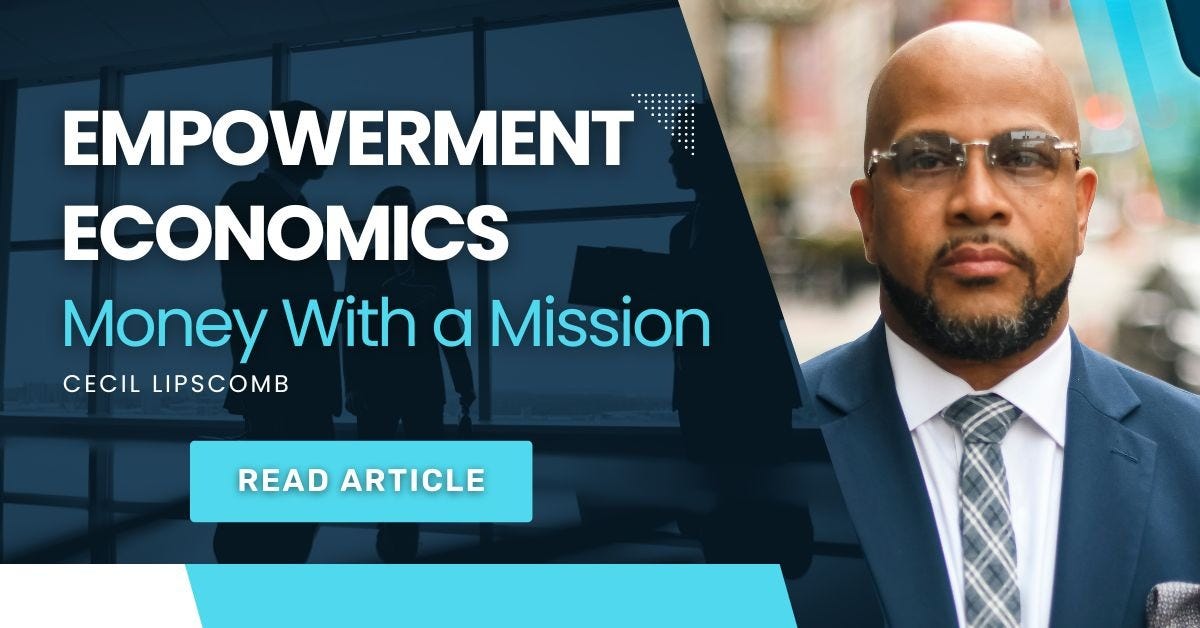
“Purpose without profit is philanthropy. Profit without purpose is exploitation.
The future lies in the space between.” — Cecil Lipscomb
Purpose, Profit, and a Volatile Economy
Purpose without profit is philanthropy. Profit without purpose is exploitation. The future lies in the space between—where good ideas meet sound economics, and where social mission becomes market power.
In today’s higher‑rate, higher‑cost U.S. economy, places like Cleveland and Northeast Ohio sit at a crossroads. We live with the legacy of industrial decline and disinvestment, even as new capital flows into select neighborhoods and corridors.
We can’t afford to separate “doing good” from “doing business.” Communities are strongest when commerce flows between specialized sectors, small businesses, and mission‑driven organizations in ways that create both wealth and well‑being.
That’s the power of collective trade—the intentional exchange of goods, services, and ideas that multiplies value across local networks instead of concentrating it at the top.
Social Impact Alone Doesn’t Pay the Bills
Good intentions don’t balance books.
According to the Nonprofit Finance Fund (2023), 47% of U.S. nonprofits end their fiscal year breaking even or in deficit. Many rely on short‑term grants, restricted contracts, or fundraising that doesn’t keep pace with rising costs and tighter credit.
Here in NE Ohio, nonprofits and small businesses feel it when:
Borrowing costs go up
Government and philanthropic dollars are more competitive
Operating expenses—from insurance to utilities—outpace revenues
If your work creates measurable community value, it has market worth. The task now is to design models where mission, money, and risk management move in the same direction.
Collective Trade: Collaboration as Capital
Collective trade happens when innovators, nonprofits, and local enterprises stop chasing the same limited funds and start building cross‑sector partnerships that circulate opportunity.
In NE Ohio, that can look like:
A manufacturer partnering with a workforce nonprofit to train and place local residents into good‑paying jobs
A grocery co‑op sourcing from Black‑, Brown‑, and women‑owned farms in the region
A tech or health‑tech startup co‑developing tools with a hospital or foundation and sharing licensing revenue
Regions with strong local B2B trade networks see 35% higher job retention and 22% faster startup growth (Brookings, 2022). For Cleveland, that’s not just a statistic—it’s a strategy.
Revenue Equals Resilience
Nonprofit Revenue Model — % Reporting Annual Surpluses
Primarily Grant/Donation Funded: 28%
Mixed (Grants + Related Earned Income): 51%
Majority Earned Income / Social Enterprise: 73%
Source: Urban Institute, Nonprofit Sector in Brief, 2023
Diversified or earned income more than doubles the likelihood of a surplus. In a region that regularly weathers plant closures, consolidations, and budget shifts, revenue diversification is protection.
For Nonprofits: Impact + Income + Reserves
Every mission needs a model—and every model needs predictable cash flow.
Examples of related earned income in NE Ohio:
A housing nonprofit launching a property management arm to generate fees and preserve affordability
A workforce or youth organization selling employer‑paid training and retention services
An arts nonprofit renting event spaces and offering fee‑based programs
Done well, these activities:
Align with mission
Create flexible revenue
Improve bargaining power with funders and lenders
Support building operating reserves for downturns and delays
Impact + Income + Reserves = Independence.
For Small and Medium Businesses: Mission as Advantage
For neighborhood contractors, food entrepreneurs, and tech firms, social value shouldn’t distract from profit—it should define and defend it.
Customers and anchor institutions increasingly ask:
Who hires locally?
Who pays livable wages?
Who is improving outcomes in the communities they serve?
In a higher‑rate environment, lenders and buyers want to know that you are financially sound and socially rooted—built to last, not just to launch.
Best Practices for an Empowerment Economy in NE Ohio
Map your local value chain. Identify who benefits, who can pay consistently, and how you plug into anchor procurement and regional supply chains.
Price for full cost and growth. Cover direct, indirect, and capacity costs—not just survival—so you can invest in people, systems, and reserves.
Measure what matters locally. Track outcomes like local hiring, retained housing, higher incomes, or reduced justice involvement, and use that data to negotiate better, longer‑term contracts.
Build economic alliances. Create shared service hubs, buying co‑ops, joint ventures, and co‑located spaces to lower costs and increase bargaining power.
Reinvest in infrastructure and reserves. Use surpluses to strengthen systems, technology, and leadership—especially for neighborhood‑based and BIPOC‑led organizations.
A Cleveland Block as a Blueprint
Picture a Cleveland block where an underused building is redeveloped into first‑floor retail and affordable housing upstairs:
Investors earn steady returns through rent and appreciation
Residents gain dignified, stable housing
Local entrepreneurs access new storefronts with fair terms
The neighborhood gains safety, foot traffic, and pride
Replicated from Glenville to Slavic Village and beyond, this is more than a project—it’s a regional playbook for Empowerment Economics.
The Takeaway: Circulation Is Strength
Empowerment Economics isn’t about charity—it’s about circulation and durability.
When nonprofits, small businesses, and social enterprises across Cleveland and NE Ohio inter‑trade intentionally—sharing contracts, capacity, and customers—they build an economy resilient enough to adapt, not just survive, when conditions tighten.
The measure of real impact isn’t how much we give away— it’s how much value we create, retain, and keep circulating locally, year after year.