

Most conversations about money start in the wrong place.
We talk about access before we talk about authority.
We talk about need before we talk about power.
We talk about dollars before we talk about decision-makers.
In community development spaces especially, we’re often encouraged to focus on “getting a seat at the table.” But very few people stop to ask a more important question:
Who built the table—and who controls what gets served?
Funding decisions are not random. They are not purely merit-based. And they are almost never made at the point where most community organizations are invited into the conversation.
They are made upstream.
The Real Architecture of Capital
Whether the money comes from philanthropy, government programs, or private institutions, capital almost always moves through intermediaries—entities designed to evaluate, filter, structure, and deploy resources on behalf of others.
Foundations rely on program officers and investment committees.
Banks rely on underwriting standards and risk models.
Federal programs rely on designated entities that translate policy into practice.
By the time capital reaches a neighborhood organization, most of the consequential decisions—eligibility, structure, scale, and risk tolerance—have already been made.
This is why so many capable organizations find themselves perpetually “almost funded.” They meet the mission test. They often meet the community need. But they were never positioned inside the part of the system where power actually operates.
Access Is Not the Same as Influence
Being invited to apply is not the same as being able to shape outcomes.
Many organizations spend years perfecting grant language, refining impact narratives, and responding to funder priorities—without ever understanding how those priorities were set in the first place.
Influence lives earlier in the process:
in how criteria are written
in how risk is defined
in which models are considered “credible”
in which organizations are trusted to steward capital at scale
That influence is rarely accidental. It is embedded in structures.
When Communities Become Intermediaries
This is where the conversation has to mature.
If capital flows through entities, then communities that want lasting power must understand—not just apply to—those entities. In some cases, that means building organizations that are not simply recipients of capital, but participants in its allocation.
One of the clearest examples of this at the federal level is the Community Development Entity (CDE) structure. CDEs sit inside the capital deployment process for programs like the New Markets Tax Credit. They are evaluated not only on mission, but on governance, track record, and capacity to deploy capital responsibly.
This is not easy terrain. Most organizations are never taught how Treasury evaluates credibility at this level, why some applications advance while others stall, or how community-based institutions can prepare for this role without losing momentum on their core work.
That knowledge gap is not accidental—but it is addressable.
For readers who want to go deeper into how these intermediary structures actually work in practice, there are targeted trainings that focus on the decision-making side of capital, not just the application side. One such session, led by Joy Johnson, walks through the CDE landscape from the perspective of readiness, governance, and what reviewers are truly assessing behind the scenes. It’s designed for organizations that are asking not just how to access funding, but how to position themselves within the systems that deploy it.
Why This Matters
Communities don’t remain underfunded because they lack ideas or commitment. They remain underfunded because they are consistently placed at the end of the pipeline, rather than inside it.
Empowerment economics is not about chasing money harder. It’s about understanding how money moves—and deciding where we intend to stand when decisions are made.
The future belongs to communities that learn the rules of capital well enough to stop playing defense.
And that work starts with asking better questions.
About the Author
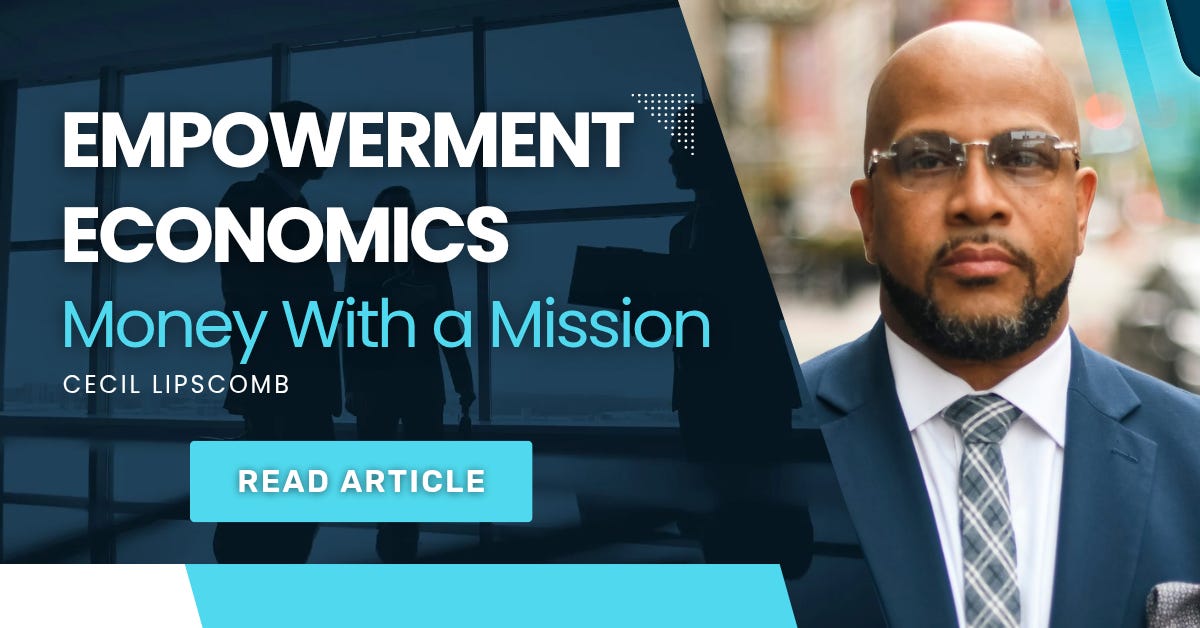
With a career dedicated to expanding opportunity, strengthening community institutions, and reshaping how capital flows into overlooked neighborhoods, Cecil Lipscomb brings a visionary, mission-centered voice to the work of economic empowerment. He believes deeply in the power of people, strategy, and intention—and in the possibility of building systems where resources align with purpose. His leadership reflects a simple but transformative conviction: when communities are equipped with the right tools and the right truth, they rise.
To reach Cecil, call (216) 238-2235.
Interesting
Thank you for this well written article! You have successfully given the reader timely insight for a better perspective on the process and you have shared how to move forward with a more pro-active strategy and informed path to take. Looking forward to future articles that will help take our community to the next level. Adrianne Sims