

Imagine a student sitting quietly in class.
Their grades have started to slip. They are withdrawing from friends. They seem tired, distracted, and disconnected. Teachers notice something is different, but cannot quite identify what. Parents may assume it is a phase. Friends may not know how to respond. Meanwhile, the student is struggling with anxiety, depression, trauma, or another mental health challenge and does not have the language to describe what they are experiencing.
This scenario plays out in schools across the country every day.
For many young people, mental health challenges begin long before they receive support. According to national research, most mental health conditions emerge during adolescence and young adulthood. Yet despite how common these experiences are, many students never receive formal education about mental health. They learn about physical health in school. They learn about nutrition, exercise, and disease prevention. But conversations about emotional well-being, stress, depression, anxiety, and suicide are often limited or absent altogether.
The result is a dangerous gap in knowledge. Students may not recognize warning signs in themselves or others. They may not know where to seek help. They may believe harmful myths about mental illness or feel ashamed to speak openly about their struggles.
Programs like NAMI’s Ending the Silence were created to address that gap.
What Is Ending the Silence?
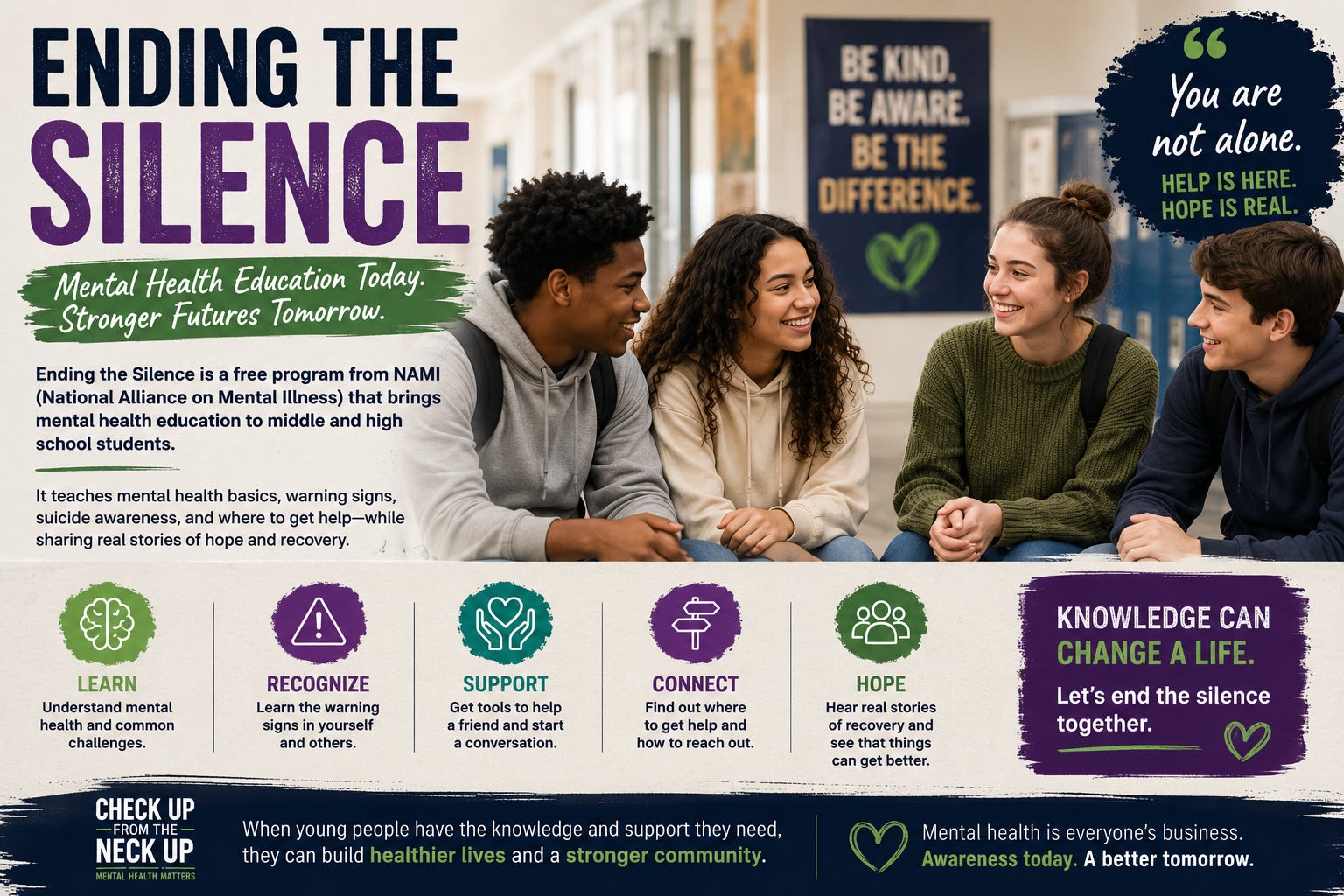
Ending the Silence is a free mental health education program developed by the National Alliance on Mental Illness (NAMI). Designed specifically for middle school and high school students, the program provides age-appropriate information about mental health, mental illness, warning signs, suicide awareness, and how to access support.
What makes the program particularly effective is that it combines education with lived experience. Students not only learn facts about mental health, but also hear personal stories from young adults who have navigated mental health challenges and recovery.
These stories help transform mental health from an abstract topic into a human experience. They remind students that mental health conditions can affect anyone and that recovery is possible.
Why Mental Health Literacy Matters
Mental health literacy refers to a person’s ability to recognize mental health concerns, understand available resources, and know how to seek help when needed.
Just as we teach students how to recognize symptoms of physical illness, we must teach them how to recognize symptoms of emotional distress.
When students understand mental health, they are more likely to:
Recognize warning signs in themselves and others.
Seek help earlier when problems arise.
Support peers in healthy and appropriate ways.
Challenge stigma and misinformation.
Develop empathy for individuals experiencing mental health challenges.
Understand that recovery and treatment are possible.
Education alone cannot solve every mental health challenge, but it can create a foundation that makes early intervention and support more likely.
The Power of Personal Stories
One of the most impactful aspects of Ending the Silence is its use of lived experience.
Students hear directly from young adults who have faced mental health challenges and found pathways toward recovery. These stories often resonate more deeply than statistics or presentations alone because they demonstrate that mental health struggles are not signs of weakness or personal failure.
For many students, hearing someone openly discuss their experiences may be the first time they realize they are not alone.
Personal stories also help reduce stigma. When mental health conditions are discussed openly and honestly, they become easier to understand and easier to talk about.
Why This Matters for Our Community
At Check Up From the Neck Up, one of our goals is to increase mental health literacy among young people, families, educators, and community members.
We recognize that many young people spend a significant portion of their lives in schools, making schools one of the most important settings for early mental health education and intervention.
Programs like Ending the Silence help create a culture where mental health conversations are normalized rather than avoided. They equip students with knowledge before a crisis occurs and encourage help-seeking behaviors that can make a meaningful difference in long-term outcomes.
For communities throughout Cleveland, Ohio, and beyond, this type of prevention-focused education represents an important step toward building healthier schools and stronger support systems for young people.
Looking Forward
Mental health challenges do not begin when someone enters a counselor’s office. They often begin long before that moment, sometimes hidden behind silence, confusion, or stigma.
The goal of mental health education is not to turn students into mental health professionals. The goal is to ensure that every young person understands that mental health is a normal part of overall health, that support is available, and that seeking help is a sign of strength rather than weakness.
Programs like NAMI’s Ending the Silence help create that foundation.
By providing education, reducing stigma, and encouraging open conversations, they move us one step closer to communities where no young person feels they must struggle alone.