

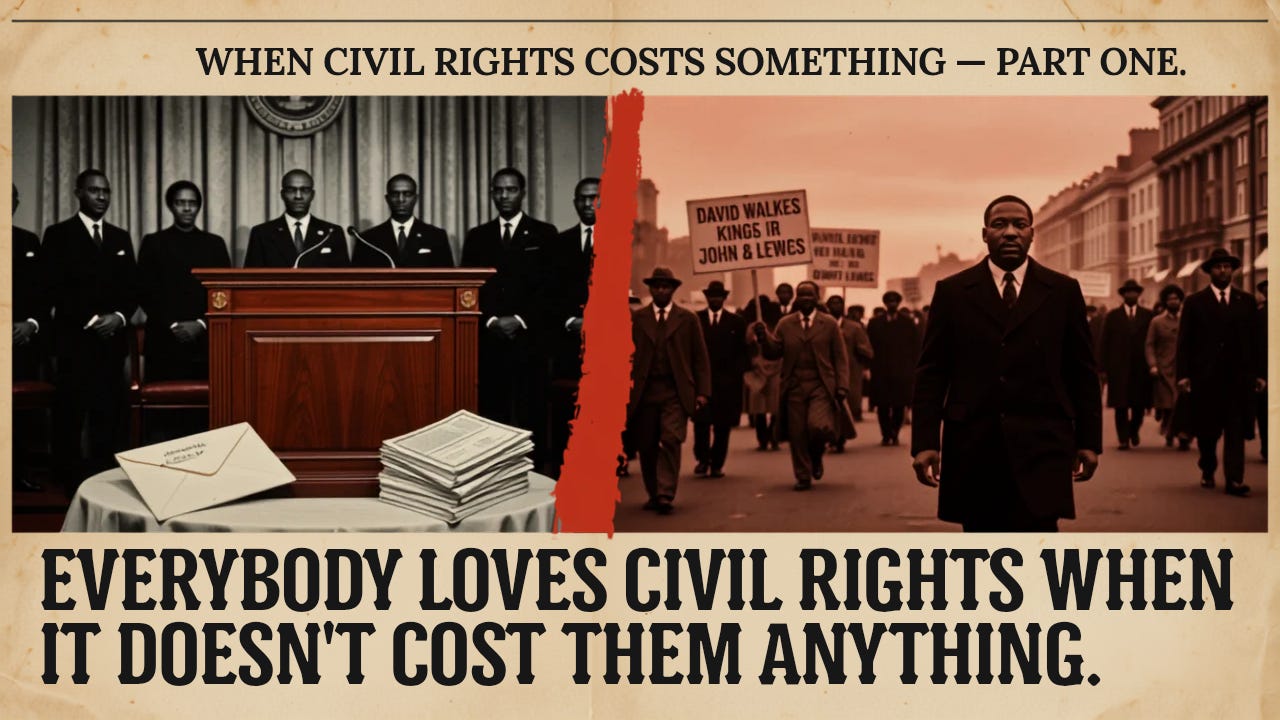
When advocacy stops at the edge of a paycheck, grant, contract or political relationship, the question is no longer what an organization says it believes. It is what it is willing to risk for those beliefs.
BLACK VANGUARD MEDIA | WHEN CIVIL RIGHTS COSTS SOMETHING — PART ONE
Everybody loves David Walker now.
Nearly two centuries after he published Appeal to the Coloured Citizens of the World, there is little professional danger in calling Walker courageous. Thomas Jefferson is dead. Slavery is illegal. Nobody is going to cancel a corporate contract because someone says Black people were right to resist enslavement.
History has made Walker safe.
The same thing has happened to Martin Luther King Jr., John Lewis, Ralph Abernathy and many of the people who confronted American racism when doing so was anything but safe.
Their words appear on social media. Their photographs hang in government buildings. Their names are invoked at banquets and commemorations. “Good trouble” fits comfortably on a T-shirt. King’s words appear in corporate statements every January.
But there is a difference between celebrating courageous people and following their example.
The people we quote today often spoke when speaking could cost them something.
That is the part of the story we have become dangerously comfortable forgetting.
Courage Before the Applause
David Walker did not write his Appeal after America reached a consensus that slavery was evil. He published it in 1829.
Walker attacked slavery, challenged Thomas Jefferson’s assertions about Black inferiority, condemned the corruption of Christianity by slaveholders, rejected colonization and insisted that Black people possessed the right to resist oppression.
Southern authorities regarded the pamphlet as dangerous. Efforts were made to prevent its circulation. Walker was not operating inside an environment designed to reward his activism.
He spoke anyway.
King did not lead from the comfort of universal approval either. He was arrested. His home was bombed. He was surveilled by the federal government. By the later years of his life, his opposition to the Vietnam War and his increasing attention to economic inequality strained relationships with political allies and parts of the broader public.
John Lewis was beaten during the Freedom Rides and suffered a fractured skull on Bloody Sunday in Selma. Ralph Abernathy was arrested repeatedly. His home and church were bombed during the Montgomery Bus Boycott.
These were not ceremonial civil-rights leaders.
They confronted power when power could answer back.
That distinction matters because modern America has developed an extraordinary ability to celebrate yesterday’s dissent while becoming uncomfortable with today’s.
Civil Rights Was Never Just a Profession
The civil-rights movement had organizations, paid staff, fundraising operations and institutional leadership. Movements require infrastructure.
But civil rights was never merely a profession.
Thousands of people who made the movement possible were not being paid to participate. People boycotted buses while still needing to get to work. Students sat at lunch counters without receiving stipends. Families housed organizers. Churches provided meeting space. Business owners contributed money. Volunteers registered voters. Ordinary people marched knowing they could be arrested, fired, threatened or assaulted.
They did not first ask whether advocacy was included in their job description.
They understood that citizenship sometimes creates responsibilities for which nobody sends a paycheck.
There is nothing inherently wrong with being paid to do civil-rights work. Professional organizations need employees. Research costs money. Lawyers, organizers and policy experts deserve compensation.
The problem begins when preserving the institution becomes more important than confronting the injustice the institution was created to address.
When the Funder Becomes the Boundary
Modern advocacy operates inside an enormous ecosystem of foundations, corporations, government grants, nonprofit contracts, political relationships and institutional partnerships.
Much of that money supports valuable work.
But money also creates incentives.
An organization can learn, without anyone ever issuing an explicit command, which subjects are safe to discuss. It can learn which public officials should not be challenged too aggressively, which corporations should not be embarrassed and which institutions control access to grants, contracts, appointments and invitations.
Eventually an organization can become very sophisticated at talking about injustice without confronting the people or systems capable of changing it.
That is where an uncomfortable question has to be asked:
What happens when the institution financing your advocacy also benefits from the conditions you are supposed to challenge?
The answer is not automatically corruption. Nor does every grant compromise every recipient.
The test is simpler.
Can you still tell the truth about the funder? Can you publicly challenge the institution writing the check? Can you demand measurable results? Can you say its policies are failing when the evidence says they are failing? Can you continue the fight if the money disappears?
If the answer is no, the funding relationship may have become something more than support.
It may have become a boundary.
The Paycheck Has Become an Excuse
There is a sentence heard frequently when something is clearly wrong:
“I agree, but I can’t say anything. I could lose my job.”
That fear is real.
People have mortgages. Children need food. Health insurance matters. Careers can be damaged. Retaliation exists. Telling people to behave recklessly with their livelihoods is not leadership.
But neither is pretending silence has no consequences.
Every generation inherits conditions the previous generation either confronted or tolerated.
When someone says, “I have children, so I cannot risk my job,” that deserves understanding. But there is another question that deserves equal consideration:
What will those children inherit if nobody challenges the system?
Protecting today’s paycheck while leaving tomorrow’s inequality untouched is not necessarily protection. Sometimes it is simply transferring the bill to the next generation.
Our children can inherit our property, our businesses and our savings.
They can also inherit the problems we were too afraid to confront.
The Comfort of Performative Civil Rights
Performative civil rights is easy to recognize once we stop listening exclusively to words.
It is loudest when the position is universally accepted.
It condemns injustice safely in the distance while negotiating quietly with injustice nearby.
It celebrates historical figures who challenged power while maintaining exceptionally comfortable relationships with present-day power.
It produces statements, panels, conferences, commemorations and slogans.
But when the issue reaches a grant, a government contract, an influential employer, a political ally or a major donor, suddenly everyone becomes interested in patience, diplomacy and timing.
That does not mean diplomacy is wrong. It does not mean every disagreement requires a press conference.
It means the standard cannot be whether advocacy makes powerful people comfortable.
King addressed precisely this problem in his Letter from Birmingham Jail. Some of his most important criticism was directed toward people who claimed to agree with the goal of equality but continually objected to the timing and methods required to achieve it.
They preferred order to disruption. They wanted justice, but they wanted it later.
History has been much kinder to King than many of his contemporaries were.
That should tell us something.
Good Trouble Is Supposed to Cause Trouble
John Lewis’s phrase “good trouble” has become part of the American civic vocabulary.
But we have managed to make even trouble comfortable.
Real good trouble interferes with something. It challenges an arrangement somebody benefits from. It creates pressure where polite requests have failed. It risks relationships.
If nobody with power is ever uncomfortable, nothing important is ever threatened and every institution funding the work remains perfectly pleased with the advocacy, it is reasonable to ask how much trouble is actually occurring.
Lewis did not cross the Edmund Pettus Bridge because crossing it was institutionally approved.
People crossed because the existing institutions were failing them.
That is the difference between commemorating a movement and becoming one.
Courage Does Not Mean Recklessness
None of this requires people to deliberately get themselves fired.
Movements need strategy as much as courage.
People occupy different positions and have different levels of vulnerability. Someone may be able to speak publicly. Someone else may document what is happening. Another person may provide resources. A business owner may finance advocacy. A lawyer may challenge a policy. A researcher may expose the numbers. A clergy member may use the pulpit. An employee may quietly provide information that allows others to ask the right questions.
Everybody does not have to take the same risk.
But everybody cannot use risk as the reason nobody does anything.
There is a difference between strategy and surrender.
Strategy asks: How can I contribute effectively given my position?
Surrender says: I agree with you, but I cannot do anything.
History was not made exclusively by people who had nothing to lose.
It was made repeatedly by people who decided something else was more important.
Who Are You Willing to Challenge?
The true test of civil-rights conviction is rarely whether someone can identify injustice committed by people they already oppose.
That is easy.
The harder test comes when the institution responsible for the disparity is politically aligned with you. When the person making the decision is your friend. When the government agency funds your program. When the corporation sponsors your banquet. When the foundation pays your staff. When speaking plainly could cost access to the room.
That is when principles become measurable.
Civil rights cannot simply mean challenging the other political party, another city, another state or another administration.
Equity does not become less important because the people failing to produce it are people we like.
The standard has to survive our relationships.
The Example We Keep Quoting
David Walker did not know that people would still be discussing his Appeal almost 200 years later.
King did not know streets across America would eventually bear his name. Lewis could not have known that “good trouble” would become a celebrated national phrase. Abernathy did not endure bombings and arrests because he expected history to reward him.
They acted before history made their positions comfortable.
That may be the most important part of their example.
We should stop asking whether we admire their courage. Of course we do.
Courage is easy to admire once somebody else has already paid its price.
The better question is what happens when our moment arrives.
When the facts are uncomfortable. When the institution is powerful. When the relationship matters. When funding could be threatened. When our friends tell us to quiet down. When everybody is not with us. When there is no guarantee that history will vindicate us.
Will we still speak?
Or will another generation inherit what we were afraid to confront?
David Walker did not wait for America to agree with him. Neither did King. Neither did Lewis. Neither did Abernathy.
They understood something that cannot be reduced to a slogan:
Civil rights has never been measured by what people are willing to say when saying it is safe.
It is measured by what they are willing to stand for when standing for it costs something.
Sources & Further Reading
David Walker, Appeal to the Coloured Citizens of the World — Library of Congress
David Walker — National Park Service
Letter from Birmingham Jail — The Martin Luther King, Jr. Research and Education Institute, Stanford University
John Lewis — U.S. House of Representatives: History, Art & Archives