

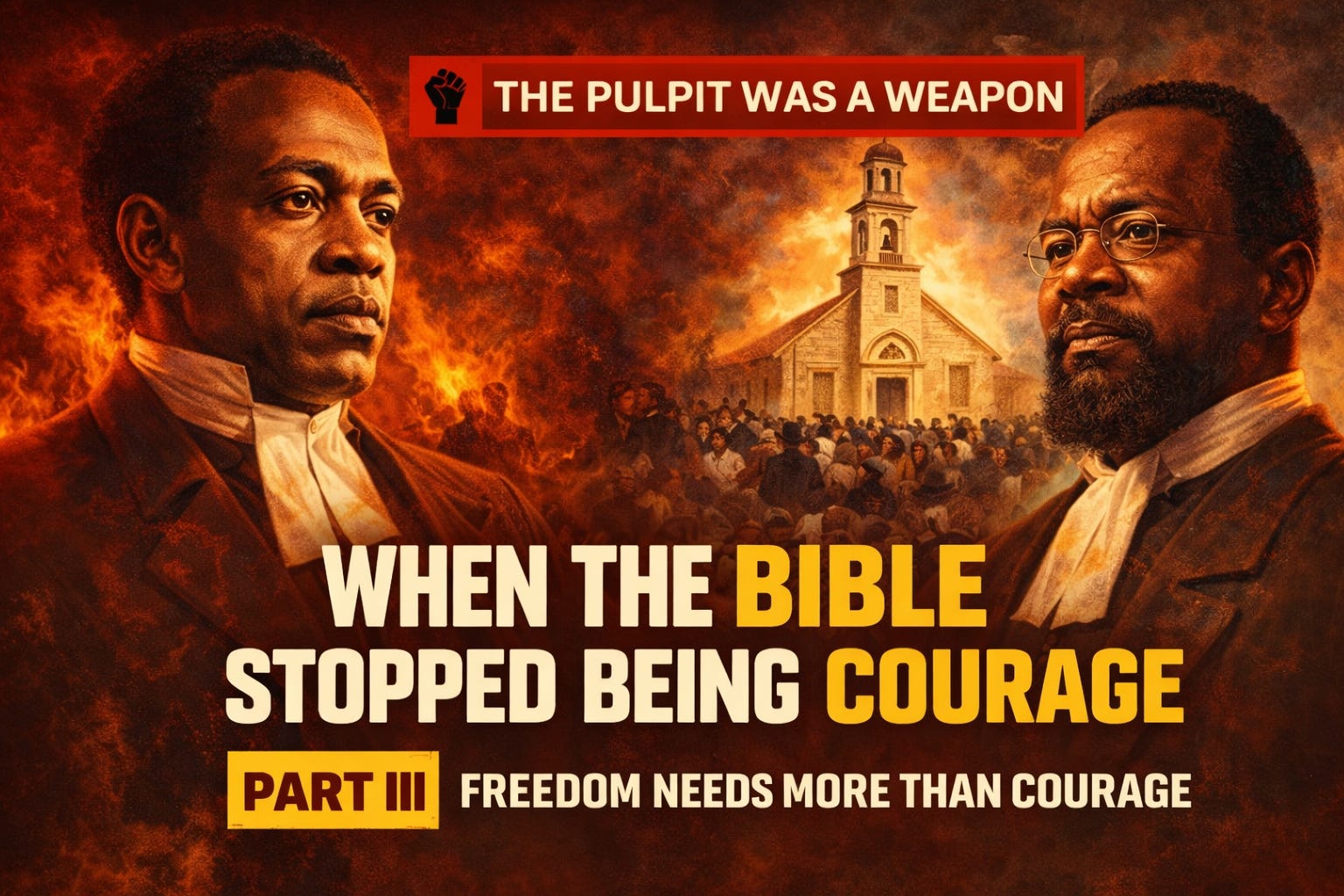
Courage is loud.
But it is not durable.
History loves moments of fire—rebellions, marches, speeches, martyrdom. What it talks about less is what happens after the fire dies down. Because courage can break chains, but it can’t always build what comes next.
That lesson sits at the center of Black liberation history.
---
The Limits of Uprising
Revolts terrified slave societies for a reason. They exposed fragility. They proved oppression wasn’t accepted—it was enforced.
But uprisings had a problem:
They could be crushed.
Leaders could be killed.
Participants could be scattered.
Memory could be erased.
Courage created disruption.
But institutions created continuity.
And a handful of pastors understood that freedom without structure was temporary.
---
Richard Allen: Building What Couldn’t Be Burned
Richard Allen didn’t lead a rebellion.
He led a withdrawal.
When Black worshippers were humiliated inside white-controlled churches, Allen didn’t call for violence. He called for exit—and then construction.
The African Methodist Episcopal Church was more than a denomination. It was a parallel system.
It produced:
Independent leadership
Education and literacy
Mutual aid
Political coordination
And most importantly, it produced ownership.
Allen understood a truth that still applies:
> If you don’t control the institution, you don’t control the outcome.
The AME Church survived because it wasn’t dependent on the approval of those it challenged.
---
Henry McNeal Turner: Power Without Apology
If Allen built the foundation, Henry McNeal Turner refused to soften it.
Turner was a bishop, a Union Army chaplain, and one of the first Black men elected to the Georgia legislature after the Civil War. He believed Black people were entitled to full humanity—without permission.
When white supremacy reasserted itself after Reconstruction, Turner didn’t pretend compromise would save Black life. He rejected respectability theology outright.
His declaration—“God is a Negro”—wasn’t provocation for its own sake. It was a direct assault on white supremacist religion.
Turner understood that institutions must do more than exist.
They must defend dignity.
---
The Tension We Don’t Like to Name
Here’s the uncomfortable truth:
Rebellion exposes injustice
Institutions determine whether justice lasts
Both are necessary.
But they are not the same.
History shows us a pattern:
Fire creates opportunity
Structure determines survival
Without institutions, victories evaporate.
Without courage, institutions rot.
---
Why This Still Matters
Many modern institutions trace their roots to liberation-era courage. But somewhere along the way, survival turned into containment.
Institutions began prioritizing:
Stability over leverage
Funding over autonomy
Access over accountability
What was built to protect freedom slowly learned how to manage it instead.
That shift didn’t happen overnight.
It happened quietly.
---
The Question That Can’t Be Avoided
If our ancestors risked death to build institutions they could control—
> Why are so many of today’s institutions afraid to risk comfort to defend the people they serve?
That question isn’t theoretical.
It’s diagnostic.
---
What Comes Next
In Part IV, we’ll examine what happened when the pulpit entered the media age—when cameras, headlines, and national visibility reshaped how pastors wielded power, and whether that visibility expanded liberation or subtly constrained it.
Part IV: When the Pulpit Learned How to Use Cameras