

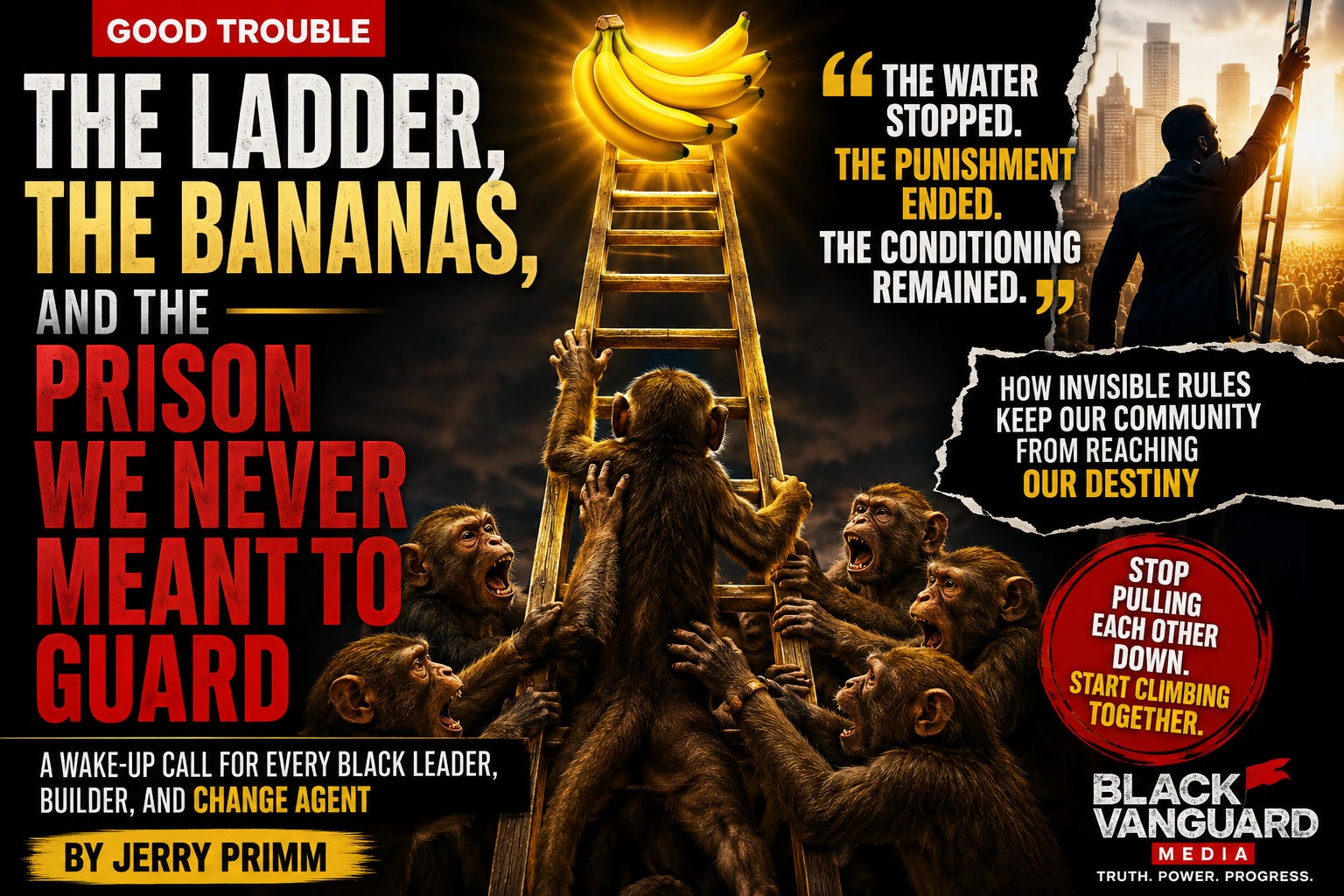
There is an old story about five monkeys, a ladder, and a bunch of bananas.
Whether the story actually happened exactly as it is told has never interested me very much.
The principle has.
The story begins with five monkeys placed in a room. In the center of the room stands a ladder. Hanging from the top of that ladder is a bunch of ripe bananas.
Naturally, one of the monkeys begins climbing toward the bananas.
Before he can reach them, every monkey in the room is sprayed with freezing cold water.
Again, another monkey tries.
Again, all five monkeys are sprayed.
It doesn’t take long before none of the monkeys wants to climb the ladder.
But something even more interesting begins to happen.
Whenever one monkey attempts to climb, the other four attack him.
They pull him down.
They beat him.
They make sure he never reaches the bananas.
Eventually, the cold water is no longer necessary.
The monkeys have become their own prison guards.
Then the story takes another turn.
One monkey is removed and replaced with a new one.
The new monkey sees the bananas and immediately begins climbing the ladder.
Before he gets very far, the other monkeys attack him.
Confused, he tries again.
Again, they pull him down.
Eventually, he learns not to climb.
Not because he understands why.
Simply because that is what everyone else does.
One by one, every original monkey is replaced.
Eventually, there is not a single monkey left in the room that has ever experienced the cold water.
Yet every one of them continues attacking anyone who reaches for the bananas.
No one remembers why.
No one questions why.
They simply know:
“Around here… we don’t climb ladders.”
I have thought about that story for years.
Not because it reminds me of monkeys.
Because it reminds me of people.
More specifically…
It reminds me of us.
Every community has dreams hanging just above its reach.
Economic ownership.
Political influence.
Institutional strength.
Business development.
Land ownership.
Generational wealth.
Educational excellence.
Independent media.
Financial freedom.
Healthy neighborhoods.
These are our bananas.
Yet every time someone begins climbing toward one of them, something familiar often happens.
Someone says…
“Slow down.”
“Who do they think they are?”
“That’s not how we’ve always done it.”
“They’re trying to get too much attention.”
“They’re going to mess everything up.”
Sometimes the criticism is legitimate.
Many times it isn’t.
Sometimes we don’t even stop long enough to ask.
We simply react.
What if we have inherited reactions that no longer serve us?
What if we have become so accustomed to seeing bold leadership punished that punishment now feels normal?
What if generations of disappointment have conditioned us to distrust anyone who believes something better is possible?
Those are uncomfortable questions.
But uncomfortable questions are exactly what progress requires.
History gives us countless examples.
Frederick Douglass was criticized for speaking too boldly.
Ida B. Wells was told to stop exposing uncomfortable truths.
Madam C. J. Walker was doubted before she became one of America’s first self-made female millionaires.
Dr. Martin Luther King Jr. was deeply unpopular with much of the American public during his lifetime. Even many who agreed with his goals criticized his methods, his timing, or his willingness to create tension.
Today we celebrate them.
Yesterday many people questioned them.
That pattern should make us pause.
This is not an argument against accountability.
Let me be perfectly clear.
Communities need accountability.
Leaders should be transparent.
Organizations should be examined.
Money should be tracked.
Power should always answer to principle.
Accountability builds trust.
Blind opposition destroys it.
There is a difference.
One protects the community.
The other protects conditioning.
Conditioning is powerful.
It teaches people to fear what once hurt them.
Eventually, they stop asking whether the danger still exists.
They simply avoid it.
Even worse…
They teach others to avoid it too.
That is how cultures develop invisible boundaries.
Nobody remembers who built the fence.
They only remember not to cross it.
For generations, Black America has survived extraordinary obstacles.
Segregation.
Redlining.
Economic exclusion.
Political disenfranchisement.
Unequal education.
Employment discrimination.
Those experiences leave scars.
Scars can become wisdom.
But scars can also become limitations when we stop distinguishing between yesterday’s dangers and today’s opportunities.
Sometimes survival teaches caution.
Sometimes it teaches fear.
Sometimes it teaches both.
The challenge is knowing the difference.
There is another lesson hidden inside the monkey story.
The cold water eventually stopped.
Think about that.
The punishment ended.
The conditioning remained.
How many opportunities exist today that previous generations never had?
How many doors have opened that we refuse to walk through because we were taught those doors were never meant for us?
How many businesses never begin?
How many partnerships never happen?
How many leaders quietly shrink themselves because they have watched what happens to people who stand too tall?
Those questions deserve honest answers.
The greatest obstacle to progress is not always opposition.
Sometimes it is expectation.
Sometimes people expect failure before success has even been attempted.
Sometimes they expect betrayal before trust has been earned.
Sometimes they expect disappointment because disappointment has become familiar.
Expectation shapes behavior.
Behavior shapes culture.
Culture shapes destiny.
Imagine what would happen if we became known as the community that encouraged builders instead of doubting them.
Imagine if our first instinct was mentorship instead of suspicion.
Imagine if innovation was met with curiosity instead of criticism.
Imagine if collaboration became more valuable than competition.
Imagine if every young entrepreneur, nonprofit leader, educator, investor, artist, developer, pastor, and civic leader knew that when they reached for something greater, their community would steady the ladder instead of shaking it.
That would change everything.
Perhaps the greatest tragedy of the monkey story is not that the bananas remained untouched.
The tragedy is that the monkeys became the guards of a prison they did not build.
That is a sobering thought.
Because every generation must decide whether it will inherit the fears of the previous generation…
…or the courage to question them.
The future of Black America will not be determined solely by the barriers placed in front of us.
It will also be determined by whether we continue enforcing barriers that no longer belong there.
The next time someone reaches for a bigger vision…
The next time someone proposes a different solution…
The next time someone dares to build something our community has never seen before…
Pause before pulling them off the ladder.
Ask a different question.
Has the water already stopped?
Because if it has…
Then perhaps it is finally time for all of us to climb together.
About the Author
With a career dedicated to expanding opportunity, strengthening community institutions, and reshaping how capital flows into overlooked neighborhoods, Jerry Primm brings a visionary, mission-centered voice to the work of economic empowerment. He believes deeply in the power of people, strategy, and intention—and in the possibility of building systems where resources align with purpose. His leadership reflects a simple but transformative conviction: when communities are equipped with the right tools and the right truth, they rise.
To reach Jerry Primm, call (216) 238-2235.
Great article today 👍🏿
I’d never heard that story. Learned something new on many fronts today. Thanks Jerry