

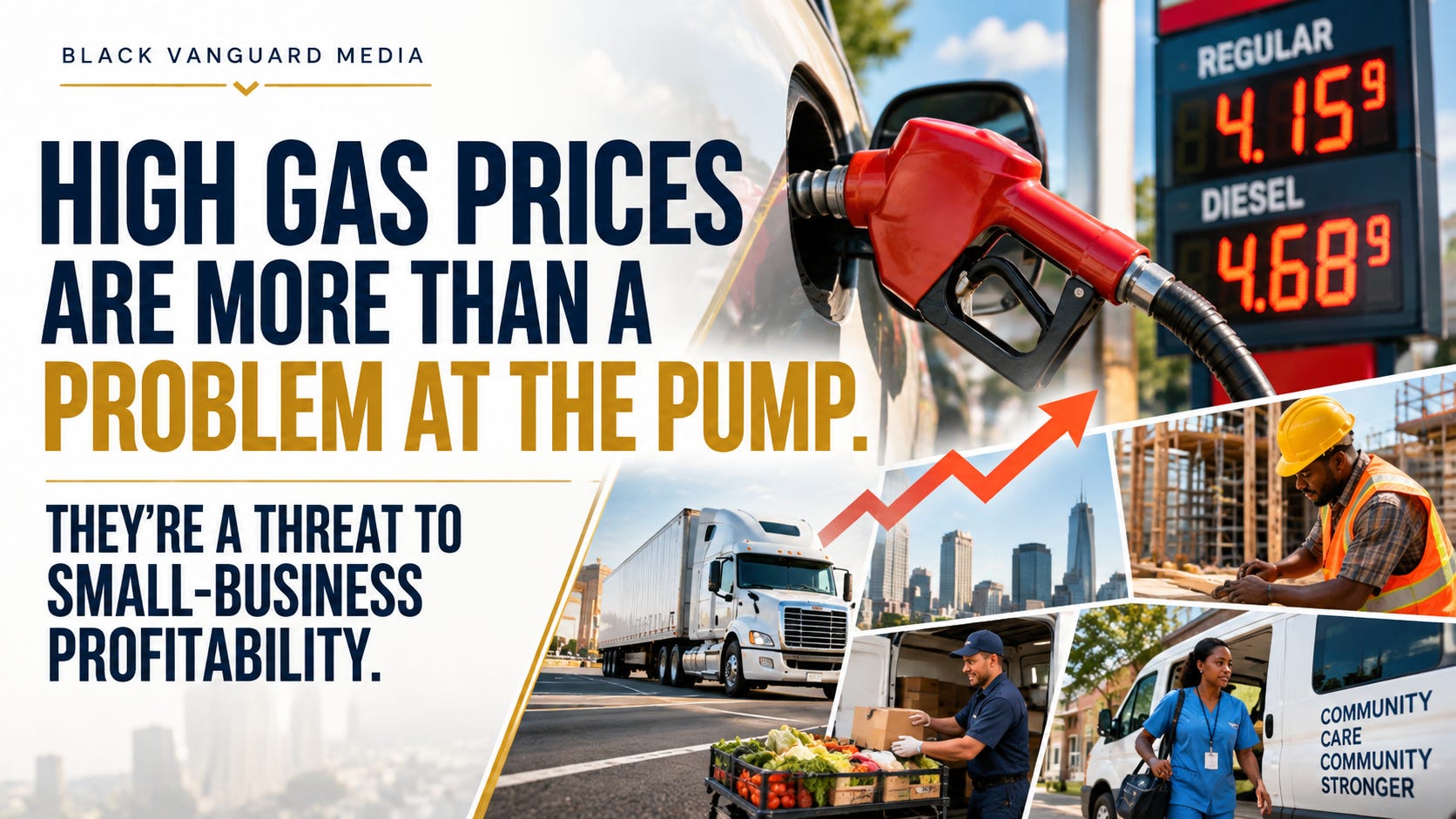
Rising fuel costs can squeeze transportation companies, contractors, healthcare providers and nonprofits even when their revenue is growing. The financial consequences extend well beyond the price displayed at gas stations.
WASHINGTON — For millions of Americans, rising gasoline prices mean spending more money to fill their vehicles. For businesses and nonprofit organizations that depend on transportation, the consequences can be considerably more complicated.
Fuel is not simply another monthly expense. It is a cost embedded in the delivery of products, construction services, medical care, food and community programs. When prices increase, businesses must either absorb the additional expense, charge customers more or find ways to operate more efficiently.
For smaller organizations with limited financial reserves, none of those options is necessarily easy.
The financial pressure can be particularly severe when fuel costs increase faster than the revenue businesses generate. A company may report higher sales, serve more customers and expand its operations while experiencing declining profitability.
That distinction is becoming increasingly important as business owners navigate volatile energy markets, financing costs and persistent pressure on operating budgets.
According to the U.S. Energy Information Administration, gasoline and diesel prices respond to several factors, including crude oil costs, refining capacity, distribution expenses, taxes and seasonal demand. Diesel prices are especially important to commercial transportation, agriculture, construction and freight distribution.
The agency’s weekly fuel-price reports provide a benchmark for understanding those changes. But the impact on an individual organization depends on its vehicles, routes, fuel consumption and ability to pass costs along to customers.
A transportation company operating 10 vehicles that each consume 50 gallons of fuel weekly would purchase approximately 26,000 gallons annually. A 50-cent increase per gallon would add $13,000 to its annual fuel expenses, assuming consumption remained unchanged.
That expense would not necessarily be accompanied by an increase in revenue.
For businesses operating on narrow margins, even relatively modest changes in operating costs can have significant consequences.
Transportation and delivery companies are among the most directly exposed. Fuel is a recurring expense, and operators may have limited control over the distances their drivers travel.
Large freight companies often negotiate contracts that include fuel surcharges, allowing them to recover some additional costs. Smaller operators may have less bargaining power, particularly when competing for contracts with customers unwilling to accept higher prices.
Independent trucking companies and local delivery services can therefore face a difficult choice between increasing prices and protecting customer relationships.
Construction companies encounter similar pressures, although fuel expenses may be less visible in their financial statements.
Contractors use gasoline and diesel to transport workers, move equipment, operate machinery and deliver building materials. Higher transportation expenses can also be reflected in prices charged by suppliers.
For contractors working under fixed-price agreements, unexpected fuel increases may reduce projected profits unless contracts include provisions allowing adjustments.
The consequences can be especially difficult for smaller construction firms that lack substantial cash reserves or the ability to negotiate favorable purchasing arrangements.
Food distribution represents another area of vulnerability.
Grocers, restaurants, caterers and food-service suppliers depend on transportation networks that move products from farms and warehouses to stores, institutions and consumers.
Higher diesel prices can increase distribution costs, although the extent to which those increases reach consumers depends on competition, contracts and other market conditions.
For businesses selling products with limited profit margins, absorbing additional delivery expenses may be difficult.
The pressure can extend to organizations providing meals to seniors, children and households experiencing food insecurity.
Unlike commercial distributors, nonprofit meal programs may depend on grants, donations and government reimbursements that do not automatically increase when fuel becomes more expensive.
Home healthcare providers face a related challenge.
Their employees frequently travel between patients, sometimes covering substantial distances in a single workday. Organizations may reimburse workers for mileage or operate vehicles directly.
When transportation expenses rise, providers must decide how to manage those costs without reducing service availability or placing additional financial pressure on employees.
For organizations serving rural communities or patients with limited transportation options, reducing travel may not be practical.
The financial impact also reaches nonprofits operating passenger vans, mobile service units and other vehicle fleets.
Community organizations providing senior transportation, youth programming, workforce services and medical outreach may face higher costs without an immediate increase in funding.
A nonprofit operating five vehicles that each consume 40 gallons weekly would purchase approximately 10,400 gallons annually. A 75-cent increase per gallon would add $7,800 in annual fuel costs, assuming usage remained constant.
For an organization with a substantial operating budget, that amount might be manageable. For a smaller institution with little unrestricted funding, it could represent money otherwise available for staffing, equipment or direct services.
The broader economic consequences are not always immediate.
Research on energy-price shocks has found that higher oil and fuel costs can affect inflation, consumer spending and economic activity. The Federal Reserve has also examined how energy prices influence business costs and inflation expectations.
However, not every increase in gasoline prices produces the same economic outcome. The effects depend on how long prices remain elevated, whether businesses can adjust and what is happening elsewhere in the economy.
Some companies may offset higher expenses through improved routing, more efficient vehicles, fuel purchasing arrangements or adjustments to pricing.
Others may have limited flexibility because their contracts, service obligations or operating geography determine how much transportation they require.
The central financial issue is the relationship between revenue and expenses.
Consider a business generating $1 million annually with $950,000 in operating expenses. Its operating surplus would be $50,000 before considering any additional costs not included in that figure.
If expenses increased by $30,000 without a corresponding revenue increase, that surplus would fall to $20,000.
Even if the business increased annual revenue by $20,000, its surplus would still decline to $40,000 if expenses rose by $30,000.
The example illustrates why revenue growth alone does not establish that an organization is becoming financially stronger.
For businesses considering expansion, rising fuel expenses can also affect borrowing decisions.
Lenders generally evaluate cash flow, existing debt obligations and the ability to repay additional financing. An organization whose operating costs are increasing faster than income may have less capacity to support new debt, even if its customer base is expanding.
That does not mean higher fuel prices automatically prevent companies from obtaining financing. It means operating-cost assumptions can influence whether proposed investments remain financially sustainable.
Organizations with reliable financial reporting can identify those pressures earlier, evaluate their options and determine whether planned expansion remains feasible.
Those without timely information may discover declining profitability only after financial reserves have already been reduced.
Higher fuel prices are therefore more than a transportation issue. They can become a test of pricing power, contract management, operating efficiency and financial preparedness.
For small businesses and community institutions, the challenge is not simply determining how much more they will spend at the pump.
It is determining whether their revenue, reserves and financing arrangements can withstand higher operating costs without undermining the services and economic activity they were established to provide.