

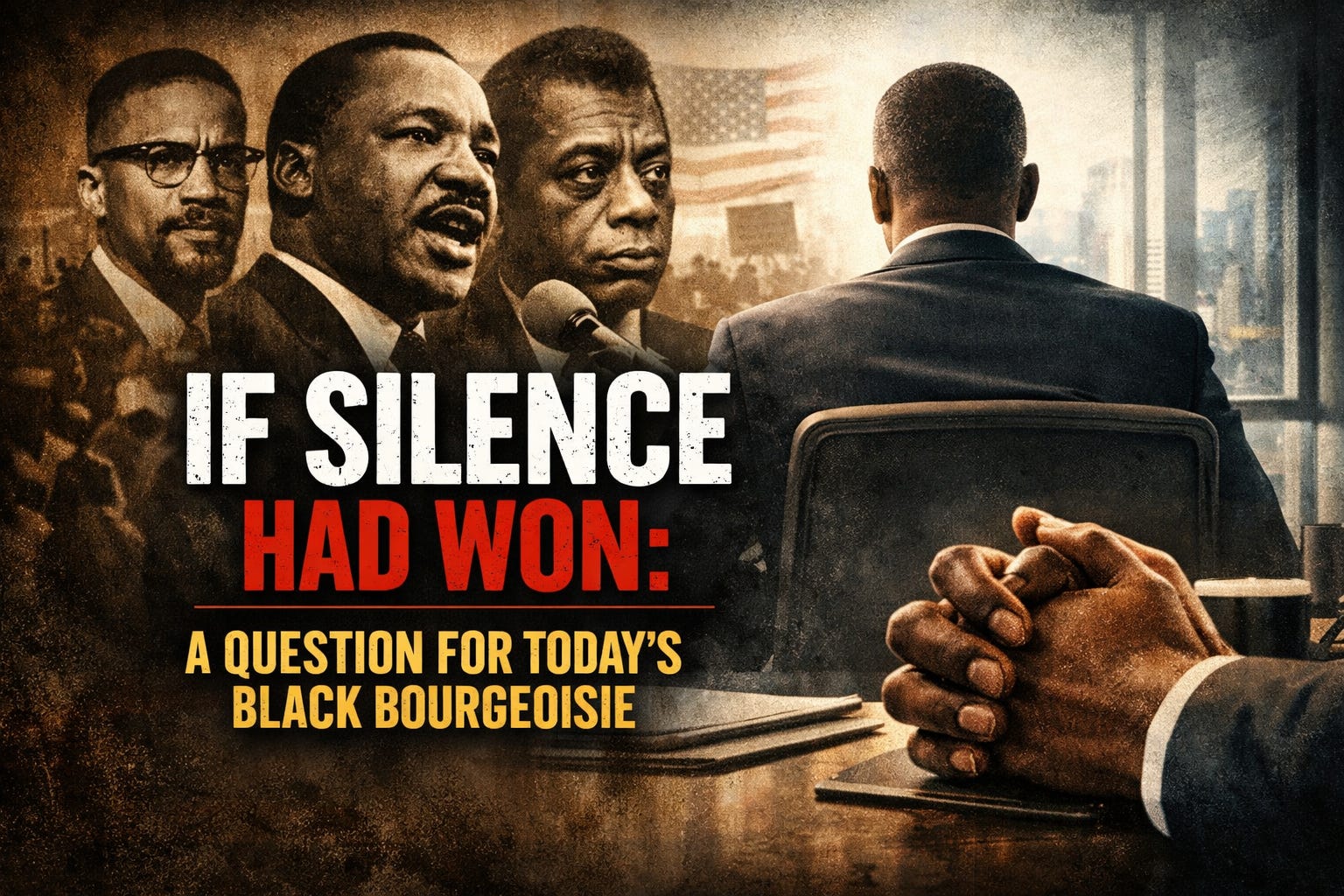
Imagine a world where there was:
No Dr. Martin Luther King Jr. to stand up against injustice…
No James Baldwin to articulate the pain of Black America…
No Malcolm X to inspire generations to stand up for themselves…
No Black bourgeoisie, unwilling to make white people uncomfortable, unwilling to risk their jobs—
choosing silence instead.
Now imagine if you were today’s Black bourgeoisie…
If Silence Had Won: A Question for Today’s Black Bourgeoisie
Now pause.
That world doesn’t exist because people were brave enough to be uncomfortable—and brave enough to make others uncomfortable too.
But history has a quieter counterfactual we rarely examine.
What if the people with education, access, proximity to power, and “something to lose” had won the argument instead?
What if caution beat courage?
What if career preservation overruled moral clarity?
What if respectability was chosen over responsibility?
Because that version of history has a name too: silence.
And silence has never been neutral.
History has a name for this posture.
It calls it complicity.
The Forgotten Role of the Comfortable
There is an inconvenient truth we don’t like to name:
Every era has its heroes—but it also has its buffer class.
The people who didn’t necessarily oppose justice, but didn’t advance it either.
The people who said, “I agree, but…”
The people who believed the message was right, but the timing, tone, or delivery was wrong.
The people who feared rocking the boat more than they feared the water rising.
Not plantation overseers.
Not lynch mobs.
But the educated, employed, credentialed, well-spoken class who understood the problem clearly—and chose silence anyway.
They weren’t villains in the traditional sense.
They were something more dangerous.
They were comfortable.
Respectability as a Restraining Order
We often celebrate the civil rights era without interrogating the internal resistance that came from within the Black community itself.
King was called reckless.
Baldwin was called too angry.
Malcolm X was called extreme.
And many of those critiques didn’t come from white America alone.
They came from Black professionals worried about grants, donors, jobs, invitations, and access.
They came from people who believed progress had to be palatable to be permissible.
What we rarely admit is this:
If respectability politics had prevailed, we would be quoting no one today.
Because history doesn’t move forward by asking permission from comfort.
Now Turn the Mirror Around
Now imagine this question isn’t about the past.
Imagine you are today’s Black bourgeoisie.
Not wealthy in the caricatured sense—but stable.
Educated.
Insulated.
Adjacent to power.
Able to absorb injustice without feeling its full force.
Ask yourself, honestly:
Where do I soften my words so others won’t feel accused?
Where do I stay silent so I don’t risk access?
Where do I confuse strategy with avoidance?
Where do I call in private what I refuse to challenge in public?
And most importantly:
If I were alive then, would I have been urging King to slow down?
Would I have told Baldwin to be less sharp?
Would I have dismissed Malcolm X as “bad for the cause”?
If the answer unsettles you—that’s the point.
The Question History Will Ask
History does not remember who was liked.
It remembers who was necessary.
It does not ask whether your stance was understandable.
It asks whether it was useful.
And one day, future generations will not ask what you believed privately.
They will ask what you were willing to risk publicly.
This is not a call for performative outrage.
It is a call for alignment.
Because the most dangerous position in any struggle is not opposition—it is comfortable neutrality.
And the most haunting question of all is this:
If silence had won before…
Would you be proud of the role you played?
Jerry Primm is the founder of Black Vanguard Media and a longtime advocate for accountability, economic empowerment, and truth-telling within Black leadership and institutions. His work challenges comfort where it competes with conscience.