

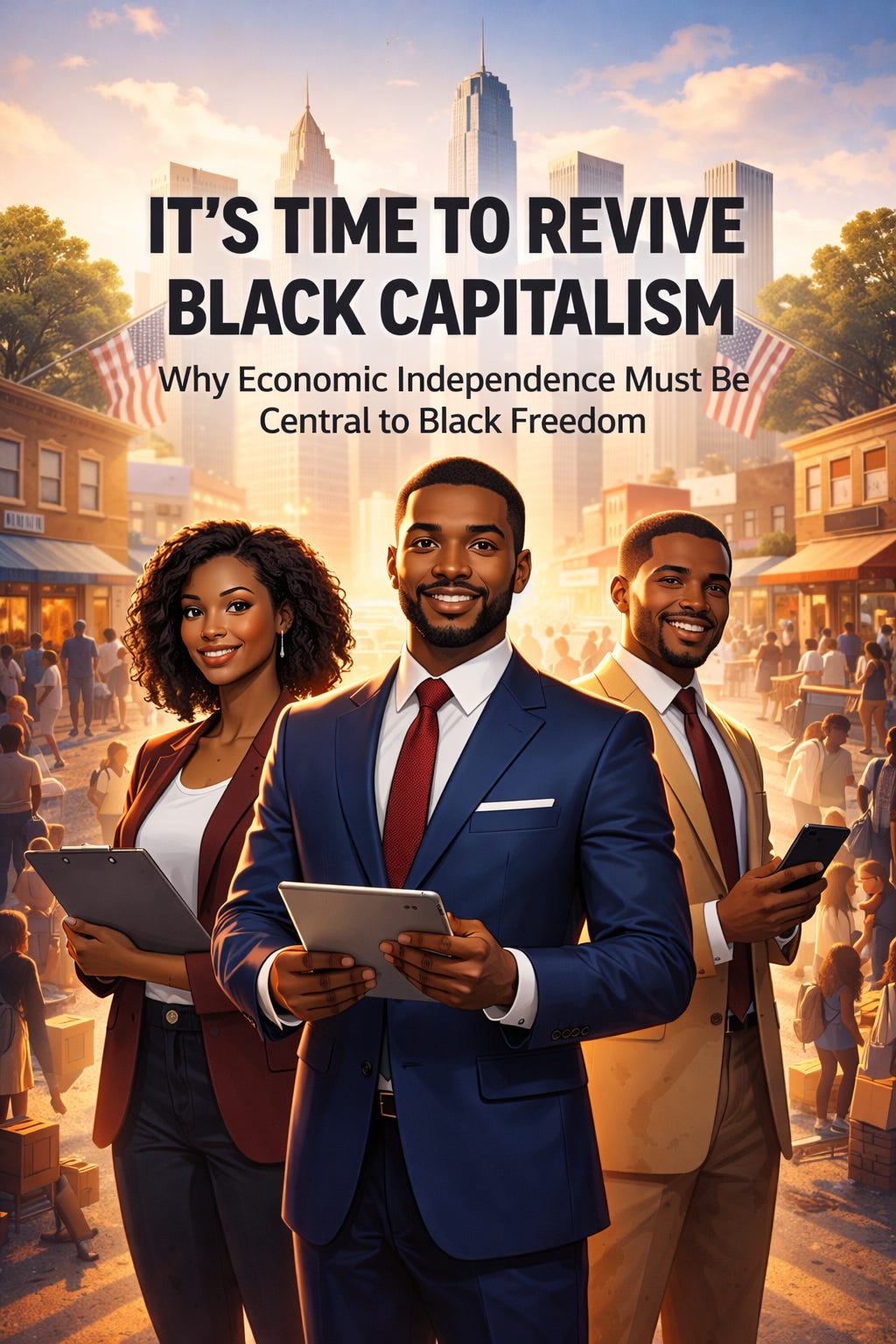
When it comes to the struggle for equality, it is time to confront a truth too many in our national conversation have avoided: economic freedom matters just as much as political freedom, and the most reliable path to both for Black Americans lies in engaging — not rejecting — the capitalist system that defines this country.
Too often today, discussions about Black progress tilt toward critiques of capitalism or romanticized calls for socialism. But telling Black Americans to be something other than capitalists in a nation governed by capital is not bold — it is strategically self-defeating. In a country where capital allocates opportunity, influences policy, and creates generational wealth, withdrawing from that system guarantees continued economic marginalization.
This is why we must revive the idea of Black capitalism — not as an abstract slogan but as a practical economic philosophy rooted in history and purpose.
Black capitalism is not a new or radical concept. Its roots stretch back well before the Civil Rights era. Free Black communities operated skilled trades and businesses in northern cities before the Civil War. During Reconstruction, Black Americans briefly gained access to land ownership and enterprise before those gains were violently reversed. Institutions such as the Freedman’s Savings and Trust Company were created to help formerly enslaved people save and build wealth, even as systemic barriers limited their reach.
The modern concept gained national prominence in the late 1960s, when policymakers began arguing that civil rights had to include economic power — not just legal recognition. By the end of that decade, there were more than 160,000 Black-owned businesses in the United States, built despite discrimination in lending, zoning, and contracting. Long before that, figures like Madam C.J. Walker and communities such as Tulsa’s Greenwood District — often referred to as “Black Wall Street” — demonstrated what Black ownership could achieve when allowed to exist.
Critics have long dismissed Black capitalism as naïve or insufficient, arguing that markets alone cannot resolve racial inequality. That critique misses the point. Black capitalism was never about pretending inequality did not exist. It was about recognizing that economic power is the most durable form of leverage in American life — and that without ownership, political gains remain fragile.
America is a capitalist nation. Every major institution that shapes our daily lives — housing, technology, healthcare, media, transportation — operates within market dynamics. Rejecting that reality because the system is imperfect does not weaken it. It simply removes those who opt out from meaningful competition. Socialism may offer a critique of inequality, but it provides no realistic path for Black Americans to build sustainable wealth within the system that actually governs opportunity here.
Black capitalism insists on engagement rather than retreat. It prioritizes ownership, scale, and competition — not just within Black communities, but across the broader marketplace. That distinction matters. A business that only circulates money within a narrow customer base remains vulnerable. A business that serves everyone builds resilience, influence, and independence.
Today’s backlash against corporate diversity, equity, and inclusion programs — once seen as tools for breaking down barriers — underscores a deeper truth: representation without ownership has limits. DEI was never a substitute for Black economic participation; it was a supplement. As many institutions scale back DEI commitments, the market will continue. What matters now is not symbolic representation but capacity to compete.
That competition, however, requires access. You cannot compete without access to capital, credit, contracts, infrastructure, technology, and networks — areas where disparities persist. This is where advocacy must now be focused. Not on abandoning markets, but on demanding fair entry into them.
Black leadership in majority-Black cities has a critical role to play here. Cities like Atlanta, Charlotte, and Cleveland often operate under Black local leadership while existing within broader state political environments that require pragmatism and coalition-building. Economic development is not a partisan exercise. Permitting reform, procurement policy, workforce development, and access to financing are governance responsibilities, not ideological debates.
Activism remains important. Moral pressure has always helped open doors. But protest without production is incomplete. Economic activism — building businesses, creating jobs, generating tax base, and reinvesting in communities — is how progress becomes durable rather than symbolic.
Reviving Black capitalism is not about ideology or nostalgia. It is about power, ownership, and permanence. If Black America wants progress that cannot be rolled back, outsourced, or defunded, then building and competing in the marketplace is not optional — it is essential.
Darvio Morrow is CEO of The First Class Broadcasting Corporation and co-host of The Outlaws Radio Show
You are either the Owner or the Help
Be the Owner
Could not have said it better myself. I would just add that nothing is keeping Black Americans from participating and thriving in the free market. History has shown that we have indeed participated and thrived in the free market in this country for centuries. As long as you have a mind for an idea for which a market can be created and/or cultivated, you have an unfettered opportunity to bring that idea to profitable fruition. Will there be barriers and failures? Yes, but you can always evaluate your failures, make corrections and try again.