

CLEVELAND, Ohio — At some point, loyalty has to produce results.
For years, Black residents of Cuyahoga County have been encouraged to vote, organize, volunteer, contribute to campaigns and stand behind elected officials who promise to represent their interests. We have celebrated election victories, developed relationships with political leaders and measured our influence by our access to people in positions of power.
But there is another measure of political influence that deserves far more attention.
The money.
Who receives the government contracts? Who owns the businesses benefiting from public expenditures? Who gets the opportunity to build companies, employ workers and create generational wealth?
And perhaps most importantly, what happens when the evidence tells us that the economic benefits of our political relationships have not matched our loyalty?
Fourteen Years of Evidence. Three Studies. The Same Persistent Problem.
Cuyahoga County has commissioned three major disparity studies examining public contracting.
The first examined 2009 through 2012. The second examined 2014 through 2018. The latest, completed in October 2025, examined 2020 through 2024.
Together, they represent 14 years of documented contracting activity across a 16-year period.
The findings demand attention.
The first study found that minority-owned businesses received just 1.4% of the county’s combined prime and subcontracting awards between 2009 and 2012.
The 2020 study examined more than $1.1 billion in prime contracting expenditures. Only 0.59% went to minority-owned businesses, compared with 4.03% going to white woman-owned firms.
The 2025 study provides an even more revealing picture when Black-owned businesses are examined separately.
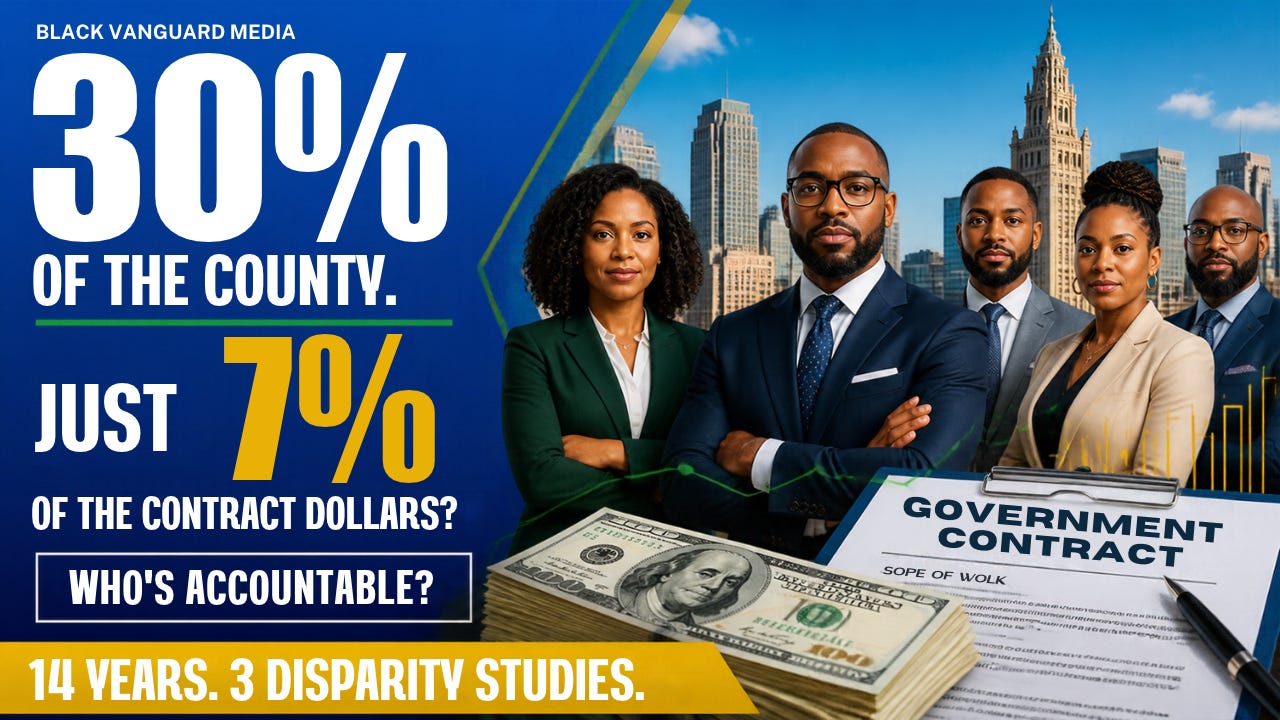
Black-owned firms received 7.01% of county prime and subcontracting dollars, despite an estimated availability of 15.92% for the contracts examined.
That means Black-owned firms received less than half the share of contracting dollars the study estimated they could have received in a level playing field.
These studies use different methodologies and contracting categories, so their percentages should not be treated as a direct year-by-year comparison. What they establish is the persistence of significant contracting disparities.
And this isn’t somebody’s political accusation.
These are findings from studies commissioned by Cuyahoga County itself.
Nearly 30% of the Population. Just 7% of the Contracting Dollars.
According to the U.S. Census Bureau, Black residents represent approximately 29.7% of Cuyahoga County’s population.
That population percentage is not, by itself, a contracting quota. Qualified business availability is the proper benchmark for evaluating procurement disparities.
But the demographic reality raises an important economic question.
How can a community representing nearly one-third of the county’s population continue to experience such substantial barriers to government contracting?
We must also stop allowing Black business participation to disappear inside statistics combining minority-owned and woman-owned businesses.
Black-owned businesses and white woman-owned businesses are not interchangeable economic categories. Both deserve fair treatment, but combining their contracting dollars can conceal substantially different outcomes.
The 2025 study found that white woman-owned firms received 11.94% of contracting dollars, compared with 7.01% for Black-owned firms. More importantly, the study identified a substantial disparity for Black-owned businesses but not for white woman-owned businesses.
That distinction matters.
Questions about ownership arrangements, affiliations between subcontractors and established prime contractors, and the potential use of pass-through businesses also deserve transparency and examination based on evidence.
If we want to understand Black economic participation, then we must measure Black economic participation.
Not everybody else’s numbers added to ours.
The County Has Already Demonstrated That Change Is Possible
Perhaps the most revealing evidence in the 2025 study concerns construction contracts.
When the county applied certain contracting equity programs, Black-owned businesses received 16.59% of the dollars, compared with an estimated availability of 17.89%.
When those programs were not applied, Black-owned businesses received just 3.73%, compared with an estimated availability of 16.31%.
Read those numbers again.
The disparity was dramatically smaller where the county applied its equity programs.
That doesn’t mean every contracting problem has been solved. It does demonstrate that available government measures can make a difference.
So the question becomes less about whether the county has tools to address inequity and more about how consistently and effectively those tools are being used.
There is a difference between lacking the ability to act and failing to produce the results that existing policies make possible.
The Semmelweis Reflex: When Loyalty Overpowers Evidence
In 1847, Hungarian physician Ignaz Semmelweis discovered that doctors could dramatically reduce deaths among women giving birth by disinfecting their hands.
Despite compelling evidence, many physicians rejected his findings because accepting them would require questioning their own established practices.
His experience gave rise to the term Semmelweis reflex: the tendency to reject new evidence because it contradicts long-held beliefs.
That concept deserves consideration in our political lives.
What happens when we have spent decades believing that our loyalty to certain political institutions guarantees they are working in our economic interests?
What happens when we are presented with documented evidence suggesting those institutions have not delivered the economic outcomes we expected?
Do we examine the evidence and reconsider our expectations?
Or do we defend the institutions because challenging them feels like challenging our own identity?
This is not an argument that every Black voter thinks alike or that loyalty to any particular political party is automatically misplaced.
It is an argument that political loyalty becomes dangerous to accountability when we refuse to question it in the face of contradictory evidence.
We should be able to respect an elected official, maintain a political relationship and still demand measurable results.
Loyalty should never require us to ignore the numbers.
The 2026 Election Has Changed the Political Equation
The November 2026 elections have created a new political environment.
Democrats won control of both chambers of Congress, with their majorities beginning in January 2027. President Donald Trump will remain in the White House, meaning federal executive policy will still be subject to political disagreement and legal constraints.
In Ohio, Democrat Amy Acton was elected governor. Republicans will retain control of the Ohio House and Senate, but their expected House majority is no longer large enough to override a gubernatorial veto without Democratic support.
And here in Cuyahoga County, Democrats will hold all 11 County Council seats beginning in 2027, following the defeat of the council’s last Republican member.
County Executive Chris Ronayne is also a Democrat.
These developments create an important opportunity to reconsider the relationship between political authority and economic outcomes.
We can no longer allow political arguments about Washington or Columbus to become blanket explanations for contracting disparities that were documented long before the current federal administration.
The first disparity study examined contracts awarded between 2009 and 2012. The problem existed long before the federal policy changes of recent years.
Federal and state laws still matter. But they do not erase the county’s responsibility to use the lawful economic tools and procurement policies available to it.
And with Democrats taking control of both congressional chambers, there will be new opportunities for federal legislative action, oversight and investment priorities.
The responsibility to produce results should become more visible, not less.
Political Access Is Not Economic Access
There is a fundamental difference between having access to elected officials and having access to economic opportunity.
A photograph with a governor does not build a business.
A meeting with a member of Congress does not automatically create employment.
An invitation to a political fundraiser does not produce a government contract.
And helping someone win an election does not, by itself, strengthen the economic foundation of a community.
Those relationships may be valuable. But their value should also be examined through what they make possible.
Cuyahoga County and its partners have access to economic-development tools involving small-business procurement, capital financing, workforce development, infrastructure investment and business expansion.
Federal programs such as New Markets Tax Credits and financing available through Community Development Financial Institutions can also help attract investment into underserved communities when appropriate projects and partners are assembled.
No single tool can eliminate decades of economic inequity. But these opportunities should be actively pursued, coordinated and measured.
The people we elect should be expected to help leverage those resources for meaningful economic outcomes.
And we should be asking about results, not merely relationships.
How many Black-owned businesses obtained county contracts? How much money did they receive? How many first-time contractors entered the market? How many businesses expanded? How many jobs and lasting economic assets were created?
Those are the questions that connect political power to economic impact.
This Is About Accountability, Not Party Switching
The point is not that Black voters should automatically abandon one political party for another.
No party deserves unconditional loyalty.
The question is whether our political relationships are producing the economic opportunities that our communities need.
For too long, the political conversation has focused on which candidates deserve our support, who receives endorsements, who attends our community meetings and who can deliver votes.
It is time to give equal attention to what happens after those candidates take office.
Government contracting is funded with public dollars. Those dollars should be administered fairly, transparently and in ways that provide qualified businesses with genuine opportunities to compete.
Where disparities exist, elected officials should be expected to explain what they are doing to eliminate the barriers and demonstrate whether their efforts are working.
We should not have to choose between political relationships and economic accountability.
We can insist on both.
Today, We Begin Measuring Political Success Differently
Three disparity studies. Fourteen years of contracting evidence. A documented history of unequal opportunity.
How much more evidence do we need before we change the way we measure political success?
We should not need another election, another campaign promise or another study to establish that this issue requires sustained attention.
Today should mark the beginning of a renewed standard of accountability in Cuyahoga County.
Every elected official, every political institution and every public agency with responsibility for economic opportunity should understand that the public will be watching the dollars.
Not just the speeches.
Not just the announcements.
Not just the meetings and promises.
The dollars. The contracts. The businesses. The jobs. The economic impact.
We have every reason to maintain relationships with people who represent us. But those relationships should never prevent us from confronting the evidence when outcomes fall short.
That is the lesson of the Semmelweis reflex.
Facts should be strong enough to challenge even our most comfortable political beliefs.
The measure of our political progress cannot remain simply how many elections we help win.
It must also include how much economic opportunity reaches the people and communities those victories were supposed to serve.
Starting today, let’s keep our eyes on the money.
And let’s hold everyone accountable.
Read the Evidence for Yourself
The following three Cuyahoga County disparity studies are publicly available or linked below so readers can examine the findings and draw their own conclusions.
2014 Cuyahoga County Disparity Study — Contracting activity from 2009–2012
2020 Cuyahoga County Disparity Study — Contracting activity from 2014–2018
2025 Cuyahoga County Disparity Study — Contracting activity from 2020–2024