

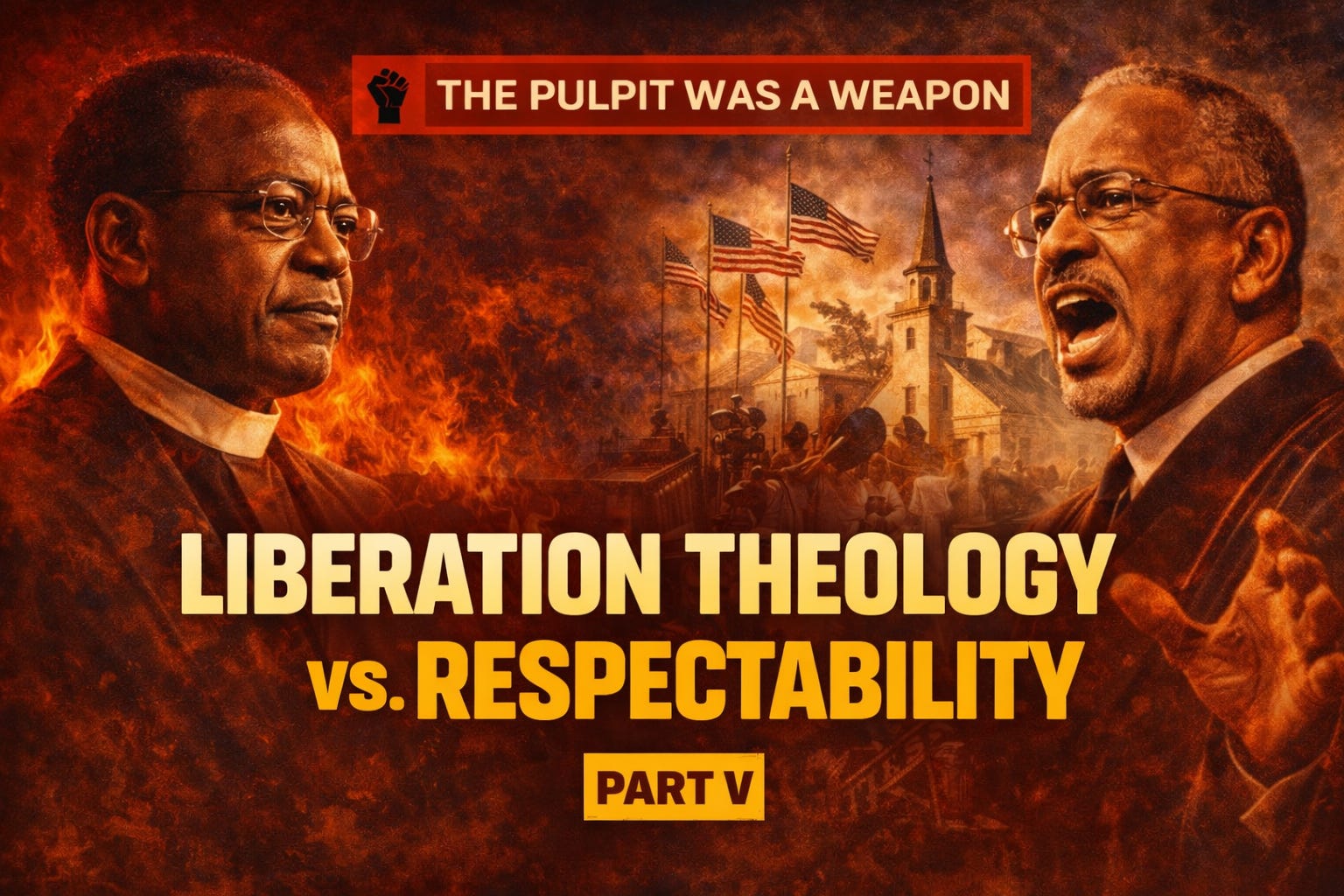
There is a line faith is allowed to cross—and one it isn’t.
You can pray for freedom.
You can march for justice.
You can even suffer publicly for righteousness.
But when faith begins to name systems, threaten economic arrangements, or challenge who God is assumed to belong to—that’s when trouble starts.
That’s where Black Liberation Theology lives.
And that’s why it was never meant to be comfortable.
When Theology Stopped Asking for Permission
For generations, Black churches preached survival. Endurance. Hope.
But in the late 20th century, a shift occurred. A group of theologians and pastors stopped asking how Black people could survive oppression—and started asking whether oppression itself was anti-Christian.
That question changed everything.
Because once oppression is named as sin, neutrality becomes impossible.
James Cone: God Was Never Neutral
James Cone didn’t write theology to be admired.
He wrote it to confront.
Cone argued something radical but historically obvious:
If God sides with the oppressed throughout scripture, then any theology that ignores Black suffering is false.
In Cone’s framing:
Jesus was not colorblind
The cross was a lynching tree
White supremacy was theological heresy
This wasn’t rhetoric. It was diagnosis.
And institutions responded the way they always do when power is named plainly:
They distanced themselves.
Cone was debated, dismissed, and marginalized—not because his work lacked rigor, but because it refused neutrality.
Jeremiah Wright: When the Line Was Crossed Publicly
Jeremiah Wright didn’t invent Black Liberation Theology.
He preached it where cameras could see.
At Trinity United Church of Christ in Chicago, Wright framed Christianity through the lived experience of Black America—slavery, segregation, state violence, and economic exclusion included.
For years, this was tolerated.
Until it wasn’t.
Once Wright’s sermons reached a national audience, the reaction was swift:
Context was stripped
Language was weaponized
Theology was reduced to soundbites
What frightened institutions wasn’t anger.
It was clarity.
Because Wright wasn’t criticizing individuals.
He was indicting systems—and doing so in God’s name.
That made him unmanageable.
Respectability: The Silent Enforcer
Respectability theology doesn’t announce itself.
It doesn’t shout.
It whispers.
It says:
“Now isn’t the right time.”
“Your tone is the problem.”
“We agree, but…”
It allows moral language without moral consequence.
And it has one unspoken rule:
You can critique injustice—so long as you don’t threaten access.
Liberation Theology threatens access by design.
Why This Was Always Going to Be a Fight
Liberation Theology asks questions institutions don’t want answered:
Who benefits from injustice?
Who funds silence?
Who decides which theology is acceptable?
Those questions don’t just unsettle pews.
They unsettle boards, donors, denominations, and political alliances.
That’s why Liberation Theology was labeled:
Divisive
Extreme
Un-American
Not because it was wrong—but because it was inconvenient.
The Cost of Making Faith “Acceptable”
When faith becomes respectable, it gains:
Platforms
Funding
Invitations
But it often loses:
Prophetic edge
Moral urgency
Accountability to the oppressed
The pulpit becomes safe.
And safety has never been how liberation was won.
The Question That Refuses to Go Away
If faith that challenges power is always labeled dangerous—
Who exactly is faith supposed to be safe for?
Because history shows us something uncomfortable:
God has never been neutral.
But institutions often are.
What Comes Next
In Part VI, we bring this series home—examining what happened to the power of the Black church, how liberation institutions became dependent ones, and whether the pulpit can ever reclaim the role it once played.