

When people talk about “fixing the economy,” they often speak in national terms—federal policy, interest rates, global markets, or election cycles. But for Black communities and other historically marginalized people, economic outcomes are rarely decided at that level.
They are decided locally.
They are shaped by those who understand how capital moves, who has access to opportunity, and who is positioned to benefit when investment finally arrives.
National prosperity may be measured in aggregate, but financial progress is experienced block by block.
The Gap Says More About Alignment Than Ability.
For decades, Black communities have been described as “under‑resourced,” “underserved,” or “left behind.” Those labels imply deficiency.
The reality is different.
Most marginalized communities are not lacking talent, effort, or ambition. What they often lack is alignment with the systems that convert activity into wealth. Capital does not automatically flow to need. It flows to structure, fluency, and positioning.
Communities that prosper tend to have institutions and leaders who understand how to translate policy into projects, and projects into sustainable outcomes.
Communities that struggle are often navigating those same systems without a map.
Data underscores this point:
Federal Reserve: Black‑owned firms represent only about 2.4% of U.S. businesses, while the Black population makes up 14% of the nation.
McKinsey & Company: Closing the racial wealth gap could add $1–1.5 trillion to the U.S. economy by 2030.
This gap is not a reflection of capability—it is a result of structural misalignment between potential and opportunity.
Why Local Economies Matter More Than Ever
Local economies are where national policy becomes real—or fails to.
Local banks decide who is considered “bankable.”
Local governments determine zoning, incentives, and procurement.
Local institutions decide whose ideas receive backing and whose remain conceptual.
For Black communities and other marginalized groups, these local decision points are often where opportunity narrows instead of expands. Not because opportunity doesn’t exist—but because the pathway to it is unclear, fragmented, or intentionally opaque. Strengthening local economies is not just about growth. It is about balanced access, clarity of process, and sustainability of outcome.
Inclusive local economies are proven catalysts for regional and national strength.
The Brookings Institution found that metro areas investing in minority‑owned businesses experience up to 15% higher GDP growth over a decade.
The Kauffman Foundation reports that diverse entrepreneurial ecosystems generate 30% higher innovation rates.
When local systems intentionally include a broader range of participants, they do not just stabilize communities—they elevate entire regions.
Sustainable Success Requires More Than Capital
One‑time investments do not create lasting prosperity. Sustainable economic success requires:
Institutions that can blend public, private, and philanthropic capital
Leaders who can navigate policy without becoming captive to it
Organizations that can evolve from grants to self‑sufficiency
Communities that are participants in development—not spectators
Government and philanthropy are essential complements to private investment.
Strategic philanthropy can de‑risk early‑stage initiatives, government policy builds enabling conditions, and investment capital scales what works. When these forces move together, communities don’t just survive—they thrive.
The Cost of Misalignment
Too often, investment arrives after communities have already been displaced—or structured in ways that extract value rather than build it.
Correcting it requires more than advocacy. It requires economic literacy, institutional competence, and strategic intent. Research shows that regions with higher local ownership and community investment are more resilient.
The communities that will thrive in the next decade are the ones learning to engage capital on their own terms—without surrendering ownership, voice, or future leverage.
A National Challenge with Local Solutions
This is not just a Black issue—it is an American issue.
When entire communities are excluded from sustainable participation, the nation pays the price in instability, inequality, and lost potential. Aligning Black communities and other historically disconnected populations with opportunity is not charity. It is strategic economics.
Strong local economies create resilient regions.
Resilient regions strengthen the nation.
An economy built on balanced access delivers:
A broader tax base
Increased consumer spending
More reliable job growth
Stronger innovation pipelines
Moving From Awareness to Application
The conversation around economic inclusion has matured. The question is no longer whether disparities exist, but how communities will be equipped to change them. That work is already happening—in rooms where strategy, capital, and community intersect.
On February 12, 2026, at 4 PM, that conversation comes to life at Midtown Tech Hive in Cleveland, OH.
The session will explore how local economies can be structured for sustained, community‑based prosperity, ensuring that those historically furthest from opportunity can meaningfully participate in rebuilding it.
Because alignment is not abstract.
It is teachable. It is repeatable. And it is necessary.
About the Author
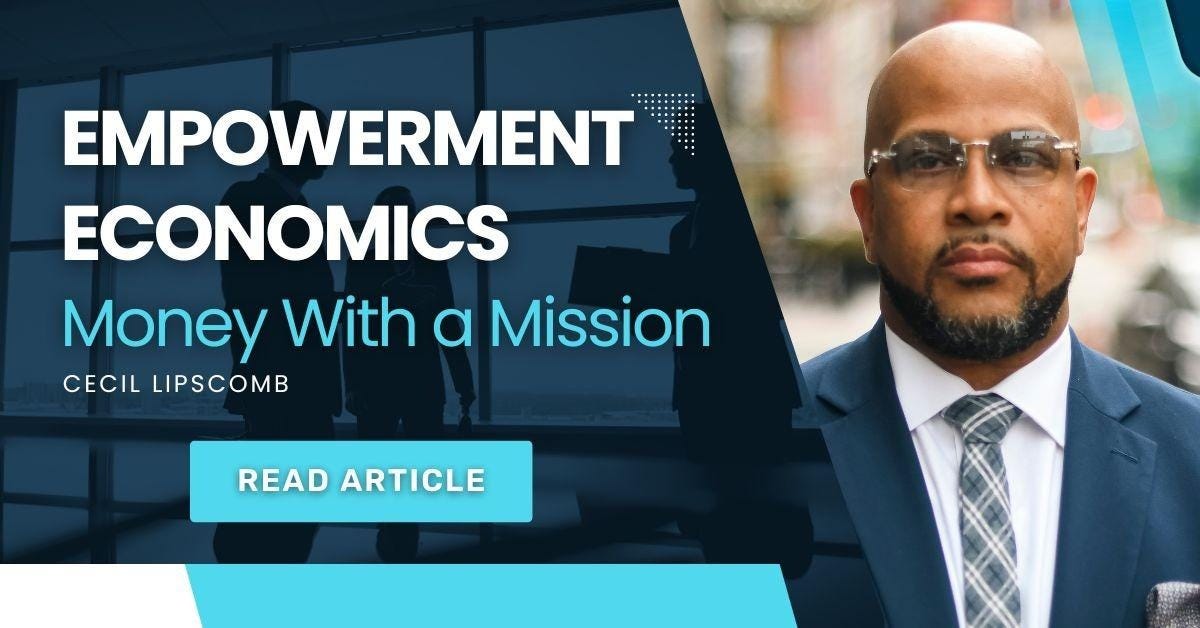
With a career dedicated to expanding opportunity, strengthening community institutions, and reshaping how capital flows into overlooked neighborhoods, Cecil Lipscomb brings a visionary, mission‑centered voice to the work of economic empowerment.
He believes deeply in the power of people, strategy, and intention—and in the possibility of building systems where resources align with purpose.
His leadership reflects a simple but transformative conviction: when communities are equipped with the right tools and the right truth, they rise.
To reach Cecil, call (216) 238‑2235.