

Every Memorial Day, Americans gather to honor sacrifice.
We wave flags. We attend ceremonies. We visit cemeteries. We pause to remember the men and women who gave their lives in service to this country.
But there is another part of the story we rarely discuss:
what happened when many Black veterans came home.
For millions of Americans, military service became a pathway into the middle class. Following World War II, the GI Bill helped veterans purchase homes, attend college, start businesses, and build generational wealth. Historians often describe it as one of the most transformative wealth-building policies in American history.
And they are right.
The GI Bill helped fuel the growth of suburbs, expand access to higher education, and create economic stability for millions of families. It helped shape modern America.
But the benefits were not equally accessible to everyone.
While the GI Bill itself appeared race-neutral on paper, its implementation often was not. Many programs were administered locally, which meant access was filtered through the realities of segregation, discriminatory lending practices, and unequal educational systems.
In many communities, Black veterans returning home from war faced barriers at nearly every turn.
Banks routinely denied mortgages to Black families. Redlining prevented many Black veterans from purchasing homes in growing suburban neighborhoods where property values would later skyrocket. Colleges and universities remained segregated or severely limited enrollment for Black students. Black veterans seeking business loans or other forms of capital often encountered systems that simply were not designed to include them.
The result was not just individual hardship. It was a massive lost opportunity for intergenerational wealth creation.
A home purchased in the 1950s for a modest amount may have helped pay for college educations, supported business creation, or been passed down to future generations. Equity accumulated over decades became inheritances, retirement cushions, and financial stability for millions of American families.
But many Black families were systematically excluded from those opportunities.
That history matters because wealth gaps do not emerge by accident.
They are often the accumulated result of policy decisions, institutional practices, and unequal access to opportunity over generations.
Today, when we discuss disparities in homeownership, neighborhood investment, educational attainment, or access to capital, we are not simply discussing present-day choices. We are also discussing the long shadow of past decisions.
This is especially important for those of us working in community development, public policy, philanthropy, and economic development.
Too often, conversations about struggling neighborhoods focus only on present conditions without acknowledging how those conditions were shaped. Communities that experienced decades of disinvestment did not simply “fall behind.” In many cases, they were intentionally excluded from the same wealth-building systems that transformed other parts of America.
Memorial Day offers an opportunity not only to remember sacrifice, but also to examine whether the opportunities promised after that sacrifice were delivered equitably.
That does not mean diminishing patriotism or questioning the value of service. In many ways, it is the opposite. It is recognizing that patriotism also requires honesty.
And honesty matters because understanding the past helps us make better decisions moving forward.
Today, there are efforts attempting to address these historic inequities:
veteran housing initiatives
down payment assistance programs
Community Development Financial Institutions (CDFIs)
Community Development Entities (CDEs)
targeted small business lending
neighborhood reinvestment strategies
These efforts are not charity. They are investments in communities and people who were too often locked out of earlier opportunities to build wealth.
The challenge is that wealth gaps built over generations are not easily closed in a single funding cycle, grant program, or development project. Sustainable change requires long-term commitment, intentional investment, and policies that expand access to capital and ownership.
Memorial Day asks us to remember sacrifice.
But honest remembrance also requires us to acknowledge a difficult truth:
many Black veterans served their country honorably while being denied full access to the very opportunities that helped build America’s middle class.
That is part of the story too.
And perhaps one of the best ways to honor sacrifice today is not only through remembrance, but through building systems and communities where opportunity is more accessible than it was for generations before.
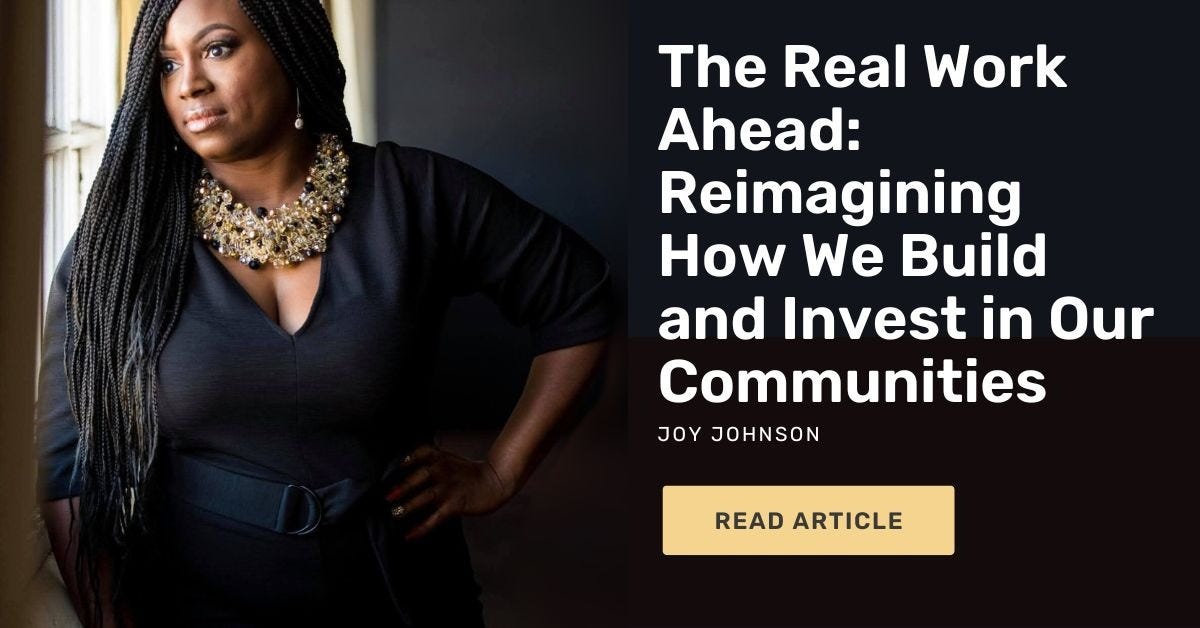
With more than two decades of experience in community development, real estate strategy, and organizational leadership, Joy Johnson brings a seasoned, solutions-focused voice to the field. She is committed to helping communities and institutions avoid systemic pitfalls and build models that truly work. To reach Joy call (216) 238-2235.