

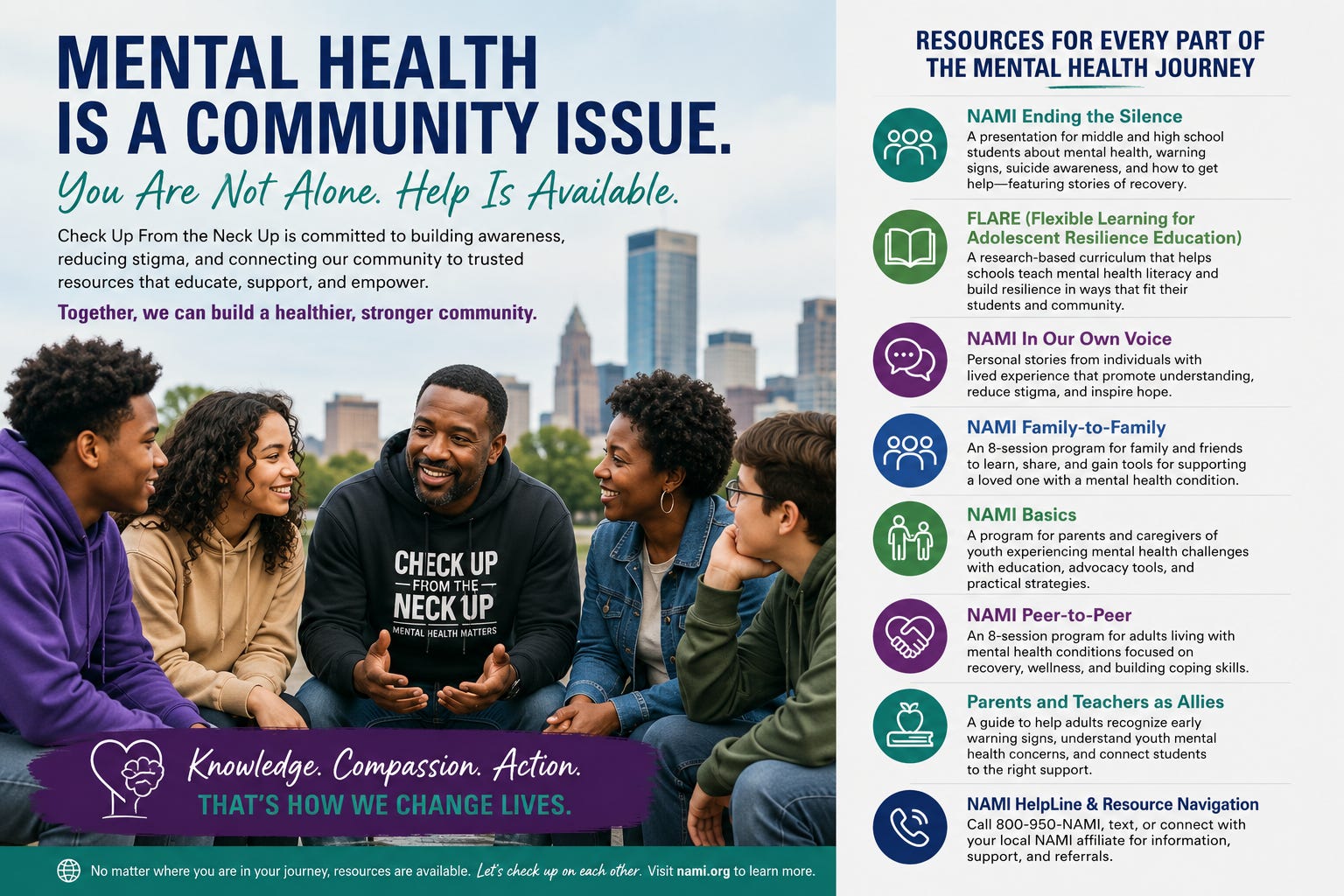
Conversations about mental health are becoming more common, yet many individuals and families still struggle to find the support they need. Young people are experiencing increasing levels of stress, anxiety, depression, loneliness, and uncertainty. Parents are often trying to navigate challenges they were never taught how to address. Teachers and community leaders regularly find themselves serving as first responders to emotional and behavioral concerns without always having the training, tools, or support necessary to do so effectively.
At Check Up From the Neck Up, we believe that mental health is not simply a healthcare issue—it is a community issue. Just as we educate people about heart health, diabetes, nutrition, and exercise, we must also educate people about emotional well-being, resilience, mental illness, recovery, and the resources available to support individuals and families.
One of the greatest barriers to mental health support is not always a lack of services. Often, people simply do not know where to start. They may not recognize the signs that someone is struggling. They may not know how to have difficult conversations. They may not know what programs exist, how to access them, or whether those resources are designed for youth, parents, educators, or individuals experiencing mental health challenges themselves.
As we continue building Check Up From the Neck Up, one of our goals is to identify practical, evidence-based resources that can help our community become more informed, more compassionate, and better equipped to support one another. During our research and engagement with mental health organizations, we identified several programs developed by the National Alliance on Mental Illness (NAMI) that address different aspects of mental health education, awareness, support, and recovery.
Some resources focus on helping students understand mental health. Others help parents and caregivers navigate difficult situations. Some are designed for educators and school staff, while others provide direct support to individuals living with mental health conditions. Together, they represent a continuum of education and support that can strengthen families, schools, and communities.
Below is an overview of the resources we identified. In future articles, we will explore each of these programs in greater detail and discuss how they may support the goals of Check Up From the Neck Up and the broader mental health needs of our community.
NAMI Ending the Silence
A free, evidence-based presentation designed for middle and high school students. The program introduces mental health concepts, warning signs of mental health conditions, suicide awareness, strategies for seeking help, and personal recovery stories shared by young adults with lived experience.
This resource helps normalize conversations about mental health and provides students with foundational knowledge that can reduce stigma and encourage help-seeking behaviors.
FLARE (Flexible Learning for Adolescent Resilience Education)
FLARE is a research-based mental health literacy curriculum developed by NAMI in partnership with mental health and education experts. The curriculum is designed to be flexible, allowing schools to adapt lessons based on student needs, state standards, available resources, and scheduling constraints.
The program provides a structured approach to teaching mental health literacy and resilience within educational settings.
NAMI In Our Own Voice
This presentation centers the experiences of individuals living with mental health conditions who share their personal stories of challenge, treatment, recovery, and hope.
By highlighting lived experience, the program helps reduce stigma, increase understanding, and demonstrate that recovery is possible.
NAMI Family-to-Family
A free eight-session educational program designed for family members, significant others, and friends who support someone living with a mental health condition.
Participants learn about mental health conditions, crisis response, communication strategies, problem-solving skills, caregiver stress management, and available community resources.
NAMI Basics
A free educational program specifically created for parents and caregivers of children and adolescents experiencing mental health challenges.
The program provides information about youth mental health conditions, advocacy strategies within school and healthcare systems, communication techniques, and practical approaches for supporting children and families.
NAMI Peer-to-Peer
A free eight-session program designed for adults living with mental health conditions.
The curriculum focuses on recovery, wellness, self-understanding, coping skills, stigma reduction, and building supportive connections with others who have shared experiences.
Parents and Teachers as Allies
This resource helps educators, school personnel, parents, and caregivers recognize early warning signs of mental health concerns among youth.
The program focuses on identifying when students may need support, understanding common youth mental health challenges, and connecting young people to appropriate services and resources.
NAMI HelpLine and Resource Navigation
For individuals and families who do not know where to begin, NAMI offers a HelpLine that provides information, referrals, resource navigation, and connections to local NAMI affiliates and support services.
The HelpLine serves as an important entry point for individuals seeking guidance, information, or assistance finding appropriate mental health resources.
Mental health challenges affect every community, every school, and every family. Building a healthier future requires more than awareness—it requires education, conversation, support, and access to resources. By understanding and utilizing programs such as these, communities can take meaningful steps toward reducing stigma, increasing mental health literacy, and ensuring that individuals and families know they are not alone.
At Check Up From the Neck Up, we view these resources as tools that can help strengthen the mental health ecosystem within our communities. In the coming weeks, we will take a closer look at each of these programs and explore how they can be utilized by youth, families, educators, faith leaders, and community organizations throughout Cleveland, Ohio, and beyond.