

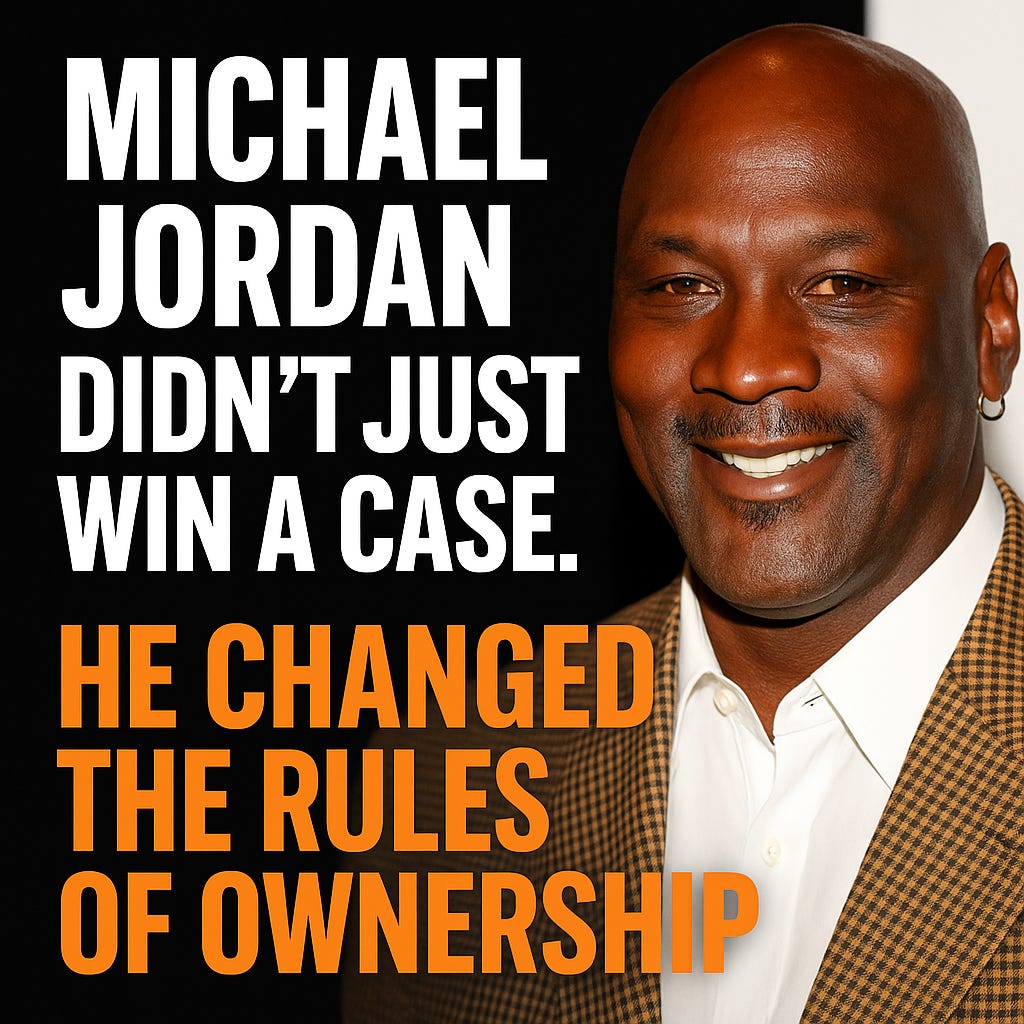
For decades, NASCAR teams poured millions into a system they did not control.
They built brands. They hired talent. They filled stadiums. They took the financial risk.
Yet the most important asset—the right to compete—was never truly theirs.
It could be changed. It could be restricted. It could be taken.
That changed when Michael Jordan decided being present wasn’t enough.
Ownership Without Power Is Not Ownership
Michael Jordan, through 23XI Racing, challenged NASCAR’s charter system on antitrust grounds. The argument was simple but profound:
If teams are required to invest like owners,
they must be treated like owners.
For years, NASCAR operated with temporary charters, keeping teams dependent on a centralized authority that controlled access, revenue, and long-term security. Teams bore the cost. NASCAR held the leverage.
That imbalance is the very definition of a closed system.
Jordan didn’t ask for special treatment.
He demanded structural fairness.
And he won.
What Changed—and Why It Matters
NASCAR agreed to move toward permanent charters.
That shift sounds technical, but it’s transformative.
Permanent charters mean:
Teams now hold assets with lasting value
Ownership stakes can be transferred, sold, leveraged, or inherited
Equity replaces permission
Stability replaces dependence
In short: teams now own something real.
This is how generational wealth is built in professional sports. This is how power moves from institutions to stakeholders.
Why This Moment Matters for Black Ownership
Black participation in elite spaces has often come with invisible ceilings:
Allowed in, but not empowered
Present, but not protected
Celebrated, but not secure
Michael Jordan already had access.
He already had money.
He already had respect.
What he challenged was something deeper: control.
Black ownership cannot stop at representation. It must extend to rule-making, leverage, and permanence.
Jordan understood what many are still uncomfortable saying out loud:
Systems rarely give up power voluntarily.
It has to be taken—legally, strategically, and unapologetically.
Being a Disruptor Is the Cost of Real Ownership
There is a reason disruptors are often criticized before they are credited.
They are called:
Difficult
Ungrateful
Arrogant
Divisive
But disruption is not chaos. It is correction.
Michael Jordan disrupted NASCAR not to tear it down—but to modernize it. To force it to align risk with reward. To bring ownership into the present.
That is leadership.
And it is a reminder that comfort is not the goal when the structure itself is flawed.
The Larger Lesson
This case is bigger than NASCAR.
It speaks to every industry where Black talent, capital, and credibility exist without corresponding power.
It asks a direct question: Are we content to be participants in systems we don’t control—or are we prepared to challenge them?
Michael Jordan answered that question decisively.
He didn’t just buy into the system. He changed it.
And that is what ownership—real ownership—has always required.