

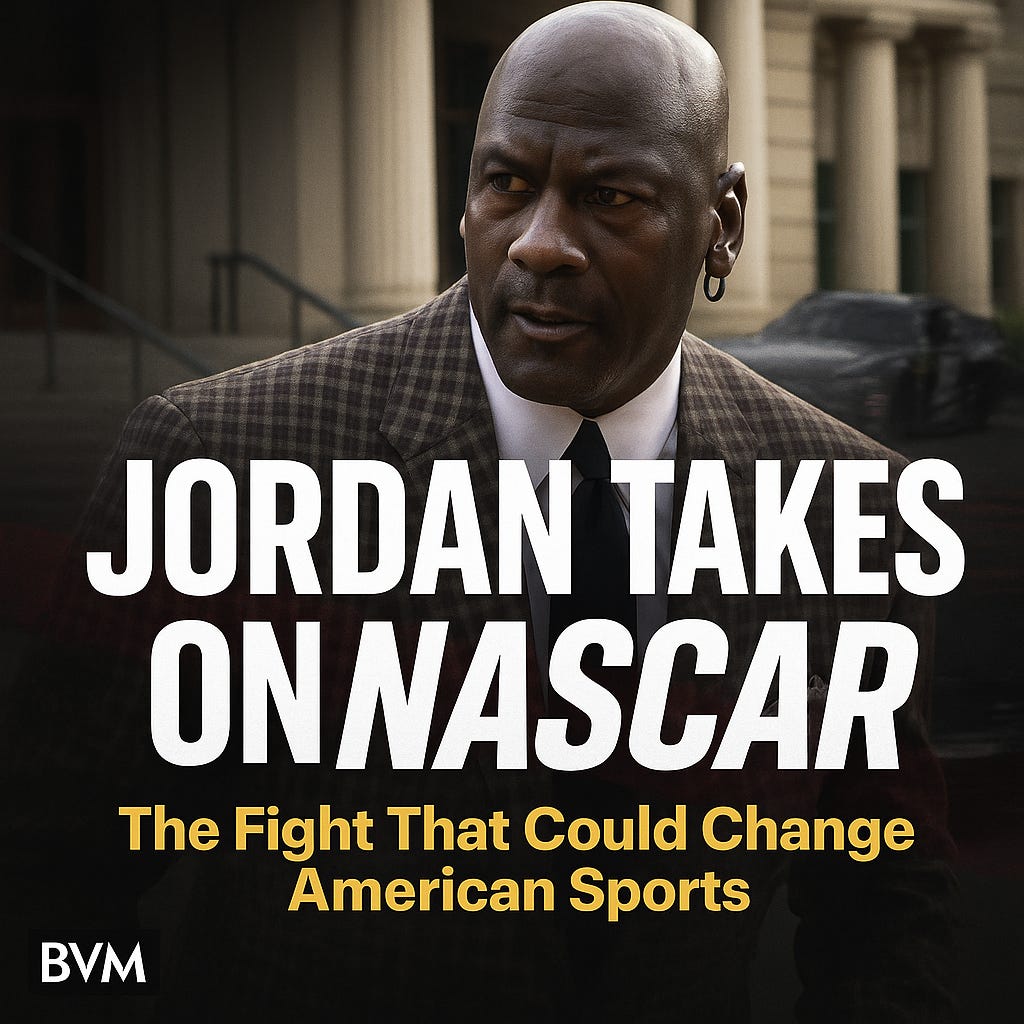
When Michael Jordan walked into a federal courthouse in Charlotte to take on NASCAR, most people saw a billionaire athlete fighting over business contracts. But if you look closer, what’s unfolding is much bigger than racing. It’s a story about power, equity, control, and the moment one of the greatest competitors of all time decided the system needed to change.
And if Jordan wins, the ripple effects won’t stop at the speedway — they’ll be felt in every industry where institutions hold all the cards and everyone else is told to “stay in your lane.”
The Core Fight: Power vs. Access
Jordan co-owns 23XI Racing, one of NASCAR’s newest and most culturally important teams. Along with partner Denny Hamlin, he refused to sign NASCAR’s new “charter agreement,” a franchise-style system that locks teams into strict rules controlling:
• Who gets to compete
• How much revenue teams receive
• What sponsors can do
• Which suppliers they must use
• How much autonomy teams truly have
Jordan and 23XI argue that NASCAR’s structure functions like a monopoly — one entity controlling the whole environment, from the race tracks to the rulebook.
So they sued.
They are claiming antitrust violations — and the judge already ruled that NASCAR does in fact dominate the entire “premier stock-car racing market.” That’s a huge legal win.
Jordan is essentially saying:
“If we’re competing, then let us really compete. Don’t build a system where the league wins and the teams lose before the race even starts.”
Why This Resonates in Black Spaces
Think about how many Black entrepreneurs know this feeling:
You enter an industry full of potential, only to discover the game is rigged — not by talent, but by structure. Licensing systems favor incumbents. Revenue models reward the institution first. New players get the scraps. Gatekeepers write rules that protect their power, not fairness.
What Jordan is challenging is not just NASCAR’s business model.
He’s challenging the idea that powerful, legacy institutions can box out fresh competition and control every pathway to advancement.
This fight echoes the same themes we see in:
• Community development
• Government contracting
• Media ownership
• Banking access
• Arts, sports, and entertainment
Jordan’s lawsuit quietly touches the same nerve we cover constantly at Black Vanguard Media:
Black ownership is never just about owning — it’s about having the ability to operate on a level playing field.
This Is the First Time NASCAR Has Faced a Challenger With Jordan’s Power
NASCAR has been sued before. But never by someone with:
• Global name recognition
• Billion-dollar business influence
• A multiracial fanbase
• The ability to move public opinion
• A track record of winning battles people said were impossible
Jordan’s presence in court forces NASCAR into the spotlight. This isn’t a small team complaining. This is Michael Jordan — and that turns a niche lawsuit into a national conversation.
When he walked into that courthouse, the visual message was unmistakable:
“I’m willing to fight you on your home turf.”
And sports leagues do not want that fight.
What Happens If Jordan Wins
If 23XI and Front Row Motorsports prevail, this case could:
1. Reshape the economics of NASCAR
Teams would gain more power in revenue negotiations and rulemaking.
2. Break the control that prevents new teams from entering
A more open market means more diverse ownership and competition.
3. Inspire similar challenges in other sports
NBA, NFL, MLB — all use franchise systems that could face fresh scrutiny.
4. Force institutions to rethink how they treat new and minority owners
Jordan winning could accelerate a shift toward fairness and transparency.
5. Change how America talks about equity in business
If Jordan proves a major league is abusing monopoly power, it opens the door for other industries — including housing, banking, and development — to face similar challenges.
The Cultural Undercurrent No One Wants to Discuss
Let’s be honest.
NASCAR has fought for years to expand beyond its traditional Southern, white, conservative fan base. Jordan joining as an owner — and Bubba Wallace as a driver — brought millions of new eyes to the sport.
But influence without power is decoration.
This lawsuit is Jordan calling out the difference.
You can invite us into the room.
You can put us on the commercials.
You can take the sponsorship money we attract.
But if we can’t shape the system — if we can’t profit fairly from the system — then we’re not partners. We’re a prop.
Jordan is refusing to play that role.
The Bigger Story
This case is ultimately about this question:
What happens when a Black-owned team challenges the economic foundation of a legacy American institution?
America has seen this movie before:
• Boxing promotions
• Music labels
• Athletic unions
• Housing authorities
• Voting rights systems
• Corporate boardrooms
Whenever the structure is being questioned — not one decision, but the entire architecture — that’s when real change becomes possible.
The trial has only just begun. The stakes are enormous. And the fact that Michael Jordan is the face of this challenge means the rest of the country is finally paying attention.
This isn’t a sports story.
This is an American power story.
And we’re watching it unfold in real time.