

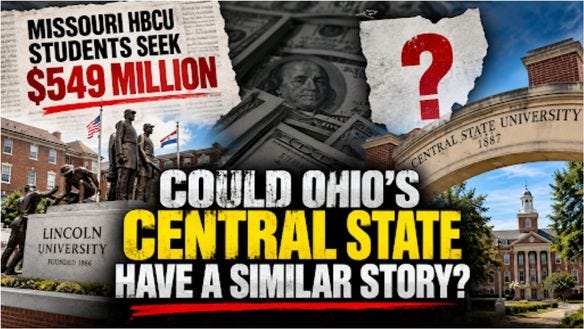
A federal lawsuit filed in Missouri this week is bringing renewed attention to a longstanding issue in American higher education: whether historically Black colleges and universities have received their fair share of public funding.
The lawsuit, filed Wednesday by seven current and former students of Lincoln University in Jefferson City, seeks approximately $549 million over allegations that Missouri systematically underfunded the historically Black institution compared with the University of Missouri.
The students are relying partly on a 2023 federal analysis that calculated a $361.6 million funding disparity between 1987 and 2020.
The lawsuit is the first brought by the 1890 Project, an initiative seeking to recover money that advocates say states failed to provide historically Black land-grant universities.
But the case also raises a question closer to home.
What about Central State University in Wilberforce, Ohio?
Central State, Ohio’s only public historically Black university, has a history that differs from Lincoln’s in one particularly important respect. While Lincoln received land-grant status in the 1890s, Central State had to wait until 2014.
That difference deserves attention.
The 120-year wait
The federal land-grant system began in 1862, when Congress established a program to support colleges specializing in agriculture, engineering and other practical fields.
Ohio State University became Ohio’s land-grant institution in 1870.
When Congress passed the Second Morrill Act in 1890, states maintaining segregated public higher education systems were required to admit Black students to their existing land-grant institutions or establish separate institutions where Black students could receive those educational opportunities.
Central State, whose origins date to 1887, sought a place in that system.
According to a 2014 report published by Farm and Dairy, citing historical records described by two Ohio state senators, the Ohio Senate passed legislation in 1892 that would have directed land-grant funding to Central State.
The Ohio House subsequently reversed course.
The report attributed that reversal to the influence of former President Rutherford B. Hayes, who served as an Ohio State trustee. The funding went to Ohio State instead.
There is an important legal distinction. Ohio did not maintain a formal policy of segregation in higher education at the time, meaning the 1890 law did not require the state to establish a separate Black land-grant university.
Nevertheless, the decision left Central State without the land-grant designation and associated funding opportunities that other historically Black institutions received.
Central State’s own historical account acknowledges that it sought the designation for more than 120 years.
It finally received that recognition through the 2014 federal farm bill, with eligibility for major federal agricultural research and extension formula funding beginning in fiscal year 2016.
The federal government found a $12.6 billion problem
In September 2023, the U.S. Departments of Education and Agriculture released an analysis comparing state funding for historically Black land-grant universities with their traditionally white counterparts.
The findings were substantial.
Federal officials identified approximately $12.6 billion in funding disparities across 16 states between 1987 and 2020.
Tennessee State University had the largest identified disparity, exceeding $2 billion. Lincoln University’s shortfall was calculated at $361.6 million.
But Ohio was not on the list.
In fact, Ohio and Delaware were the only two states identified as having provided equitable funding under the federal comparison.
That finding matters. It means there is no basis for claiming that federal investigators determined Ohio owed Central State hundreds of millions of dollars.
However, it does not settle a different question: What opportunities did Central State miss before it became eligible for the same federal land-grant programs available to other institutions?
The 2023 analysis was not designed to calculate the financial consequences of Central State’s delayed designation.
No verified public accounting has established the dollar value of those missed opportunities.
A new Ohio funding decision raises additional questions
The historical debate is not the only issue worth examining.
In June 2026, the Ohio Controlling Board approved a request from the Ohio Department of Higher Education to transfer approximately $3.5 million from Central State’s agricultural research and cooperative extension appropriations into general university operations for fiscal year 2026.
The board also approved approximately $5.35 million in transfers for fiscal year 2027.
According to the state’s official request, those appropriations had previously been earmarked for state matching obligations connected with federal land-grant funding.
The stated purpose was to help Central State maintain general university operations during its financial difficulties.
The university has faced significant fiscal problems, and Ohio placed it under fiscal watch in 2024.
Separately, lawmakers approved more than $29 million in capital funding for campus improvements in 2026, subject to a requirement that the university transfer oversight of its facilities management to a state agency or another governmental entity.
Those decisions demonstrate that Ohio continues to provide financial support to Central State while also imposing additional oversight.
The land-grant transfer, however, raises a separate accounting question: Were all federal matching requirements satisfied after the money was reassigned?
The transfer records do not, by themselves, establish that federal funding was lost or that Ohio violated any law.
Determining that would require reviewing the university’s federal awards, matching obligations, actual expenditures and any applicable waivers.
Could Central State pursue a similar claim?
The Missouri lawsuit and Central State’s circumstances should not be confused.
Lincoln University already possessed land-grant status during the period in which federal investigators documented significant funding disparities. The Missouri plaintiffs also allege specific failures to provide matching funds, forcing the university to use operating money and, at times, forfeit federal assistance.
Central State’s historical circumstances are different.
Its designation was delayed until 2014, and no comparable federal calculation has established a funding debt owed to the university.
A potential legal claim in Ohio would require proof of an enforceable obligation, a violation of that obligation and resulting harm. Historical inequity alone does not automatically establish a right to compensation.
Still, a comprehensive review could answer several important questions.
How much funding did Central State miss during the decades it lacked land-grant status? Were opportunities for research, infrastructure, faculty development and agricultural education lost? Have Ohio’s matching obligations been fully satisfied since the university became eligible for federal formula funding? And what do the recently approved budget transfers mean for those programs?
Those are questions that can be examined through legislation, appropriations records, federal grant data and university financial reports.
A question worth answering
The Missouri case is likely to draw national attention because it puts a specific dollar amount on a longstanding dispute over the treatment of historically Black universities.
Central State’s history is more complicated.
Ohio received a favorable finding in the 2023 federal funding analysis. At the same time, its only public HBCU spent more than a century seeking access to a designation that other Black universities had possessed for generations.
Both facts can be true.
There is not yet sufficient evidence to conclude that Central State has a legal claim comparable to Lincoln University’s, much less that Ohio owes it a particular amount of money.
But the university’s history and the state’s recent funding decisions provide legitimate reasons for further examination.
Missouri’s lawsuit is asking whether its historically Black university received the money it was legally entitled to receive.
For Ohio, the question begins even earlier.
What did Central State lose during the 120 years it waited, and has anyone ever fully accounted for it?
That is a question worth answering with records, not assumptions.