

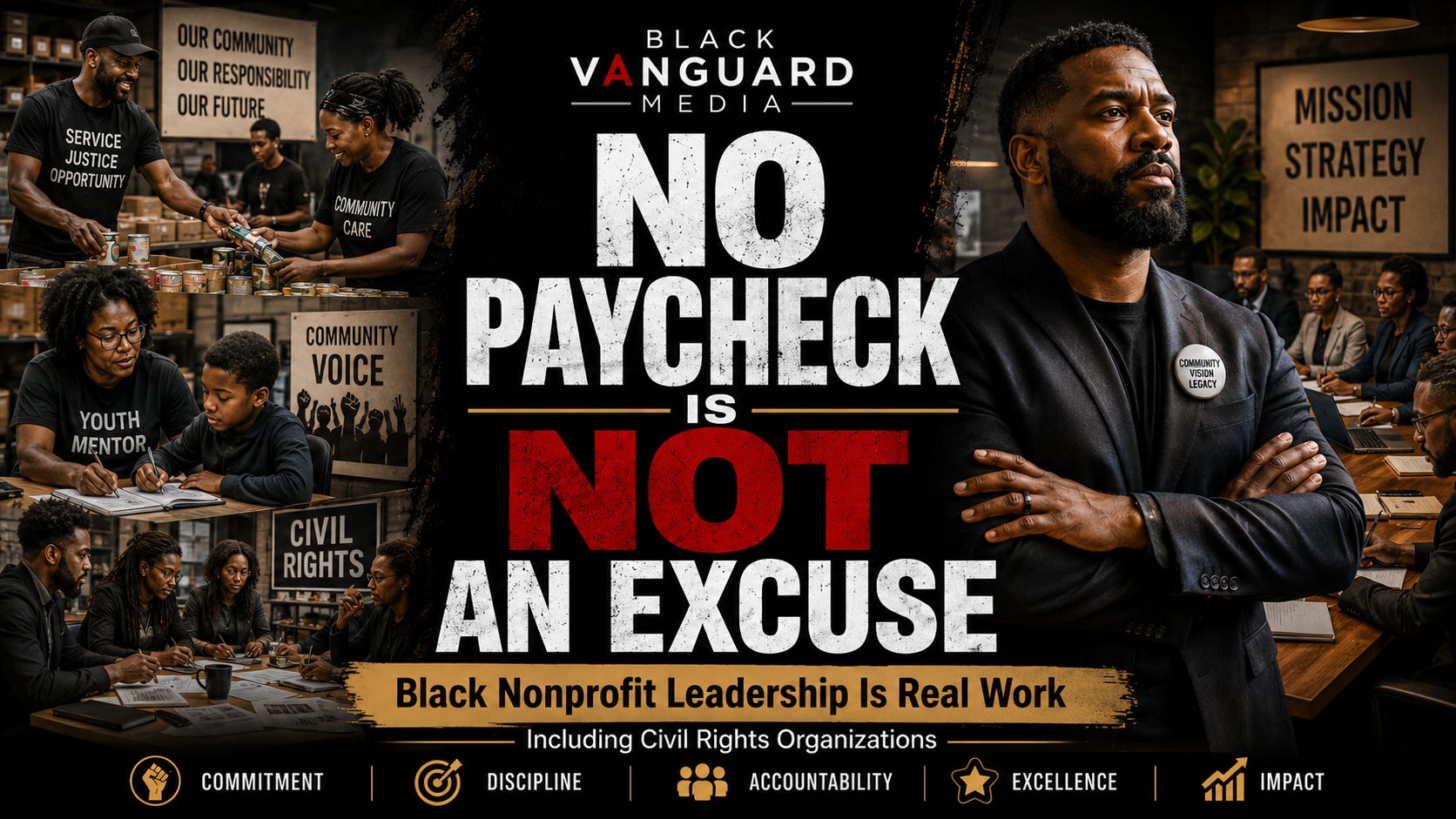
A familiar explanation is heard far too often inside nonprofit and civil rights organizations serving the Black community:
“I am not being paid.”
The statement may come after a meeting was missed, a telephone call went unanswered, a report was not completed or an important opportunity was allowed to pass. It is sometimes offered as though the absence of compensation automatically lowers the standard of performance expected from a person who voluntarily accepted a leadership position.
It should not.
Black-led nonprofit organizations should raise the resources necessary to compensate people fairly. No organization should exploit volunteers, overload committed community members or use the language of service to avoid building a sustainable institution.
But compensation and responsibility are not the same question.
Once a person accepts a position as a board member, committee chair, officer, organizer or community leader, that position comes with an obligation. The responsibility does not become less important simply because the role is unpaid.
There may be a reasonable difference in the number of hours expected from a full-time employee and a volunteer. There should not be a difference in integrity, preparation or dependability.
The title cannot be real while the work remains optional.
Limited resources require stronger leadership
Black nonprofit organizations are frequently asked to confront large problems with limited resources.
Community organizations are expected to improve neighborhoods, create economic opportunities, mentor young people, support families, protect voting rights, address health disparities and respond to discrimination. Many are expected to do this work with small staffs, volunteer boards and unpredictable funding.
Those limitations are real. They also make disciplined leadership more important.
An organization with limited resources cannot afford leaders who fail to prepare, communicate or follow through. It cannot afford committees that exist only on paper or board members who appear only when recognition is being distributed.
A missed deadline can cost an organization funding. A neglected relationship can eliminate a future partnership. A poorly managed program can damage public confidence and harm the very people the organization was created to serve.
In a large, well-funded institution, weak leadership is costly. In a small Black-led nonprofit, it can be devastating.
This does not mean every volunteer must dedicate the same amount of time as a paid employee. It means people must be honest about the commitment they are accepting.
If a person agrees to chair a committee, the committee should meet. If someone accepts responsibility for outreach, the calls should be made. If a person agrees to serve on a board, that person should attend meetings, review information and participate in governing the organization.
A volunteer may have limited time. That limitation should be communicated before accepting the assignment, not used later to excuse its abandonment.
Civil rights organizations were built through sacrifice
Civil rights organizations are an essential part of this discussion because much of the Civil Rights Movement was sustained by people who were not receiving salaries.
Domestic workers, students, ministers, teachers, business owners and church members attended meetings after completing their regular workdays. They organized transportation, printed flyers, prepared meals, housed organizers, raised bail money and helped sustain demonstrations and boycotts.
They did not wait for someone to guarantee them a paycheck before deciding that the work mattered.
The Montgomery Bus Boycott lasted more than a year because thousands of ordinary people made extraordinary commitments. Students participating in sit-ins and Freedom Rides risked their safety, education and future employment. Families opened their homes. Churches became organizing centers. Local communities helped finance their own struggle.
Paid organizers also played important roles. Movements need funding, professional staff, legal assistance, communications systems, transportation and administrative support.
But the movement could not have survived if every participant had refused to act until personally compensated.
Those involved understood that freedom required preparation, sacrifice and discipline. They also understood that accepting responsibility in a movement meant other people would depend on them to perform it.
That principle remains relevant today - not only for civil rights groups, but for every nonprofit organization claiming to serve the Black community.
The community experiences the failure either way
A person seeking help from a nonprofit organization may never know whether the individual responsible for assisting them is paid or volunteering.
The family waiting for housing assistance does not know whether a board member receives compensation. The young person waiting for a mentoring program does not know whether the committee chair has a salary. The small business owner waiting for a returned call does not know whether the person responsible for outreach is a volunteer.
They experience the failure either way.
That is why there should be no difference in the seriousness with which a paid or unpaid leader approaches an accepted responsibility.
Compensation can determine the amount of time an organization may reasonably demand from someone. It should not determine whether the person keeps their word.
Black communities are not asking volunteers to ignore their families, employment or personal responsibilities. They are asking people to be truthful about their capacity.
There is no shame in declining a leadership position. It is more honorable to admit that a person does not have the necessary time than to accept a title and repeatedly neglect the work.
Not everyone has to be an officer.
People can support an organization by volunteering for specific projects, contributing financially, recruiting members, attending events, making introductions or sharing professional expertise.
Every supporter does not have to hold a position, but everyone who accepts a position should be prepared to perform it.
Our opposition is not operating casually
The forces working against Black political, economic and social progress are not approaching their work casually.
They are raising money, recruiting candidates, developing organizations, influencing legislation, building relationships and pursuing legal and communications strategies.
Some are paid professionals. Others are volunteers who believe strongly in what they are trying to accomplish.
They are counting on Black organizations being disorganized. They are counting on unanswered emails, poorly attended meetings, weak financial oversight and leaders who enjoy recognition but avoid responsibility.
They are counting on our communities accepting mediocre performance because the person responsible was not being paid.
Every time a leader uses the absence of compensation as permission to produce lackluster work, the opposition gains an advantage.
This is particularly dangerous for civil rights organizations. Their effectiveness can influence whether communities are organized, whether discrimination is challenged, whether voters receive accurate information and whether public officials are held accountable.
Leadership failure in these organizations is not merely an internal inconvenience. It can affect an entire community.
Leadership is an assignment, not an award
Too many leadership positions are treated as recognition for popularity, loyalty, longevity or public visibility.
Someone has been around for years, so they are made an officer. Someone knows influential people, so they are invited to join the board. Someone wants recognition, so they are given a title.
But leadership is not an award.
It is an assignment.
A president must lead. A treasurer must understand and monitor the organization’s finances. A board member must govern. A committee chair must organize the committee. A community organizer must organize people.
Titles should describe responsibilities, not decorate biographies.
Before accepting a position, a person should honestly consider whether they have the time, ability and willingness to perform it. They should understand what the organization expects and determine whether they can be dependable.
People should also be willing to accept accountability.
Service does not mean a leader should never make a mistake. It means the leader should communicate when difficulties arise, seek assistance when necessary and take responsibility for correcting the problem.
Silence, avoidance and excuses are not leadership.
Organizations must build the capacity to succeed
Accountability should not be directed only at individual volunteers.
Nonprofit organizations must build structures that allow leaders to succeed. They need clear job descriptions, realistic expectations, training, administrative support and measurable goals.
Boards should understand their responsibility to govern, review finances, protect the mission, raise resources and evaluate executive leadership. Committees should receive specific assignments and deadlines. Important information should not be stored only in one person’s head or personal email account.
Organizations must also stop relying on the same handful of exhausted people to carry every initiative.
Leadership development and succession planning are essential. New people must be trained before existing leaders become burned out, unavailable or unable to continue serving.
Organizations should also work toward compensating positions that require substantial and consistent labor. Some responsibilities are too extensive to remain volunteer assignments forever.
The absence of funding, however, does not excuse the absence of standards.
An organization without the capacity to manage ten programs should operate three with excellence. It should not announce ten initiatives, poorly execute all of them and blame every failure on a lack of money.
Smaller does not have to mean sloppy. Volunteer-led does not have to mean disorganized. Black-led should never be treated as a synonym for underprepared.
Good intentions are not enough
Black nonprofit leaders often carry significant burdens. Many work long hours, contribute their own money and serve communities while maintaining jobs, businesses and family responsibilities.
Those sacrifices deserve recognition.
But sacrifice should not be confused with dysfunction.
Being tired is understandable. Refusing to communicate is not. Having limited time is understandable. Accepting more responsibility than one can manage is a decision.
Good intentions are valuable, but they are not the same as good performance.
The community cannot survive on intentions. Organizations cannot be sustained by passion alone. The mission requires planning, accountability, systems and completed work.
No one should be forced to accept a leadership role. But once that role is accepted, it should be taken seriously.
Do the work with discipline. Ask for help when necessary. Build a capable team. Communicate honestly. Accept accountability.
When a leader can no longer give the position what it requires, that person should step aside with dignity and allow someone else to serve.
Black communities do not need more people collecting titles.
They need leaders who will complete the assignment.
The mission is too important, the opposition is too organized and the community is depending on us.
No paycheck is not an excuse.
Jerry Primm writes about leadership, strategy, institutional accountability and the future of Black communities for Black Vanguard Media.