

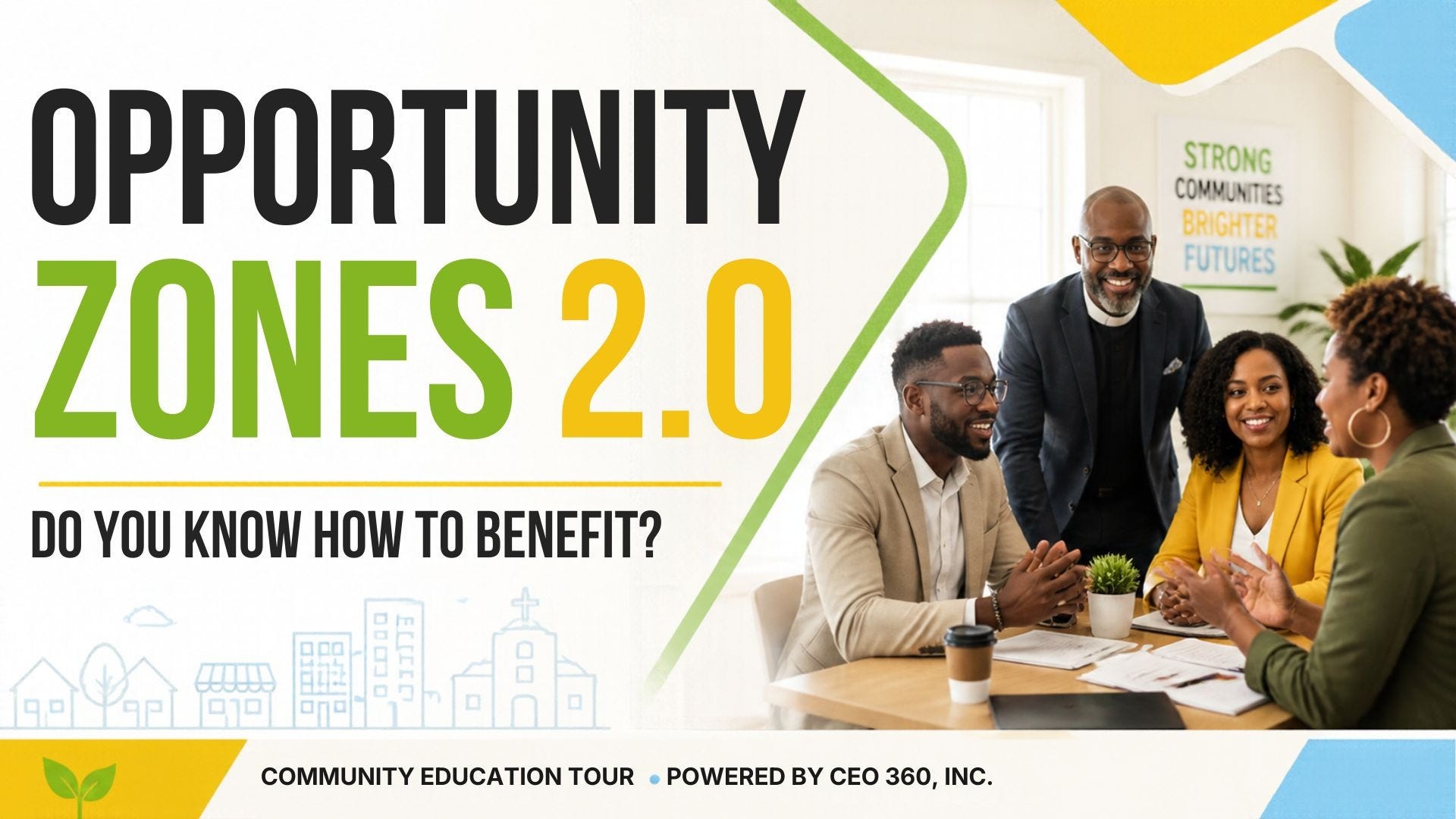
EAST CLEVELAND, Ohio — The new Opportunity Zones 2.0 maps are out, opening another chapter in the nation’s efforts to encourage private investment in economically distressed communities. But an important question remains: Will the people who live, work, worship and own businesses in these neighborhoods understand how to benefit from the opportunities?
That question is at the center of a new multistate community education initiative powered by CEO 360, Inc., which is organizing a series of training sessions designed to help residents, churches, entrepreneurs, property owners, community development organizations and investors understand how Opportunity Zones work and how they can participate.
The initiative begins with a simple premise: It’s one thing to know that Opportunity Zones are here. It’s a whole other thing to know what to do with them.
View the new Opportunity Zones 2.0 Press release and maps here:
https://home.treasury.gov/news/press-releases/sb0682
An Economic Tool Communities Need to Understand
Opportunity Zones were created to encourage investment in designated economically distressed areas by offering federal tax incentives to qualifying investors. The program is intended to help attract capital into communities that have historically struggled to secure sufficient private investment.
Opportunity Zones 2.0 introduces a new generation of designated communities and investment opportunities. But the existence of a designation does not automatically mean that new businesses will open, abandoned properties will be redeveloped, affordable housing will be built or residents will experience greater economic security.
Those outcomes require knowledge, planning, partnerships and participation.
A neighborhood might contain vacant commercial buildings that could be renovated. A church might own underutilized land that could support housing or community facilities. A small-business owner might be looking for capital to expand operations and create jobs. A community development corporation might have a redevelopment project that needs private investment to move forward.
Understanding Opportunity Zones could help these organizations and individuals explore new ways to connect their projects with investors and other financing resources.
The incentives generally benefit qualifying investors, rather than providing automatic tax credits or grants to residents and property owners. That makes it especially important for communities to understand how investment partnerships work, what kinds of projects may qualify and how local interests can be protected.
The goal is not simply to attract money into neighborhoods. It is to help communities become informed participants in decisions about their economic future.
Why the Black Community Must Be at the Table Early
For generations, Black communities have experienced the consequences of economic development decisions made without sufficient participation from the people most affected.
Neighborhoods have watched investment flow around them. Residents have seen properties change hands without understanding the financing behind those transactions. Small businesses have struggled to access capital while larger investors pursued opportunities nearby.
Opportunity Zones 2.0 creates another occasion to ask whether communities will be prepared to participate from the beginning.
The answer starts with education.
Residents should understand what an Opportunity Zone designation means for their neighborhood. Property owners should know what questions to ask when investors express interest in their land or buildings. Churches and nonprofit organizations should understand how their existing assets might support development. Entrepreneurs should learn how qualifying investments could potentially support business expansion.
And community leaders should understand how to advocate for development that creates jobs, supports existing businesses, expands housing opportunities and produces benefits for longtime residents.
None of these outcomes is guaranteed by an Opportunity Zone designation. But communities that understand the program will be better positioned to evaluate proposals, identify opportunities and negotiate partnerships.
That is the purpose of the upcoming training tour.
A Movement Rooted in the Black Church, Open to Everyone
Throughout American history, the Black church has served as far more than a place of worship.
It has been a gathering place for organizing, education, civil rights advocacy, economic cooperation and community advancement. Many of the nation’s most consequential movements for Black freedom and opportunity found leadership, meeting space and organizational strength within Black churches.
The Opportunity Zones 2.0 Community Education Tour seeks to build upon that tradition.
Its national kickoff is planned for Monday, December 14, 2026, at Starlight Baptist Church in East Cleveland, Ohio, in collaboration with East Cleveland Concerned Pastors for Progress and Starlight Community Development Corporation.
Beginning in the Black church is intentional. Churches have longstanding relationships with residents, families, neighborhood businesses and community leaders. They can help bring economic education directly to people who might otherwise never attend a development conference or investment seminar.
But this initiative is not exclusive to the Black community, nor is participation limited to church members.
Everyone is welcome.
The intention is to use the organizing tradition of the Black church to help launch a broader movement for economic education and community participation. The opportunities being discussed affect entire neighborhoods, and their benefits should be accessible to people of every background.
Bringing Opportunity Zone Education Directly to Communities
Rather than expecting residents and small organizations to travel to specialized investment conferences, the tour will bring practical education into community institutions and gathering places.
The planned events and partnerships include:
East Cleveland, Ohio — National Kickoff
Starlight Baptist Church will host the opening event in collaboration with East Cleveland Concerned Pastors for Progress and Starlight Community Development Corporation. The session will focus on helping residents, churches, businesses and community organizations understand the opportunities associated with the new program.
Cleveland, Ohio — Ward 1
Harvard Community Services Center will serve as the community location for a training session organized in collaboration with Cleveland City Councilman Joseph Jones. The event will emphasize neighborhood investment, property redevelopment, small-business participation and community economic development.
Columbus, Ohio
COED Worldwide, headed by Deryck Pannell, will participate in the Columbus training in collaboration with Columbus Empowerment Community Development Corporation. The session will bring together community organizations, business owners and others interested in understanding the potential of Opportunity Zones.
Atlanta, Georgia
The Gathering Spot will serve as the planned location for the Atlanta training, connecting entrepreneurs, investors, community leaders and development organizations with information about Opportunity Zones 2.0.
Houston, Texas
The Impact Hub will serve as the planned Houston location, providing a setting for education and discussion about how businesses, community organizations and property owners can participate in investment opportunities.
Additional sessions are being planned for Akron and Canton, Ohio, as part of the broader initiative.
Dates and registration information for events beyond the East Cleveland kickoff will be announced as arrangements are finalized.
From Knowing About the Opportunity to Knowing How to Participate
The training sessions will go beyond explaining the basic definition of an Opportunity Zone.
Participants will learn about the role of qualified investment funds, the kinds of businesses and real estate projects that may attract investment, and the importance of preparing projects before seeking financing.
The sessions will also introduce related economic development tools, including New Markets Tax Credits, Low-Income Housing Tax Credits and Historic Tax Credits, where appropriate.
These programs have different rules and requirements, but understanding how they may complement one another can help community organizations and developers consider financing strategies that might otherwise be overlooked.
For a church with vacant property, the first step might be understanding the property’s potential and the requirements for development.
For a small-business owner, it might be learning what makes a business attractive to investors.
For a neighborhood organization, it might involve identifying properties, understanding community priorities and developing relationships with experienced partners.
For residents, it might mean learning how to participate in discussions about development before major decisions have already been made.
The training is intended to make these concepts understandable and accessible, even to people who have never worked with tax-credit financing or economic development programs.
The Time to Learn Is Now
Economic development rarely begins when construction equipment arrives on a vacant lot.
It begins much earlier, when people identify opportunities, organize partnerships, evaluate properties, assemble financing and decide where capital should go.
That is why early education matters.
The beginning of Opportunity Zones 2.0 provides an important moment for communities to become familiar with the program, identify their own priorities and prepare to engage with investors and development professionals.
Communities do not have to wait until someone else presents a project to begin asking what development should look like in their neighborhoods.
They can begin those conversations now.
They can identify properties with redevelopment potential. They can discuss the needs of local businesses. They can explore opportunities for housing, commercial investment and job creation. And they can begin building the knowledge necessary to make informed decisions about future partnerships.
The Opportunity Zones 2.0 Community Education Tour is designed to support that process.
Powered by CEO 360, Inc., the initiative brings together community institutions, economic development experience and specialized knowledge of federal investment incentives to help make a complicated economic tool more understandable.
Its message is straightforward: Communities should not have to stand on the sidelines while decisions about their economic future are being made.
They deserve the information necessary to participate.
Opportunity Zones 2.0 is here. The question is not simply where the zones are located. The question is whether the people who call these communities home will understand how to take advantage of the opportunities.
And that begins with education.
Learn More About the Opportunity Zones 2.0 Community Education Tour
Residents, business owners, churches, nonprofit organizations, developers, investors and community leaders are encouraged to attend the upcoming training sessions.
National Kickoff: Monday, December 14, 2026
Location: Starlight Baptist Church, East Cleveland, Ohio
Community Partners: East Cleveland Concerned Pastors for Progress and Starlight Community Development Corporation
Tour Powered By: CEO 360, Inc.
For additional information, upcoming training dates and participation opportunities, contact the CEO 360 Team: Phone: (216) 238-2415.
All communities and interested participants are welcome.