

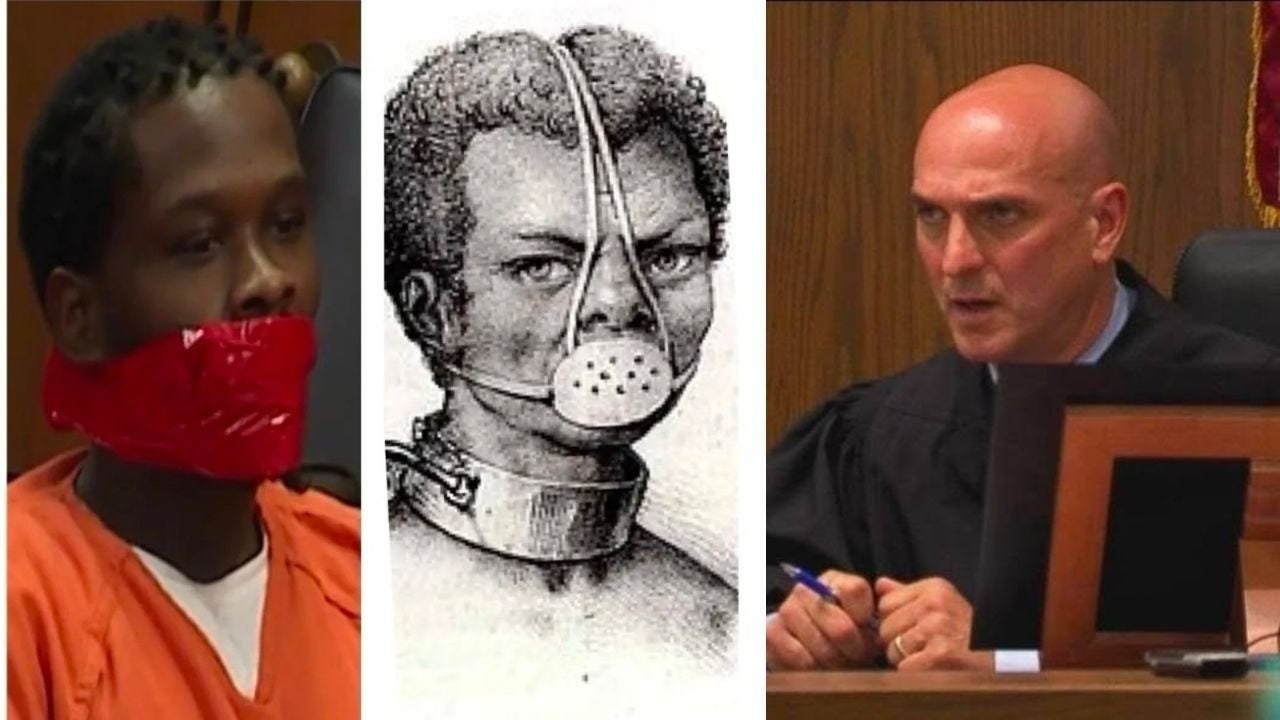
In 2018, a courtroom in Ohio became the site of a disturbing scene that still echoes today. A judge, frustrated with a defendant’s repeated outbursts, ordered deputies to place duct tape across the man’s mouth. Not a figure of speech. Not a metaphor. Actual tape — stretched from cheek to cheek — binding his mouth shut in a court of law.
Images of the moment sparked international outrage, and rightfully so.
Because no matter how disruptive a defendant may be, the courtroom is supposed to be the one place where constitutional rights are protected the most, not the least.
Yet what happened in that courtroom wasn’t discipline.
It wasn’t order.
It wasn’t justice.
It was humiliation — and a gross misuse of judicial power.
And it raises a critical question:
If taping a human being’s mouth shut is the solution… then what does that say about the system?
Because here’s the truth:
Judges already have an entire toolbox designed to handle disruptions.
Tools that every judge is trained to use.
Tools that keep dignity intact, maintain order, and uphold constitutional rights.
In other words, duct tape was never an option.
What the Judge Should Have Done — According to the Supreme Court
In Illinois v. Allen (1970), the U.S. Supreme Court spelled out exactly how courts must handle disruptive defendants. The judge could have used:
1. Formal Warnings
A clear, documented warning that further disruption will result in removal.
2. Temporary Removal From the Courtroom
Take the defendant out until he agrees to behave.
Bring him back only after confirming he can follow the rules.
3. Contempt of Court
Sanctions. Fines. Additional time.
A lawful, respected remedy.
4. A Separate Viewing Room With Audio/Video
The defendant can still see the trial, talk privately with counsel, and participate — without disrupting proceedings.
5. Additional Bailiffs or Security Measures
Non-silencing restraints if absolutely necessary, but never anything that strips a person of speech.
6. Mental Health or Competency Evaluation
If the behavior suggests instability, the law requires an assessment before continuing.
7. A Short Recess
Sometimes 10 minutes can defuse what force escalates.
8. Defense Counsel Intervention
Lawyers can often calm what the bench inflames.
9. Proceeding Without the Defendant
If — after warnings — the disruption continues, the court can legally move forward without him.
A judge does not need tape to maintain order.
These are not “nice alternatives.”
They are the law.
So Why Tape a Man’s Mouth Shut?
Because sometimes the problem isn’t the defendant.
Sometimes it’s the culture of certain courtrooms, where frustration becomes force and power replaces procedure.
When a judge reaches for duct tape instead of judicial tools, that’s not just a lapse in judgment — it’s a revelation:
Of how abuse can hide behind robes.
Of how humiliation is sometimes mistaken for authority.
Of how quickly dignity can be discarded when the defendant is poor, Black, or powerless.
This incident wasn’t about maintaining order.
It was about control — and crossing a line that should never be crossed in any American courtroom.
What This Means for the Community
Courtrooms are supposed to reflect the best of the justice system:
fairness, restraint, order, and respect for human rights.
When they instead become sites of public degradation, it doesn’t just scar one defendant — it undermines community trust in the entire system.
Because if they can tape one person’s mouth, who’s next?
Why This Moment Still Matters
Incidents like this don’t fade. They form the backdrop of why communities demand:
more judicial training,
more transparency,
more accountability, and
more humanity
in a system that too often defaults to humiliation instead of due process.
A courtroom is not a stage.
A judge is not a warden.
And justice is not duct tape.
This isn’t about excusing bad behavior — it’s about insisting that the people who hold the most power in the courtroom use it lawfully, wisely, and with dignity.
Because the moment a judge feels entitled to silence a defendant by force…
the entire justice system speaks volumes.
Illinois v. Allen (1970), https://tile.loc.gov/storage-services/service/ll/usrep/usrep397/usrep397337/usrep397337.pdf?utm_source=chatgpt.com
Background:
ACLU Coverage:
https://www.aclu.org/news/criminal-law-reform/man-wanted-speak-his-trial-judge-taped-his-mouth-shut
A judge had police duct tape a defendant’s mouth shut. But is he allowed to do that?
https://www.miamiherald.com/news/nation-world/national/article215897645.html
Improper Ex Parte Communication (2023)
The Plain Dealer reported that Russo attempted private communication with prosecutors — excluding defense counsel — during a contentious trial issue.
Plain Dealer Article:
Ethics Documentation
Links to additional background on Russo’s past conduct.
🔗 Additional Documentation: