

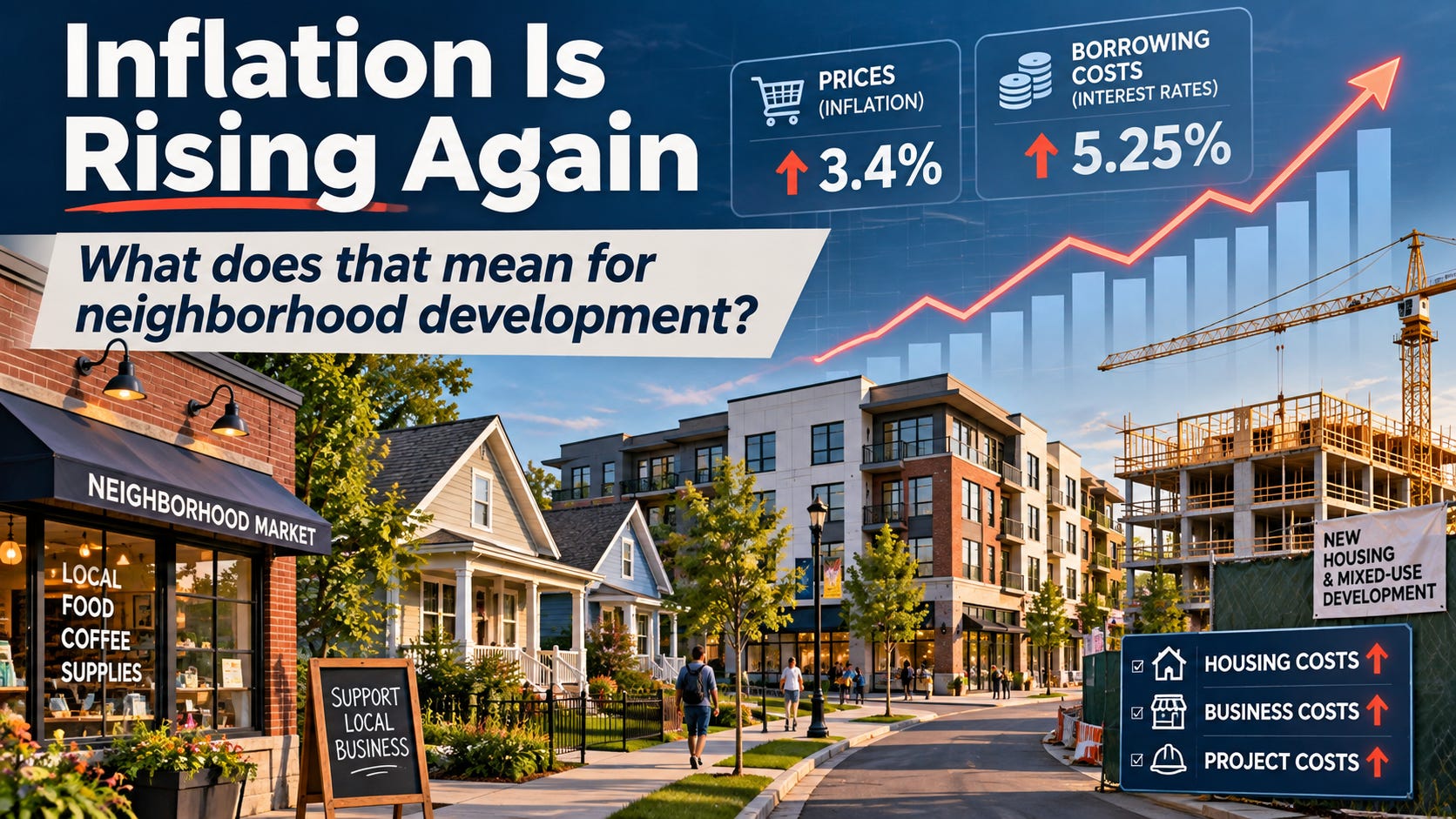
CLEVELAND, Ohio — A neighborhood needs new housing. A developer has a plan. The community supports it. Financing appears possible.
Then the numbers change.
Higher construction costs, more expensive loans or additional lender requirements can turn a promising development into a project that never gets built.
That financial reality deserves renewed attention following Tuesday’s inflation report from the U.S. Bureau of Labor Statistics.
Consumer prices increased 0.4% in October, following a 0.6% increase in September. Food prices rose 0.5%, shelter costs increased 0.3%, and energy prices climbed 0.7%.
Although monthly inflation slowed, prices continued rising. For families already struggling with housing and everyday expenses, that distinction offers little immediate relief.
For developers and neighborhood businesses, the challenge extends beyond consumer prices to the cost of borrowing money and completing projects.
When Interest Rates Change, Projects Change
Consider a hypothetical neighborhood development requiring a $7 million loan.
At 6% interest, the annual interest expense would be $420,000. At 8%, it increases to $560,000.
That’s an additional $140,000 annually, assuming the full loan remains outstanding under an interest-only arrangement.
The example is illustrative, not a current Cleveland lending quote. But the consequences are real. A development financially feasible at one interest rate may become impossible at another.
The Federal Reserve’s October 2026 Senior Loan Officer Opinion Survey found banks tightening lending standards for construction, commercial real estate, multifamily housing and smaller businesses.
For neighborhood developers with limited financial reserves, securing financing can become particularly difficult.
Construction Costs Add Another Obstacle
Financing isn’t the only concern.
The Associated General Contractors of America reported that national construction input costs increased 11.9% between September 2025 and September 2026.
Higher materials, fuel and transportation costs contributed to the increase.
Those figures represent national construction input prices, not actual Cleveland project budgets. Local costs vary considerably depending on the property, contractors and materials involved.
Nevertheless, the pressure reaches neighborhood development.
Contractors face higher expenses. Developers must reconsider budgets. Projects may require additional financing, smaller scopes or delayed construction schedules.
For smaller, locally owned contracting businesses, rising costs also mean more working capital is needed before they can complete jobs and collect payment.
Neighborhood Businesses Are Feeling It Too
A neighborhood entrepreneur hoping to renovate a vacant storefront faces many of the same challenges.
Property acquisition, equipment, utilities, renovations and financing all affect whether the business can open or expand.
The National Federation of Independent Business reported that a seasonally adjusted net 33% of surveyed small-business owners raised selling prices in October, while a net 13% reported paying higher interest on their most recent loans.
These are national survey findings rather than Cleveland-specific results.
In neighborhoods where household incomes are already stretched, raising prices may also reduce customer spending. Businesses can find themselves caught between increasing expenses and customers who cannot afford to pay more.
Affordable Housing Has Even Less Flexibility
Affordable housing developers face a particularly difficult calculation.
Unlike conventional market-rate developments, affordable housing projects often cannot increase rents enough to offset rising construction and financing costs.
A May 2026 Federal Reserve Bank of Cleveland report found that 61% of surveyed community stakeholders reported declining affordable housing availability during the previous six months.
Another 72% reported deteriorating financial conditions among lower- and moderate-income residents.
Those findings highlight the importance of developing housing that families can actually afford while maintaining financially sustainable properties.
Finding Capital Without Losing Community Ownership
The financial environment places greater importance on tools such as Low-Income Housing Tax Credits, New Markets Tax Credits, Community Development Financial Institution financing and eligible Opportunity Zone investments.
These programs have different requirements, but properly structured investments can help close financing gaps and support projects that conventional lending alone cannot accommodate.
Public incentives should also raise an important question: Who ultimately benefits from the investment?
Outside capital can help neighborhoods grow. But development should also create opportunities for local ownership, neighborhood businesses, contractors and residents.
A successful project should do more than increase property values. It should help communities retain economic value and participate in the wealth being created.
The Real Test Is What Gets Built
National inflation figures cannot tell Cleveland residents exactly what it costs to renovate a building on Miles Avenue or construct affordable housing in East Cleveland.
Those answers require actual construction estimates, financing commitments and local market analysis.
What the national figures do show is that the financial environment matters.
For neighborhoods seeking investment, economic development must involve more than identifying vacant properties and announcing ambitious plans.
It requires understanding the cost of capital, securing workable financing and ensuring that the resulting development benefits the people who live and do business there.
Because when the numbers no longer work, neighborhoods don’t simply lose investment opportunities. They lose housing, businesses, jobs and another chance to build lasting wealth.