

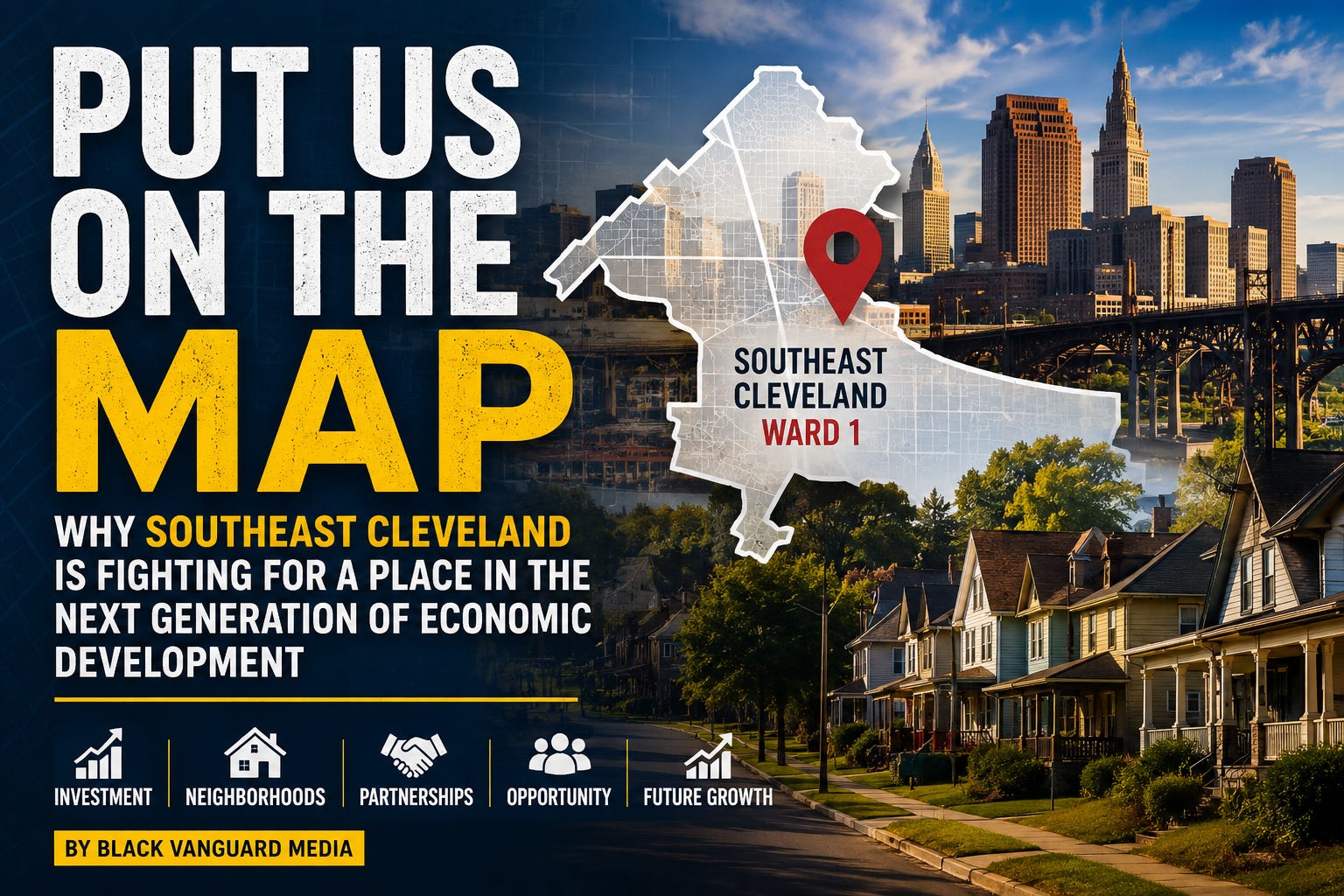
Something important is happening on Cleveland’s Southeast Side.
And if successful, it could quietly shape the next 10 years of economic development, investment, housing, commercial growth, and neighborhood revitalization in Ward 1 and beyond.
Recently, Joseph Jones addressed the Cleveland City Council about an initiative called “Put Us On The Map” — a coordinated effort involving Community Development Corporations, stakeholders, and development partners seeking to position portions of Southeast Cleveland for inclusion in future Opportunity Zone maps.
At first glance, this may sound technical or bureaucratic.
It is not.
In reality, this effort touches one of the most important questions facing modern cities:
Which neighborhoods are structurally positioned to receive investment — and which ones are not?
What Are Opportunity Zones?
Opportunity Zones were created as a federal economic development tool designed to encourage long-term private investment into economically distressed communities.
The concept is relatively simple:
If investors place capital into designated Opportunity Zones and keep investments there long enough, they may receive significant tax advantages.
That incentive matters because investment rarely moves based on emotion alone. It moves based on:
• Risk
• Return
• Predictability
• Long-term incentives
Opportunity Zones help alter that equation.
Over the last decade, they have become a major part of the economic development playbook used in cities across America.
And Cleveland is no exception.
The Quiet Reality Behind Development
When people see cranes, apartment projects, mixed-use developments, commercial corridors, or major reinvestment efforts, they often assume it happened because someone simply “decided” to invest there.
That is rarely how modern development works.
Behind many large-scale projects are layers of structured economic tools:
• Tax credits
• Incentive programs
• Public-private partnerships
• Capital stacking
• Opportunity Zones
• Institutional financing mechanisms
These tools do not guarantee development.
But they often determine where investment becomes more likely.
And that is what makes the current Southeast Side effort noteworthy.
The Part Many Residents Never Hear
According to Councilman Jones, when the original Opportunity Zone maps were drawn years ago, large portions of Ward 1 and the Southeast Side were not included.
That matters more than many people realize.
These maps are not adjusted every year. They remain in place for long periods of time — often approximately a decade.
In practical terms, that means a neighborhood either spends years positioned to attract capital… or years trying to compete without the same structural advantages.
That does not mean investment becomes impossible.
But it does mean the playing field changes.
“Put Us On The Map”
Rather than treating the issue as purely political, the organizations involved appear to be approaching it strategically.
The phrase “Put Us On The Map” is more than branding.
It reflects a broader realization emerging in many urban communities across America:
If neighborhoods are not included in the systems that influence capital flow, they risk being excluded from major phases of long-term economic growth.
What makes this effort especially notable is that it is not being framed as anti-development elsewhere.
Instead, it is being framed as inclusion.
The argument being made is straightforward:
If structured economic tools helped stimulate growth in parts of Cleveland such as:
• Downtown Cleveland
• University Circle
• Detroit–Shoreway
…then Southeast Cleveland should at least have the opportunity to compete using similar tools.
That is a very different conversation than simply asking for more funding.
It is a conversation about positioning.
That theme of “positioning” was further explored during Councilman Joseph Jones’ recent interview with Darvio Morrow on The Outlaws Radio Show, where Jones explained that the effort is not simply about securing a designation, but about making sure Southeast Cleveland is structurally positioned to participate in the next generation of economic growth.
During the interview, Morrow asked Jones what he learned by studying where Opportunity Zone investment had already taken place throughout Cleveland.
Jones responded:
“I learned that communities that were strategically positioned benefited from long-term investment momentum. It reinforced how important these tools are in modern economic development and why we need to make sure the Southeast Side is not overlooked again.”
The conversation also highlighted the role of the Community Development Corporations helping lead the effort.
When asked about Harvard Community Services Center and NuPoint Development Corporation, Jones emphasized their long-term strategic focus:
“Harvard Community Services Center and NuPoint Development Corporation have been doing important work advocating for these neighborhoods and thinking long-term about economic growth. They’ve been collaborative, strategic, and committed to making sure the Southeast Side has a voice in these conversations.”
The interview helped frame the initiative less as a short-term political issue and more as a broader conversation about how communities compete for investment, visibility, and long-term economic participation.
Listeners can hear the full interview on The Outlaws Radio Show here.
Why Sophisticated Investors Will Notice This
Investors who understand the development strategy will likely recognize several important signals in this initiative.
First, the CDCs involved are not speaking solely in traditional community-service language.
They are increasingly discussing:
• Investment readiness
• Long-term positioning
• Capital access
• Federal engagement
• Opportunity Zone strategy
• Public-private alignment
Second, the effort involves active engagement beyond the neighborhood level.
According to the initiative’s organizers, stakeholders are already building relationships in:
• Columbus
• Washington, D.C.
• Economic development circles
• Structured finance conversations
That is significant.
Because sophisticated development ecosystems are rarely built through isolated local conversations alone.
Third, the messaging itself signals a shift in mindset.
This is not simply:
“We need help.”
It is:
“We are organizing ourselves to participate in the modern economic development environment.”
That distinction matters.