

The future belongs to people who decide to act before they’re invited.
There is a familiar pattern in professional life. We wait for the promotion before we see ourselves as leaders. We wait for an organization to invite us to the table before offering our expertise. Entrepreneurs wait for capital before fully pursuing an idea, and nonprofit organizations sometimes wait for a funding opportunity before deciding whether an initiative is worth pursuing.
In each case, we have placed the decision about what happens next in someone else’s hands.
There are certainly times when we need an invitation. Someone has to hire us for the job. A funder has to approve the grant. An investor has to decide to invest. A board has to authorize certain decisions. But there is a difference between needing someone else’s participation and needing someone else’s permission to begin.
That distinction matters.
Recognition Usually Follows the Work
One of the misconceptions about professional advancement is that recognition creates opportunity. More often, recognition is the result of work that has already been done.
People become known as experts because they have spent years developing expertise. Professionals become candidates for larger leadership roles because they have demonstrated an ability to lead beyond the boundaries of their current positions. Organizations become attractive to funders because they can show evidence of relationships, infrastructure, outcomes and a clear understanding of the problem they are trying to solve.
By the time someone appears to have been “chosen,” there is usually a body of work behind that moment.
I have seen this repeatedly throughout my career in community development. Some of the strongest partnerships I have been part of did not begin with a funding announcement. They began with organizations understanding what they could contribute and identifying what they could not accomplish alone.
In projects involving greenspace development, neighborhood revitalization and community programming, our organization might bring land, community relationships, real estate experience and the trust of residents. Another partner might bring technical expertise, programming or access to capital. We did not need to become experts in everything. We needed to understand our value well enough to bring it to the table.
That is an important form of choosing yourself: knowing what you bring before someone else assigns a value to it.
The Organizational Version of Waiting to Be Chosen
The same dynamic occurs within nonprofits and community-based organizations.
Organizations can become so focused on responding to funding opportunities that funders inadvertently begin determining organizational strategy. A grant opportunity appears, and suddenly an organization is considering a new program. A government initiative is announced, and priorities shift to fit the available resources.
Over time, this can create organizations that are very good at responding to opportunities but less clear about what they actually intend to accomplish.
A stronger approach begins with the organization’s own strategy. What problem are we trying to solve? What assets do we already have? What evidence tells us this work is necessary? Who needs to be at the table? What can we begin doing now?
Funding then becomes a tool for advancing the strategy rather than the reason the strategy exists.
This does not mean money is unimportant. Anyone who has managed a nonprofit understands that vision without resources has limits. It does mean, however, that an organization can begin developing partnerships, gathering data, engaging stakeholders, designing the model and demonstrating demand before every dollar has been secured.
When funding does become available, that organization is no longer presenting an idea that exists primarily on paper. It is presenting a direction it has already begun to pursue.
Waiting Has a Cost
Waiting can look responsible because it allows us to avoid unnecessary risk. Sometimes it is responsible. Good leaders know when additional information, resources or consensus are necessary before moving forward.
But waiting also has a cost, and we rarely calculate it.
There is the opportunity we did not pursue because we assumed we were underqualified. There is the relationship we did not initiate because we were waiting for an introduction. There is the idea we kept private while someone else began working on something similar. There is the organization that spent another year discussing a problem it could have begun addressing on a smaller scale.
The question, then, is not simply whether there is risk in moving forward. Good decision-making requires us to ask about the risk of standing still.
This is particularly relevant during periods of uncertainty. When funding environments tighten, industries change or institutions become less predictable, waiting for conditions to return to “normal” can become its own strategy. It is rarely a very good one.
Leaders still have to make decisions.
Choosing Yourself Is Not the Same as Going It Alone
There is an important distinction here. Choosing yourself does not mean believing you do not need other people.
In fact, effective leadership requires exactly the opposite. The ability to build partnerships, ask for help, recognize gaps in your own expertise and share ownership is often what allows an idea to grow.
Choosing yourself means deciding that you do not need someone else’s recognition before you begin contributing at the level you know you are capable of contributing.
You can initiate the conversation.
You can develop the proposal.
You can apply for the position.
You can publish your thinking.
You can convene the partners.
You can test the idea on a smaller scale.
You can walk into a room knowing what you bring to it, even when no one has formally asked you to be there.
The invitation may still matter. It just does not have to be the beginning of the story.
Leadership Often Starts Before the Title
Some of the most consequential leadership decisions happen before anyone formally recognizes them as leadership.
They happen when someone identifies a gap and decides to address it. When an organization refuses to allow a funding cycle to dictate its entire vision. When a professional stops waiting for a title to demonstrate executive-level thinking. When a community decides that outside investment would be helpful, but its absence will not prevent residents from organizing around what they can change themselves.
Eventually, some of those efforts will attract recognition, resources and larger opportunities. Others will not. Choosing to act does not guarantee that every idea succeeds.
It does something more important: it returns responsibility for the next move to you.
There may be a position you want, an organization you want to build, an initiative you believe should exist or a conversation you know needs to happen. Instead of asking who needs to choose you before you can move forward, consider what part of that work is already within your control.
Start there.
The future belongs to people who decide to act before they’re invited.
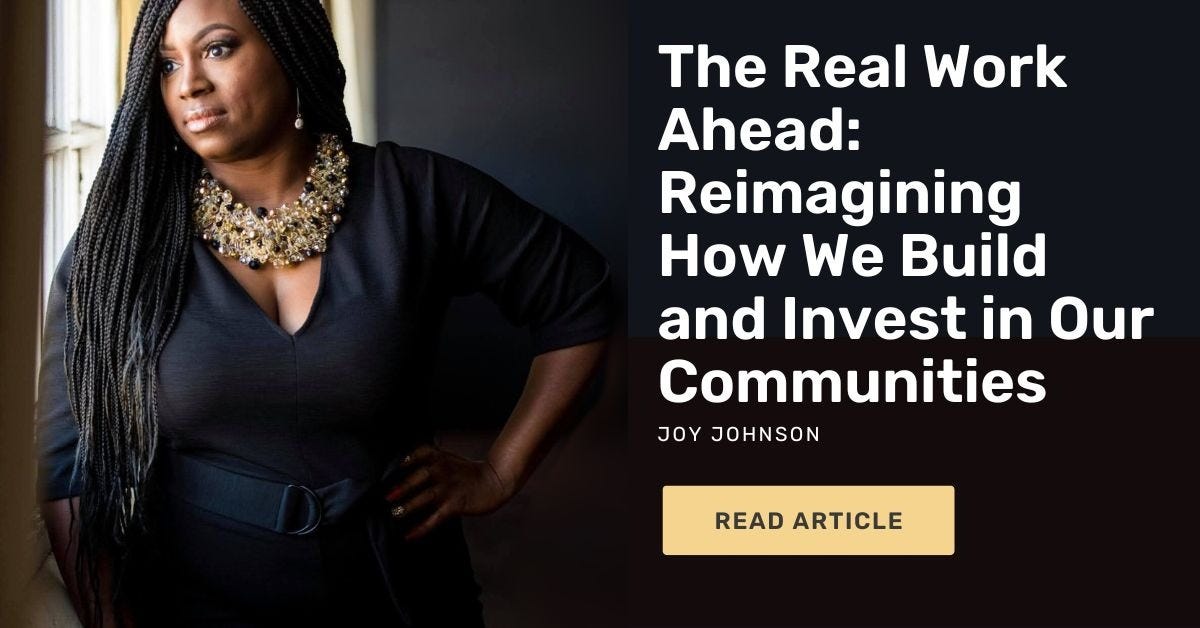
With more than two decades of experience in community development, real estate strategy, and organizational leadership, Joy Johnson brings a seasoned, solutions-focused voice to the field. She is committed to helping communities and institutions avoid systemic pitfalls and build models that truly work. To reach Joy call (216) 238-2235