

When someone is diagnosed with a mental health condition, they are rarely the only person affected.
Parents begin searching for answers. Spouses wonder how best to provide support. Siblings struggle to understand sudden changes in behavior. Friends want to help but often don’t know what to say or do. Entire families can find themselves navigating unfamiliar territory while trying to balance work, school, relationships, finances, and the emotional weight of caring for someone they love.
Mental illness is often described as an individual experience, but its impact extends well beyond the individual. Families frequently become caregivers, advocates, crisis responders, and sources of emotional support—often without any formal training or guidance.
At Check Up From the Neck Up, we believe that supporting mental health means supporting families as well. One of the most valuable resources available for caregivers is the National Alliance on Mental Illness (NAMI) Family-to-Family program.
What Is Family-to-Family?
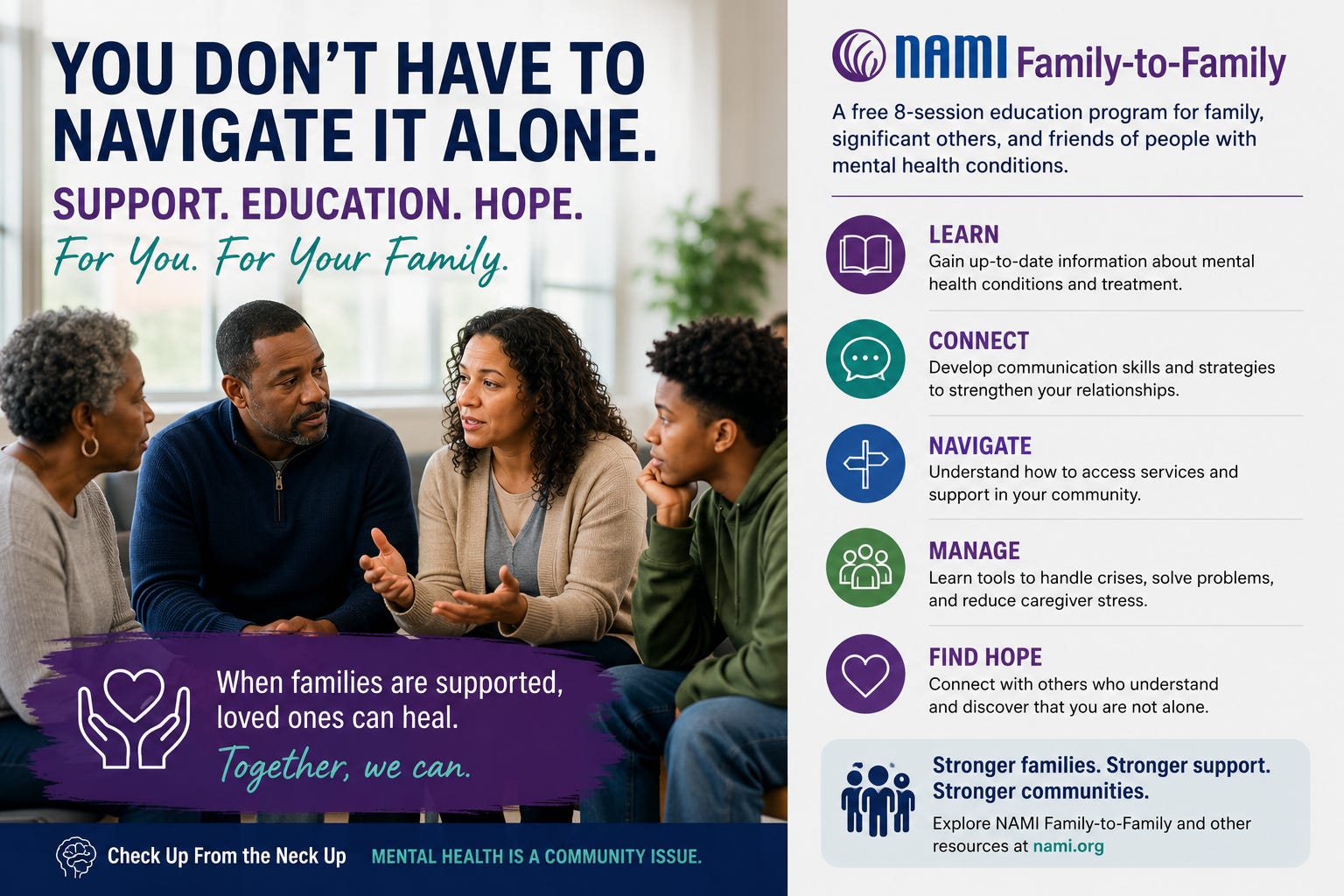
NAMI Family-to-Family is a free, eight-session educational program designed specifically for family members, significant others, and close friends of individuals living with mental health conditions.
Rather than focusing solely on mental illness itself, the program equips participants with practical knowledge and skills to better understand what their loved one may be experiencing while also helping caregivers care for themselves.
Participants learn from trained facilitators who have lived experience supporting a family member with mental illness, creating an environment built on empathy, understanding, and shared experience.
Caring for Someone Can Be Challenging
Supporting someone through depression, bipolar disorder, schizophrenia, anxiety disorders, or another mental health condition can be emotionally exhausting.
Families often ask questions such as:
Am I saying the right thing?
How do I respond during a crisis?
How can I encourage treatment without creating conflict?
Where do I find reliable information?
How do I take care of myself while caring for someone else?
These questions are common, yet many caregivers feel they must answer them alone.
Family-to-Family recognizes that caregivers need support, education, and community just as much as the people they are helping.
What Participants Learn
Throughout the eight-session program, participants gain practical tools that can be applied in everyday life.
Topics include:
Understanding common mental health conditions.
Effective communication strategies.
Responding to mental health crises.
Problem-solving techniques.
Navigating treatment and community resources.
Managing caregiver stress and preventing burnout.
Building healthy boundaries while maintaining supportive relationships.
The goal is not to turn family members into mental health professionals. Instead, it is to help them become informed, confident partners in their loved one’s recovery journey.
The Importance of Caring for the Caregiver
One of the most overlooked aspects of mental health care is the well-being of caregivers themselves.
Parents, spouses, grandparents, siblings, and close friends often place their own emotional and physical health on hold while focusing entirely on someone else’s needs.
Over time, this can lead to chronic stress, anxiety, compassion fatigue, and burnout.
Family-to-Family reminds participants that caring for themselves is not selfish—it is essential. Healthy caregivers are better equipped to provide consistent, compassionate support while maintaining their own well-being.
This emphasis on caregiver wellness makes the program unique. Recovery is not only about helping the individual experiencing mental illness; it is also about strengthening the family system surrounding them.
Why Peer Support Matters
One of the program’s greatest strengths is its peer-led approach.
Participants are surrounded by others who have experienced similar challenges. They can ask difficult questions, share frustrations, celebrate successes, and learn from people who genuinely understand what they are going through.
For many caregivers, simply hearing someone say, “I’ve been there,” can reduce feelings of isolation and provide hope during difficult moments.
These shared experiences often become a reminder that no family has to navigate mental illness alone.
Why This Matters for Our Community
At Check Up From the Neck Up, we recognize that improving mental health outcomes requires more than expanding clinical services. It also requires strengthening the families and support systems that individuals rely on every day.
Programs like Family-to-Family help communities become more informed, compassionate, and resilient. They empower families with knowledge instead of fear, confidence instead of uncertainty, and connection instead of isolation.
Whether someone is supporting a child, spouse, sibling, parent, or close friend, access to education and peer support can make an enormous difference in both the caregiver’s well-being and the recovery journey of their loved one.
Looking Forward
Mental health recovery is rarely a journey taken alone. Behind many individuals living with mental illness are family members, friends, and loved ones who quietly provide encouragement, stability, and hope.
Those caregivers deserve support as well.
NAMI’s Family-to-Family program recognizes that when families are educated, connected, and empowered, they become stronger advocates and healthier partners in recovery.
By investing in caregivers, we strengthen entire families—and when families are stronger, communities become stronger too. That is a vision we proudly support through Check Up From the Neck Up.