

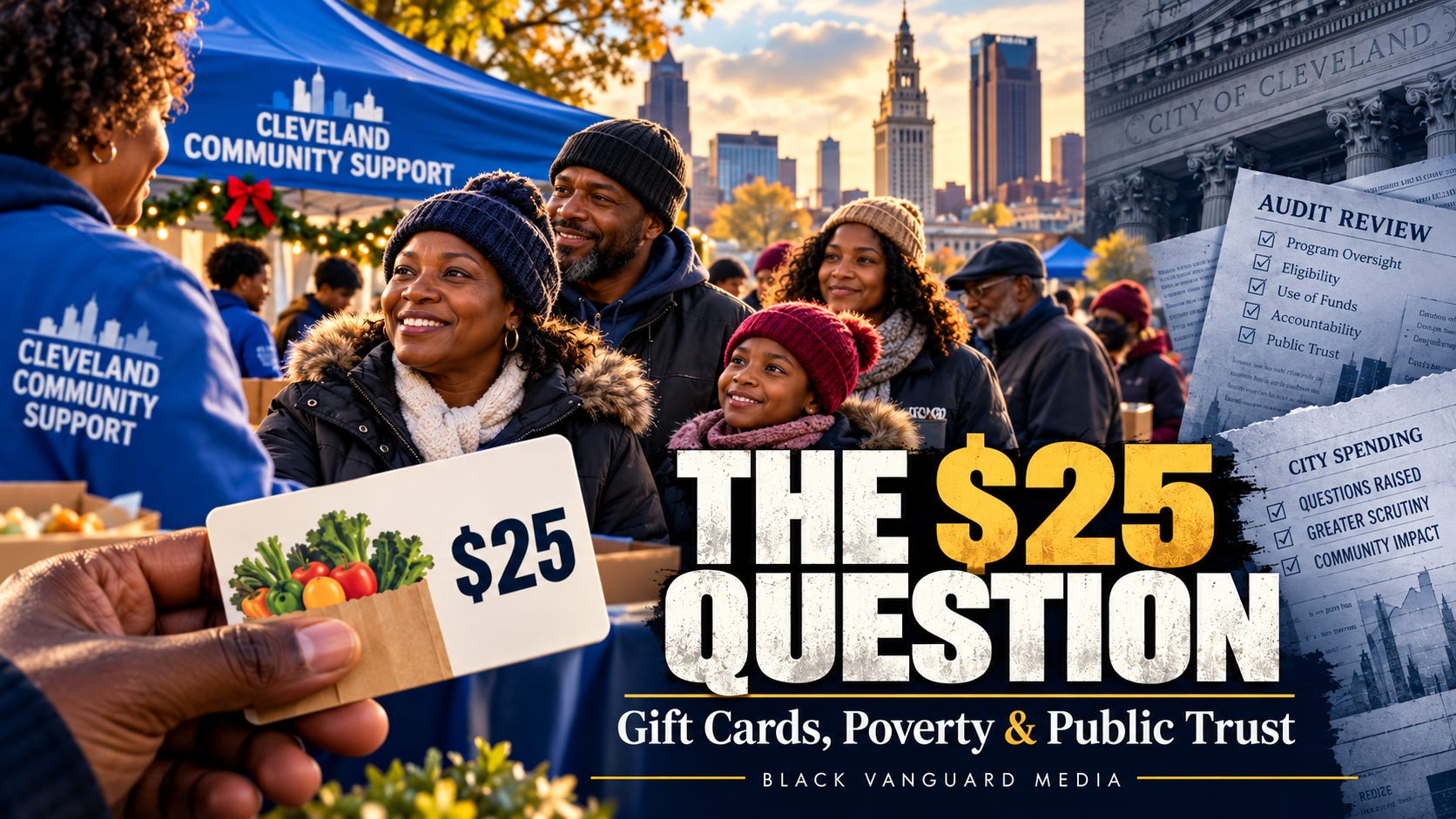
CLEVELAND — When government provides financial incentives to developers, it is generally described as economic development. When corporations receive tax credits, the assistance is often justified as an investment in jobs and economic growth. But when Cleveland distributes a $25 grocery gift card to a struggling resident, the conversation can turn to political corruption and buying votes.
The distinction deserves examination, particularly in a city where poverty remains a persistent challenge and community organizations are being asked to accomplish more with increasingly limited resources.
During an October 22 Cleveland City Council Operations Committee hearing chaired by Councilman Kris Harsh, members and invited academics discussed the ethical questions surrounding the city’s longstanding grocery gift card program. The discussion addressed legitimate concerns about accountability, documentation and whether elected officials should participate in distributions.
It also raised a question that received considerably less attention: Why does government assistance appear to be viewed differently depending on who receives it?
Cleveland’s holiday grocery gift card program is not new. City Council records document its use in multiple wards by at least 2019, when council authorized nonprofit organizations to distribute food assistance using ward casino revenue funds.
The program developed into a familiar holiday tradition in neighborhoods where residents have struggled with food insecurity, rising living expenses and limited household income.
For some families, receiving a gift card is part of a larger community gathering that may include holiday activities, refreshments and opportunities to interact with neighbors and local organizations. It is not simply a financial transaction.
And while $25 has never represented a substantial amount of money, its purchasing power has declined significantly.
According to the U.S. Bureau of Labor Statistics, grocery prices nationally increased approximately 33 percent between September 2019 and September 2026. Something that cost $25 seven years ago would now cost approximately $33.
Consider the price of ordinary groceries. A large bag of potato chips can cost $5, while a bottle of pop can approach $3. Those two purchases alone can consume nearly one-third of the card’s value.
Depending on the store and the size of the bird, $25 may not even cover a Thanksgiving turkey, much less the ingredients necessary to prepare an entire holiday meal.
Yet the assistance remains meaningful enough that residents sometimes wait hours to receive it.
Having attended multiple gift card distributions, this writer has observed residents spending nearly two hours waiting for a $25 card. That willingness to wait does not establish every person’s financial circumstances, but it illustrates how valuable even modest assistance can be.
It also raises questions about the suggestion that accepting such assistance somehow compromises a resident’s political independence.
The implication that a $25 grocery card could purchase the loyalty of Black voters is especially troubling.
Cleveland’s Black electorate has a long history of political participation, organizing and holding public officials accountable. Accepting a modest government benefit does not mean a resident is incapable of making an independent political decision.
Someone can appreciate receiving assistance from a council member and still vote against that council member in the next election.
To assume otherwise risks reducing an entire community to a collection of voters whose political judgment can be purchased for the price of a few groceries.
The distinction between constituent service and political bribery was addressed directly during the October 22 hearing. One invited academic noted that elected officials routinely receive political credit for legitimate public investments, including playgrounds, neighborhood improvements and grocery development projects.
Residents who appreciate those improvements may subsequently support the officials responsible for securing them. That does not automatically transform the expenditures into corruption.
Ohio law prohibits offering things of value to improperly influence voting behavior. But providing assistance through an authorized public program, with established eligibility requirements and appropriate safeguards, is not inherently the same as purchasing votes.
That distinction matters.
It also invites comparison with the financial tools government routinely makes available to businesses.
Ohio’s Tax Increment Financing program allows local governments to redirect certain revenues associated with increased property values toward eligible public infrastructure improvements. Property Assessed Clean Energy financing helps property owners finance qualifying improvements through assessments repaid over time. Job creation tax credits provide financial incentives to businesses that meet employment and investment commitments.
These programs have different legal structures and purposes. PACE financing, for example, generally involves repayment rather than an outright grant. Business incentives are also subject to scrutiny, and some have generated significant public controversy.
Nevertheless, they demonstrate government’s willingness to use financial tools to achieve objectives considered beneficial to the public.
The question is whether helping a financially struggling resident purchase food should be viewed as any less legitimate than encouraging a business to expand.
The public benefits are different, but both can serve a recognized governmental purpose.
There is also an administrative reality largely missing from the debate.
Community development corporations, commonly known as CDCs, have historically played an important role in distributing grocery cards. Under the reimbursement arrangements described by those familiar with the process, participating organizations may be required to purchase the cards before recovering their expenditures from the city.
For an organization handling a $50,000 distribution, that can mean advancing $50,000 of its own money.
When reimbursement can take up to six months, as has been reported in some instances, the CDC is effectively financing a municipal assistance program.
That arrangement presents a substantial challenge for smaller neighborhood organizations.
Most CDCs operating on Cleveland’s East Side do not have the financial flexibility to comfortably set aside $50,000 while continuing to meet payroll, maintain facilities, administer programs and satisfy existing obligations.
The problem has become more pronounced as neighborhood organizations have confronted a changing funding environment since 2022, including reductions in available support and increased competition for resources.
The pressure on these organizations was evident in the October 23 Development, Planning and Sustainability Committee hearings, where council members and city officials discussed CDC funding, program administration and possible changes to the distribution of federal Community Development Block Grant resources.
Officials acknowledged funding shortfalls affecting several organizations and discussed supplemental assistance and potential changes to future funding arrangements.
The connection to the gift card program is important. A city seeking to help low-income residents should not have to rely on financially strained nonprofits to carry the upfront cost of providing that assistance.
If the organizations closest to the communities cannot afford to participate, the administrative system itself becomes a barrier to delivering resources.
That is a problem worth solving before the next holiday distribution.
None of these concerns eliminate the need for accountability.
Ohio Auditor Keith Faber’s office identified documentation and eligibility problems involving gift card distributions in Wards 1 and 10. Findings reported in July 2026 included 88 cards distributed to individuals with addresses outside Cleveland and more than 1,500 missing or incomplete compliance forms across the two wards.
Those findings are serious and should not be dismissed.
Public funds require appropriate documentation, eligibility verification and safeguards against improper use.
At the same time, incomplete documentation does not automatically establish intentional corruption or election bribery.
Large-scale distributions involving hundreds of residents, limited staffing and eligibility requirements can be difficult to administer perfectly. That reality does not excuse administrative failures, but it should inform how those failures are evaluated and corrected.
A discrepancy is a discrepancy, whether it involves one record or hundreds. Every discrepancy deserves appropriate review. But the response should be based on its nature, significance and cause, rather than an assumption that every administrative error reflects deliberate wrongdoing.
The fairest approach would be a consistent examination of the program across every participating ward, using the same requirements and the same standards.
That broader perspective also matters when considering the attention directed toward individual council members.
Councilman Joe Jones weathered a significant political storm in 2025 surrounding questions about his ward’s gift card distributions. His name resurfaced during this year’s ethics discussion, even as the hearing was intended to address a citywide public-policy question.
The renewed attention raises a concern that a hostile political working environment may be developing around Jones, particularly given the controversies he experienced last year.
That concern does not establish that the committee intended to target him or that any coordinated effort exists. But repeatedly returning to one council member while debating a program used in multiple wards risks creating the appearance of selective scrutiny.
During the hearing, Councilman Richard Starr also questioned why the discussion appeared to focus on an individual ward and suggested that the conversation should be taken directly into the neighborhoods where residents receive the assistance.
The larger issue is not whether Jones, or any other elected official, should be questioned. Public officials must be accountable.
It is whether accountability is being applied consistently, without allowing a citywide administrative issue to become unnecessarily personalized.
By the conclusion of the October 22 hearing, Harsh acknowledged broad agreement that grocery gift cards serve a legitimate purpose and should remain available to residents who need them.
That provides a reasonable starting point for reform.
The city can strengthen eligibility verification, improve recordkeeping, establish clearer rules governing the involvement of elected officials and develop a more predictable reimbursement system.
It can also reconsider whether requiring neighborhood nonprofits to advance substantial sums is financially practical, particularly in the communities with the greatest need.
There is room for stronger oversight without abandoning a program that has become part of Cleveland’s holiday traditions.
There is also room to question the assumptions that accompany debates over assistance to low-income residents.
Government routinely accepts that public resources can be used to encourage economic activity, support development and improve communities. Assistance to vulnerable residents should be evaluated with the same seriousness and commitment to public benefit.
A $25 grocery card will not eliminate poverty. It will not resolve Cleveland’s food insecurity challenges or replace the need for meaningful economic opportunities.
But it can help someone purchase groceries.
And for the resident willing to spend two hours waiting to receive it, that assistance may be considerably more important than the political debate surrounding it.
The challenge for Cleveland is to preserve that benefit while creating a system that protects public resources, respects recipients and does not place an unreasonable financial burden on the organizations responsible for delivering assistance.
The question should not be whether government has a legitimate role in helping a struggling family purchase groceries.
It should be how Cleveland can do that responsibly, efficiently and with the same recognition of public value that it extends to other forms of government investment.