

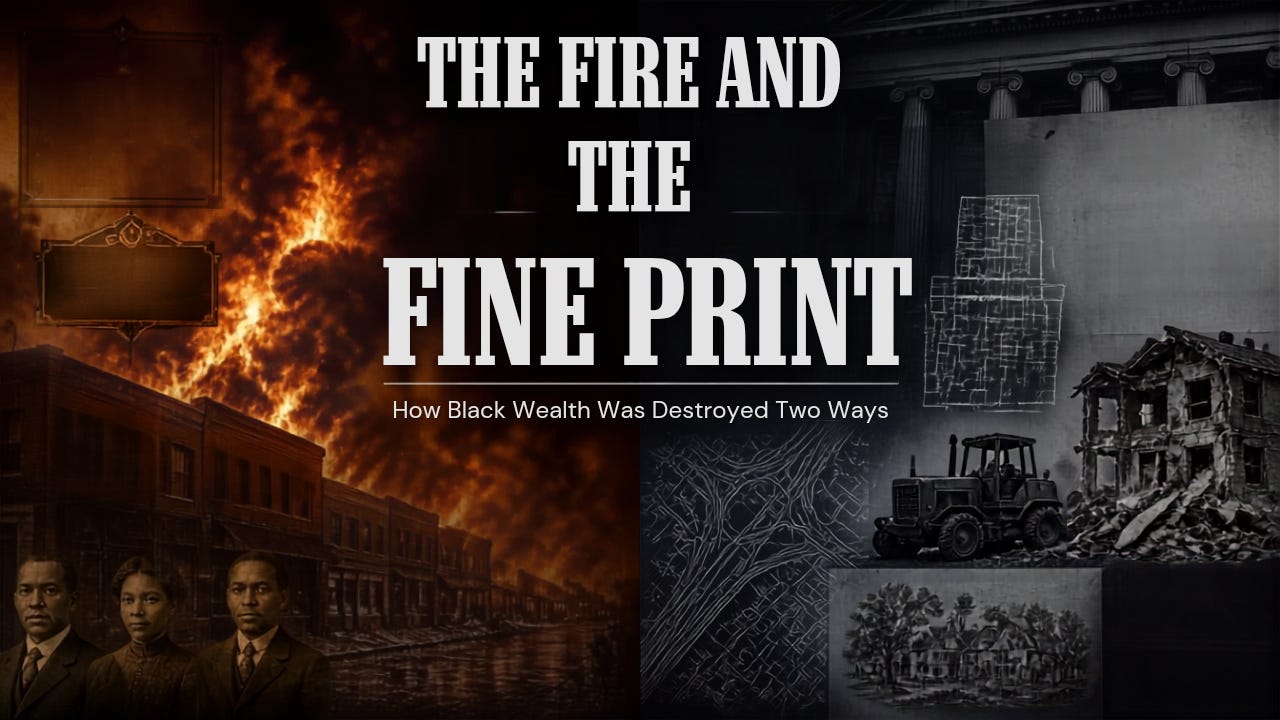
From Greenwood and Wilmington to Seneca Village, Detroit’s Black Bottom and Winston Willis’s Cleveland empire, American racism did not always arrive carrying a torch. Sometimes it arrived carrying a redevelopment plan, a court order and a smile.
America has two very different ways of destroying a community.
One is impossible to miss.
There are mobs. Guns. Flames. Bodies in the street. Businesses reduced to ashes.
The other can happen without a single window being broken.
There are condemnation notices. Building inspections. Foreclosures. Zoning decisions. Highway plans. Court orders. Eminent domain proceedings. Redevelopment authorities. Property valuations. Tax bills.
One looks like violence.
The other looks like paperwork.
But when the smoke clears — or the paperwork is finally signed — the result can be remarkably similar: Black people lose land, businesses, institutions and the ability to pass wealth from one generation to the next.
That distinction matters because much of America’s understanding of attacks on Black economic power begins and ends with what happened in the South and border states.
We know about the fires.
We talk much less about the fine print.
When Black Success Could Be Burned
Wilmington, North Carolina, was not simply the scene of racial violence in 1898. Before the massacre and coup, Wilmington had a thriving Black middle class, Black professionals, business owners and Black elected officials participating in a biracial political coalition.
White supremacists responded by overthrowing the elected government.
The office of the Black-owned Daily Record was burned. Black residents were killed. Elected officials were forced from office. Black leaders and business owners fled.
The coup shattered Black political and economic power in Wilmington for generations.
Then there was Greenwood.
By 1921, Tulsa’s Greenwood District had become one of the most prosperous Black communities in America. Its concentration of Black doctors, entrepreneurs, hotels, restaurants, churches, theaters and other businesses earned it the name “Black Wall Street.”
Then came May 31 and June 1.
An armed white mob descended on Greenwood. More than 1,100 homes were burned along with businesses, churches, a hospital, a school and a library. As many as 300 people may have been killed, and thousands were left homeless.
That story is finally becoming part of the American consciousness.
But there is another part of the Greenwood story that receives considerably less attention.
Black Wall Street came back.
Greenwood residents rebuilt despite attempts to use new zoning and building restrictions to prevent them from doing so. By the 1930s and 1940s, the community was again thriving.
Then another weapon arrived.
Highways.
Beginning decades after the massacre, highway construction and urban renewal cut through rebuilt Greenwood. Smithsonian has described this as Black Wall Street’s “second destruction.” This time there was no white mob carrying kerosene. Government plans and transportation policy did much of the work.
Greenwood may therefore be one of the clearest examples of both systems operating against Black wealth.
First came the mob.
Then came the map.
Seneca Village: Before There Was Central Park
Long before Greenwood, free Black New Yorkers were building something remarkable in Manhattan.
Beginning in 1825, Black families began purchasing property in an area that eventually became known as Seneca Village.
By 1855, approximately 225 people lived there, roughly two-thirds of them Black. The community contained homes, three churches and a school. More than half of its Black households owned property — an extraordinary rate of Black landownership for nineteenth-century New York.
Property ownership carried another enormous benefit. Under New York law at the time, Black men who met a property qualification could vote.
Then New York City decided to build Central Park.
The government used eminent domain.
By 1857, Seneca Village was gone.
Its houses were removed. Its residents dispersed. The community eventually disappeared so thoroughly from New York’s historical memory that scholars had to reconstruct its existence more than a century later.
There is an important historical distinction here.
Researchers working with the Central Park Conservancy say there is no evidence that officials selected the Central Park site specifically for the purpose of destroying Seneca Village. Research also suggests property owners were generally compensated at market values comparable with other owners whose land was taken.
That matters.
History should not be turned into conspiracy simply because conspiracy makes a better story.
But something else matters too.
A legally authorized action still eliminated one of Manhattan’s most significant communities of Black property owners.
Intent and impact are not the same question.
A check for the assessed value of a house does not recreate a community. It does not replace the church next door, the customer base down the street, the political power associated with concentrated landownership or the future appreciation of property that might otherwise remain inside a family for generations.
There does not have to be a burning cross for Black wealth to disappear.
Sometimes the government can take the land legally.
Detroit: When “Progress” Came Through the Neighborhood
Detroit tells the story even more clearly.
Black Bottom and the neighboring commercial district known as Paradise Valley became centers of Black life during the Great Migration.
By 1942, more than 300 Black-owned businesses were operating in Black Bottom and Paradise Valley — including restaurants, barber shops, beauty salons, hotels, doctors’ offices and drugstores.
Black Detroiters had already been restricted in where they could live through discriminatory housing practices and restrictive covenants.
Then the areas where Black residents had been concentrated were labeled for redevelopment.
The Housing Act of 1949 and Highway Act of 1956 provided the governmental machinery and money.
Buildings came down.
The Chrysler Freeway and what became I-375 went through the area. Lafayette Park rose on part of the former Black Bottom.
The Michigan Department of Transportation today explicitly acknowledges that I-375 was constructed as part of a larger urban-renewal project that cleared the redlined Black Bottom and Paradise Valley neighborhoods and created a historic environmental-justice harm.
No mob had to burn 300 businesses.
The bulldozers were authorized.
The money was appropriated.
The plans were approved.
And the neighborhood disappeared.
James Baldwin understood exactly what was happening.
In 1963, he reduced an entire era of American public policy to five devastating words:
“Urban renewal means Negro removal.”
Baldwin understood something about Northern racism that remains important today.
Moving north did not necessarily mean escaping Jim Crow. Writing about Harlem, Baldwin observed that Black Americans who migrated north did not simply escape the system; they encountered what he described as another “not-less-deadly variety.”
The signs changed.
The mechanisms changed.
The consequences did not always change with them.
Winston Willis and the Miracle on East 105th Street
Cleveland has its own version of this history.
His name is Winston Willis.
Willis founded the Jazz Temple in Cleveland in the early 1960s. It became one of the city’s great jazz venues, hosting musicians including Miles Davis, John Coltrane, Dizzy Gillespie, Cannonball Adderley and Herbie Hancock.
It also attracted interracial audiences.
After threats and violence, the Jazz Temple was bombed and ultimately closed.
Willis did not disappear.
He got bigger.
Around East 105th Street and Euclid Avenue, Willis acquired commercial real estate and built an extraordinary collection of businesses through University Circle Properties Development.
There were restaurants.
Movie theaters.
Retail shops.
Entertainment venues.
A food market.
A money exchange.
Clubs.
Studios.
Adult-oriented businesses were part of the portfolio, but they were hardly the entire portfolio.
At its height, Willis controlled roughly 28 businesses and employed hundreds of people. A 1973 Cleveland Press story called what he had created the “Miracle on E. 105th Street.”
And he had built it in one of the most strategically valuable areas in Cleveland — between powerful medical, educational and cultural institutions with their own visions for University Circle.
By the 1960s and 1970s, municipal officials and University Circle institutions were looking toward redevelopment of the East 105th and Euclid area.
Willis was sitting in the middle of it.
Then came years of lawsuits, inspections, tax disputes, criminal proceedings, foreclosures and battles with the city.
Cleveland Historical, a public-history project based at Cleveland State University, describes Willis as having been locked in legal battles with the city throughout the late 1970s and early 1980s. It reports that after city investigations, Willis was imprisoned, his property was confiscated and nearly all of his properties were ultimately demolished as redevelopment moved forward and the William O. Walker Center was constructed.
Willis and members of his family have made a much stronger allegation: that city officials and powerful institutions deliberately used the legal system to destroy his business empire and take his land.
Those allegations should be described as allegations, not settled judicial findings.
Willis pursued litigation alleging that defendants conspired to deprive him of property without due process. Federal courts dismissed later claims, and a Sixth Circuit decision in 1990 held that his renewed challenge to a foreclosure was barred because the underlying foreclosure dispute had already been adjudicated.
That legal history is important.
But so is the physical history.
A Black man controlled a remarkable concentration of businesses and valuable commercial real estate at one of Cleveland’s most important intersections.
He fought powerful public and private institutions over that land.
And eventually, his business district disappeared.
Today, almost nothing about driving through University Circle tells a visitor that a Black entrepreneur once controlled an empire there.
That raises a question worth asking even without accepting every allegation Willis made:
If Black economic power disappears through foreclosure, litigation, condemnation or redevelopment rather than fire, is the economic destruction somehow less real?
Why Dr. King Was Shaken by Chicago
This is also why Martin Luther King Jr.’s experience in Chicago deserves far more attention.
King had marched through Birmingham.
He had confronted Bull Connor.
He had seen police dogs.
He had seen fire hoses.
He had marched from Selma.
He had watched Southern authorities jail, beat and terrorize demonstrators.
Then he went north.
The Chicago Freedom Movement increasingly focused on housing discrimination — particularly the systems that kept Black families from renting or purchasing homes in white neighborhoods.
Activists tested real estate offices. Black prospective tenants and buyers were routinely denied opportunities that were available to whites.
Then King and other demonstrators marched into white neighborhoods.
On August 5, 1966, during a march near Marquette Park, King was struck in the head by a rock.
Bricks and bottles flew.
The crowd screamed racial slurs.
Some demonstrators encountered Nazi symbols and chants of “white power.”
King was stunned.
His actual words are more powerful than the version that is sometimes repeated today:
“I have never seen, even in Mississippi and Alabama, mobs as hostile and as hate-filled as I’ve seen in Chicago.”
King did not literally say Chicago was worse in every respect than Birmingham, Selma, Memphis or every Southern city in which he had worked.
What he said was specific.
The hostility of the mobs shocked a man who had already confronted some of the most notorious white supremacists in the South.
Why?
Partly because Chicago disrupted the comforting American idea that racism was a Southern disease.
In Birmingham, segregation announced itself.
There were laws.
Signs.
Sheriffs.
Governors standing in schoolhouse doors.
Chicago could describe segregation differently.
Property values.
Neighborhood character.
Private housing choices.
Real estate practices.
Local control.
King had moved from confronting a system that frequently said “No Negroes allowed” to confronting one capable of producing many of the same results without putting those words on a sign.
That can be harder to fight.
The enemy is easier to identify when he is standing in the doorway.
It is harder when he is sitting across the table telling you that he agrees with equality — but this particular development, this particular neighborhood, this particular loan, this particular property or this particular moment simply will not work.
Malcolm X Warned About the Smile
Malcolm X had his own metaphor for this distinction.
The wolf and the fox.
Malcolm argued that the conservative racial opponent was often like a wolf: you could see the teeth and recognize the threat.
But he described the white liberal as a fox.
The teeth were still there.
The difference was the smile.
“The white liberals are foxes,” Malcolm said, describing people who could show their teeth while appearing to smile. He warned that this version of political power could be more dangerous precisely because Black people might trust it.
Malcolm’s warning should not be lazily converted into a 2026 Democratic-versus-Republican talking point.
His argument was larger than a party label.
It was about power.
He was warning Black America against confusing friendly language with aligned interests.
A wolf tells you he opposes you.
A fox tells you he supports you while maneuvering you somewhere else.
Put Malcolm beside Baldwin and the history becomes difficult to ignore.
A city can call displacement urban renewal.
A bank can call exclusion risk management.
A developer can call displacement revitalization.
A government can call taking land eminent domain.
A real estate industry can call segregation market preference.
An institution can call expansion economic development.
None of those phrases tells you who ultimately lost the property.
America Taught Us to Look for the Fire
None of this means racism was gentle in the North.
It was not.
Northern cities had bombings, riots, restrictive covenants, police brutality and white mobs of their own.
Nor does it mean every redevelopment project involving a Black neighborhood was conceived as a racist conspiracy.
History is more complicated than that.
But the geographic distinction still teaches us something.
Where naked white supremacy could operate openly, Black advancement could be confronted with violence.
Where overt racial violence became politically unacceptable, institutions possessed other tools.
Law.
Finance.
Real estate.
Planning.
Regulation.
Taxation.
Infrastructure.
And courts.
A fire can destroy a business overnight.
A freeway can destroy its customer base forever.
A mob can steal what is inside a building.
A foreclosure can change who owns the land underneath it.
A riot can scatter a community.
Eminent domain can do the same thing with signatures.
That is why the history of Black economic destruction cannot stop with Tulsa.
We should ask what happened after Greenwood rebuilt.
We should ask what existed before Central Park.
We should ask what stood where I-375 stands in Detroit.
Cleveland should ask what existed at East 105th and Euclid before the institutions surrounding that intersection became what they are today.
And every city should learn to ask a few uncomfortable questions whenever an old Black neighborhood disappears in the name of something new:
Who owned the land before redevelopment?
Who decided its value?
Who received compensation?
Who was able to relocate?
Who lost customers?
Who received the redevelopment contracts?
Who received the new property?
Whose assets appreciated afterward?
And whose children inherited nothing?
Those questions do not require conspiracy theories.
They require deeds, court files, planning documents, tax records and maps.
For generations, Black history taught us to look for the smoke.
Maybe it is time we learned to read the paperwork.