

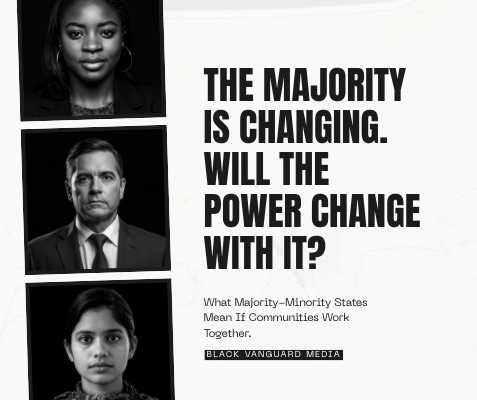
For much of American history, conversations about race have centered on one assumption: that minorities were exactly that — a collection of smaller groups with limited political and economic influence individually.
That assumption is becoming increasingly outdated.
According to recent U.S. Census estimates, eight states are now considered majority-minority, meaning non-Hispanic White residents make up less than half of the population. Georgia recently joined that list, alongside California, Texas, New Mexico, Nevada, Maryland, Florida, and Hawaii.
Even more notable, states such as Arizona, New York, and New Jersey are approaching the same threshold.
This is not merely a demographic story. It is a strategic one.
The Numbers Are Changing
For decades, demographic projections predicted that America would become more diverse. That future is no longer theoretical.
Communities that once represented smaller shares of the population are growing through births, migration, and immigration, while the non-Hispanic White share of the population continues to decline in many states.
But demographics alone do not create influence. History proves that.
Population Does Not Automatically Equal Power
There are many places around the world where large populations possess relatively little political or economic influence.
Why? Because influence is rarely determined simply by numbers.
It is determined by organization.
It is determined by institutions.
It is determined by ownership.
It is determined by participation.
It is determined by whether people can work together toward shared goals.
The question facing America’s changing demographics is not whether minority populations are growing. The question is whether they can convert population into measurable influence.
The Opportunity — And the Challenge
The phrase majority-minority can sometimes create the impression that one group has become dominant. That is not what it means.
Rather, it means that multiple communities — Black Americans, Hispanic Americans, Asian Americans, Native Americans, Pacific Islanders, multiracial Americans, and others — collectively represent more than half of a state’s population.
These communities have distinct histories, cultures, priorities, and political views. They do not vote as a single bloc, nor should anyone assume they will.
At the same time, many communities face overlapping challenges, including access to quality education, entrepreneurship, affordable housing, healthcare, workforce opportunities, and capital.
Where interests align, collaboration can increase collective influence.
What If Collaboration Became Strategy?
Imagine if communities that often operate independently began cooperating around shared economic priorities:
Supporting minority-owned businesses across communities.
Investing in neighborhoods rather than waiting for outside investment.
Building regional business networks.
Increasing civic participation.
Creating stronger pipelines into leadership positions.
Sharing knowledge, capital, and opportunity.
A New Era Requires New Thinking
Such cooperation would not require communities to give up their identities. Instead, it would recognize that collaboration can expand opportunity for everyone involved.
America’s demographic landscape is changing whether people acknowledge it or not.
The larger question is whether leadership will change alongside it.
Communities that organize effectively — regardless of race — have historically been better positioned to shape public policy, attract investment, build businesses, and influence the future.
Numbers matter. Organization matters more.
The Black Vanguard Perspective
At Black Vanguard Media, we believe this moment deserves more than headlines about census statistics.
It deserves a conversation about leadership. About institution-building. About ownership. About economic strategy.
Demographic change creates possibility — but possibility alone is not enough.
If America’s growing minority populations choose to work together where interests align, invest in institutions that outlast election cycles, and build economic ecosystems instead of isolated successes, they may discover that the greatest transformation is not demographic at all.
It is the transformation of influence into lasting power.
Because history has shown that the future belongs not simply to those who are numerous — but to those who are organized.