

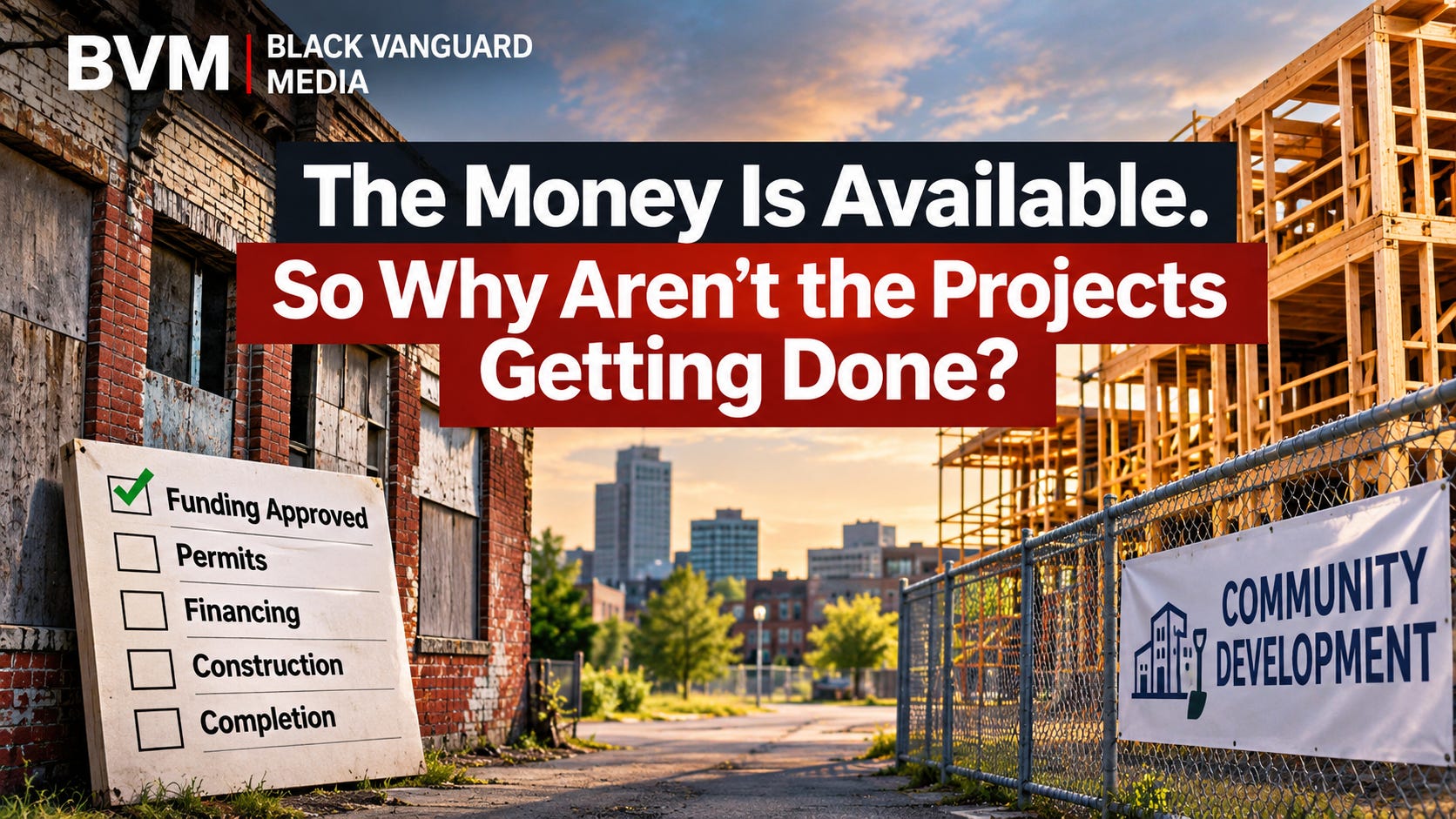
From abandoned buildings in Ohio to housing opportunities in Georgia, millions in public funding cannot improve communities unless organizations are prepared to turn those dollars into results.
Across America, government officials announce millions of dollars for neighborhood revitalization, affordable housing, and economic development. The announcements generate headlines, public celebrations, and promises of progress.
But months later, residents sometimes see little change.
The abandoned building remains standing. The vacant lot is still empty. The promised housing development has not begun.
The immediate question is often: Where did the money go?
A more revealing question may be: Was the project actually ready to use the money?
The distinction matters because public funding does not automatically produce public benefits. Between a government appropriation and a completed project lies a complicated process involving financing, documentation, partnerships, approvals, and organizational capacity.
And when that process breaks down, communities pay the price.
Ohio’s Demolition Program Reveals the Challenge
Ohio’s Building Demolition and Site Revitalization Program provides a clear example.
The state allocated $21.5 million for fiscal year 2027, plus certain previously unreserved funds, to support demolition and site revitalization.
However, according to the Ohio Department of Development’s official guidelines, projects must satisfy specific requirements before receiving funding.
Eligible applicants are designated county lead entities, often county land banks. Property owners cannot simply submit independent applications.
Projects must demonstrate property access, blight, vacancy, appropriate environmental status, and financial readiness.
The state also limits grants to 75 percent of eligible project costs.
That means a $400,000 demolition project could require $100,000 in matching resources.
An organization may have an abandoned building, a legitimate community need, and access to a government funding opportunity, yet still be unable to proceed because it lacks matching funds or necessary documentation.
Ohio’s scoring system also evaluates project readiness, local support, and anticipated economic impact.
These requirements are not necessarily examples of government obstruction. They are intended to protect public resources and establish whether proposed projects can be completed.
But they expose a significant weakness in economic development: Having an eligible project is not the same as having an executable project. Ohio Development Services Agency +1
Georgia Is Asking Similar Questions
Georgia’s Rehoused initiative provides another example.
The Georgia Department of Community Affairs is accepting applications for programs designed to reduce unsheltered homelessness and expand housing opportunities.
The current funding cycle includes substantial state and federal resources, but applicants must demonstrate more than a desire to help.
According to Georgia Rehoused’s official requirements, proposals must include documented partnerships involving local government, project plans, budgets, and appropriate homelessness data-system participation.
Applicants must first complete a pre-application process that evaluates eligibility and readiness.
The current pre-application deadline is November 25, 2026, followed by the competitive application deadline on December 16.
Georgia is effectively asking whether organizations have the partnerships, resources, and operational capacity to deliver what they propose.
That question is as important as the amount of money available. Georgia Department of Community Affairs +1
Delays Have Economic Consequences
When a demolition project stalls, surrounding properties may continue experiencing the effects of deterioration.
When housing construction is delayed, families wait longer for needed housing, contractors lose anticipated work, and communities postpone potential economic activity.
Delays can also increase project costs, particularly when construction prices, financing conditions, or regulatory requirements change.
But accountability requires distinguishing between legitimate obstacles and avoidable failures.
A project delayed by unexpected environmental contamination is not necessarily evidence of poor management. Neither is a delay caused by unresolved legal ownership.
However, repeated missed deadlines, incomplete applications, inadequate financial planning, or unexplained administrative delays deserve scrutiny.
Government agencies and funding recipients both have responsibilities.
Public officials should establish clear requirements, process applications efficiently, and communicate decisions transparently.
Organizations seeking funding must demonstrate financial readiness, secure necessary partnerships, and maintain the administrative capacity to manage public resources.
Neither side should automatically escape accountability by blaming the other.
We Must Measure Results, Not Announcements
The public conversation about economic development too often focuses on how much money government has committed rather than what that investment has accomplished.
Those are two different measurements.
Communities should know how much funding was approved, how much was awarded, how much was actually disbursed, and what was completed.
They should also know whether projects met their deadlines, how many housing units were produced, how many properties were demolished, and what measurable economic benefits resulted.
When projects fall behind schedule, the reasons should be documented and publicly understandable.
These measurements protect taxpayers, responsible government agencies, and organizations that are doing the work effectively.
Most importantly, they help residents distinguish between promises and progress.
Public investment remains essential to addressing abandoned properties, housing shortages, and longstanding economic challenges.
But money alone cannot solve problems that require capable institutions, coordinated leadership, and disciplined execution.
The next time government announces millions for community development, the public should ask more than how much money is available.
Ask who is responsible for delivering the results, whether they are prepared to do the work, and how the community will know when the investment has succeeded.
Because the true measure of economic development is not the size of the announcement.
It is the improvement people can actually see.