

There is one sentence that makes seasoned community development professionals quietly wince:
“We’ll figure it out after we get the money.”
It sounds harmless. Responsible, even. After all—capital is scarce, timelines are tight, and communities are waiting.
But in today’s financing environment, that sentence is often the first warning sign that an organization is about to outgrow its own infrastructure.
I’ve watched it happen across cities, deal types, and funding programs. Not because leaders lacked commitment—but because capital exposes whatever systems an organization hasn’t yet built.
Why That Sentence Is So Tempting
Let’s be honest about why leaders say it.
Most neighborhood-based organizations operate in scarcity. Teams are lean. Timelines are compressed. Funders come and go. Executive Directors carry more portfolios than most people realize. Boards are volunteering nights and weekends. Entire communities are waiting on projects that have already taken too long.
When an opportunity finally appears—New Markets Tax Credits, historic credits, a catalytic loan fund, a public-private partnership—the pressure to move fast is enormous.
Saying “we’ll figure it out later” can feel like pragmatism.
Sometimes it even feels like courage.
But in capital markets—especially the increasingly sophisticated space where public purpose meets private investment—later is usually too late.
What Capital Actually Requires
Here’s the part that rarely gets said out loud:
Serious capital does not flow to passion alone.
It flows to systems.
Investors, Treasury programs, and institutional partners are not just underwriting projects. They are underwriting organizations. They are looking for evidence that you can steward money over time, manage risk, report accurately, and make decisions when things get complicated—because they always do.
That means they are paying attention to things like:
Does the board understand financial oversight, or simply approve budgets?
Is there a clear pipeline of projects, or is everything opportunistic?
Who has underwriting authority—and how disciplined is that process?
What happens when a deal stalls?
Are compliance and reporting treated as strategic functions or administrative afterthoughts?
Can leadership explain its capital stack without flipping through slides?
These questions aren’t punitive.
They’re protective.
They exist because capital deployed poorly does not just harm balance sheets—it damages trust in communities that can least afford another broken promise.
When Organizations Try to Build the Plane Mid-Flight
Over the years, I’ve watched well-intentioned groups scramble after securing a big commitment.
Policies get written in a hurry.
Finance teams stretch beyond capacity.
Board committees form on paper but rarely meet.
Construction timelines slip.
Reporting requirements pile up.
Investors start calling more frequently.
Then lawyers get involved.
Sometimes the project survives.
Sometimes it limps across the finish line.
Sometimes it doesn’t.
What almost always happens, though, is this: reputations take a hit. Future opportunities become harder to access. The next investor asks more questions. The next application gets read more skeptically.
The tragedy is that these organizations were often doing transformative work.
They just weren’t structurally ready for the scale of capital they pursued.
The Reframe Strong Leaders Make
The best Executive Directors and boards I work with say something very different:
“We’re building the machine before we win the race.”
They treat capital readiness as part of their mission, not a distraction from it.
They understand that professionalism is not the opposite of community values—it is how those values get protected.
Instead of waiting for the award letter, they invest early in:
governance training for board members
financial policies that actually guide decisions
risk management frameworks
deal pipelines tied to community priorities
investor communication protocols
audit readiness and internal controls
They practice answering hard questions before anyone asks them.
They simulate what happens when a project underperforms.
They clarify who makes what decisions under pressure.
By the time money shows up, the organization already knows how to carry it.
This Is About Stewardship, Not Bureaucracy
Sometimes leaders hear conversations about systems and think: That sounds like bureaucracy. That sounds like mission drift.
I see it differently.
I see stewardship.
Communities do not just need projects to start.
They need them to finish.
They need institutions that can manage capital responsibly over decades, not just through one grant cycle. They need boards who understand that governance is not ceremonial. They need executives who can sit at investor tables without shrinking—or posturing.
They need organizations that are strong enough to hold opportunity when it arrives.
That strength is built long before the ribbon cutting.
A Gentle Challenge to the Field
If you are an Executive Director, board member, or emerging community developer, I want to offer a respectful challenge:
Before you chase the next catalytic dollar, pause and ask:
Are our systems built for the scale we’re pursuing?
Does our board truly understand our capital strategy?
Could we survive a delayed closing?
Do we know who we are accountable to—and how?
Could we explain our full capital stack without notes?
If those questions make you uneasy, that’s not a failure.
That’s data.
And it’s much easier to strengthen an organization before the term sheet arrives than after.
What Comes Next
In my next column, I’ll break down what the post-2025 capital landscape actually looks like—the expanding mix of tax credits, Treasury programs, and private equity shaping community-based development right now.
The organizations that prepare for that environment today will be the ones closing deals tomorrow.
Capital is coming.
The question is whether our institutions are ready to hold it.
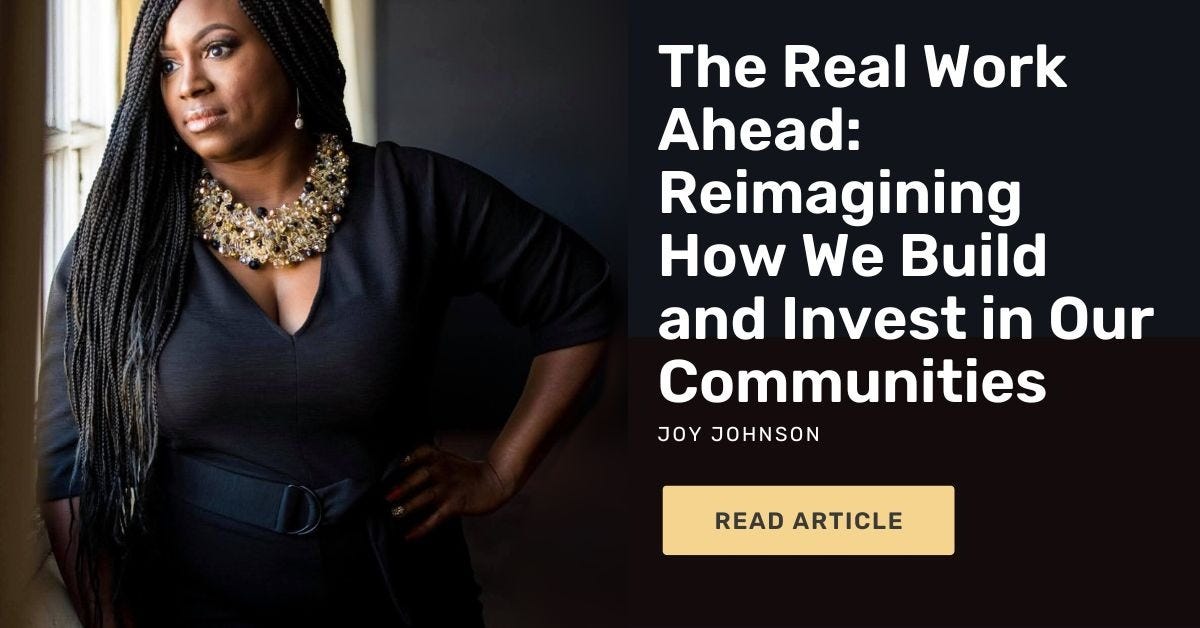
With more than two decades of experience in community development, real estate strategy, and organizational leadership, Joy Johnson brings a seasoned, solutions-focused voice to the field. She is committed to helping communities and institutions avoid systemic pitfalls and build models that truly work. To reach Joy call at (216) 238-2235