

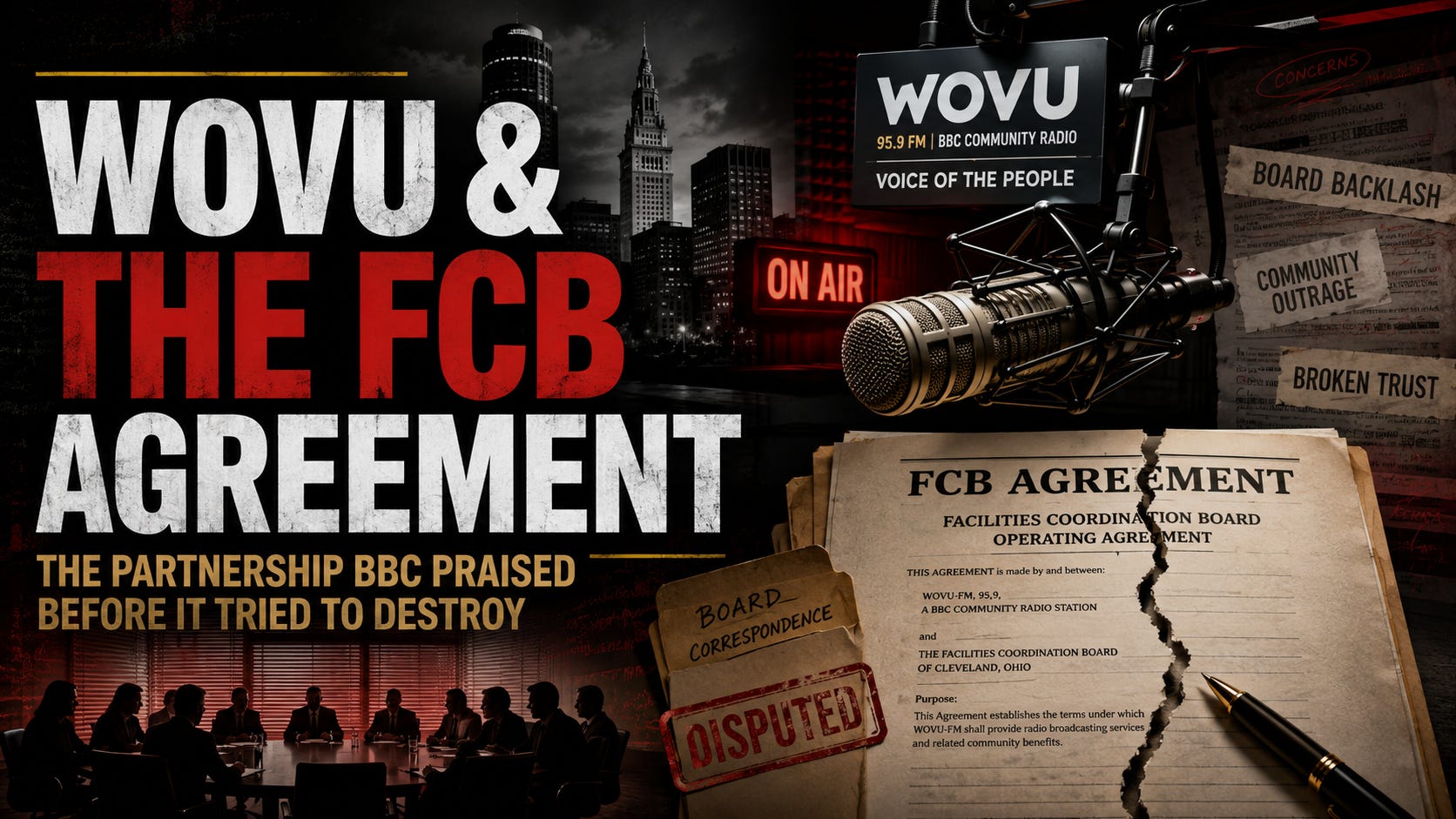
Before Burten, Bell, Carr Development, Inc. tried to turn the WOVU partnership into a scandal, it was a solution.
That is the fact BBC cannot escape.
WOVU 95.9 FM was not simply a radio station. It was a community asset. It carried history, identity, neighborhood voice, and cultural meaning. For Cleveland’s Black community, a station like WOVU was not just a broadcast signal. It was supposed to be a platform — a place where local stories, local concerns, local voices, local music, local culture, and local accountability could live.
But mission alone does not pay bills.
Mission does not automatically create audience growth.
Mission does not build digital infrastructure.
Mission does not produce underwriting revenue.
Mission does not manage programming strategy.
Mission does not turn a struggling low-power FM station into a sustainable media platform.
That was the problem BBC faced.
WOVU had value, but it also had a cost. It had purpose, but it also required resources. It had community meaning, but it needed a stronger operational model.
And BBC knew it.
That is why Joy Johnson was asked to find a way for WOVU to stop draining BBC’s resources.
That is why First Class Broadcasting entered the picture.
That is why the WOVU-FCB relationship must be understood for what it was before BBC tried to rewrite it:
A board-recognized problem met with a professional media solution.
BBC Needed a WOVU Solution
The public should understand the condition of the problem before judging the solution.
WOVU was important. But WOVU was also financially and operationally difficult for BBC to carry. A low-power FM station serving the community may sound simple from the outside, but running a station requires programming, staffing, technical support, compliance, production, digital distribution, underwriting, audience development, sponsorship strategy, and consistent management.
BBC was not primarily a media company.
It was a community development corporation.
That distinction matters.
A CDC can own a station. A CDC can value a station. A CDC can believe deeply in the station’s mission. But that does not mean it has the internal media infrastructure to make the station financially sustainable.
That is why the board’s request to Joy Johnson matters so much.
Joy was not freelancing.
Joy was not inventing a problem.
Joy was not secretly creating a relationship to benefit someone outside BBC.
She was responding to a problem BBC’s own leadership knew existed.
The board wanted WOVU to stop draining BBC’s resources. Joy was tasked with finding a more sustainable path. The FCB relationship was her answer.
That fact should end much of the bad-faith speculation surrounding this issue.
Because when a board asks an executive to solve a problem, the board cannot later pretend the solution came from nowhere.
Enter First Class Broadcasting
First Class Broadcasting was not brought in as a mystery actor.
FCB was a media company with radio experience, programming capacity, digital relationships, audience-growth strategy, and a plan to move WOVU beyond the limits of a traditional neighborhood LPFM model.
The Radio Syndication, Affiliation, and Consulting Agreement described the relationship in clear terms. BBC was the FCC-designated licensee of WOVU-LP. FCB was engaged to provide content, programming, and consulting services, including underwriting acquisition services, digital strategy consulting, and assistance with expansion onto digital platforms.
That is not a scandal.
That is a business arrangement.
And more importantly, it was a business arrangement directly tied to the problem BBC had asked Joy to solve.
WOVU needed stronger programming.
FCB brought programming.
WOVU needed digital growth.
FCB brought digital strategy.
WOVU needed underwriting and sponsorship development.
FCB brought revenue strategy.
WOVU needed broader reach.
FCB brought media infrastructure and distribution relationships.
WOVU needed to become more sustainable.
FCB brought a plan to help move it there.
That is why BBC’s later attempt to portray the relationship as suspicious deserves scrutiny.
If BBC understood WOVU was a financial burden, and if BBC needed a sustainable model, and if FCB was brought in to provide exactly the services WOVU lacked, then the partnership was not the problem.
It was the response to the problem.
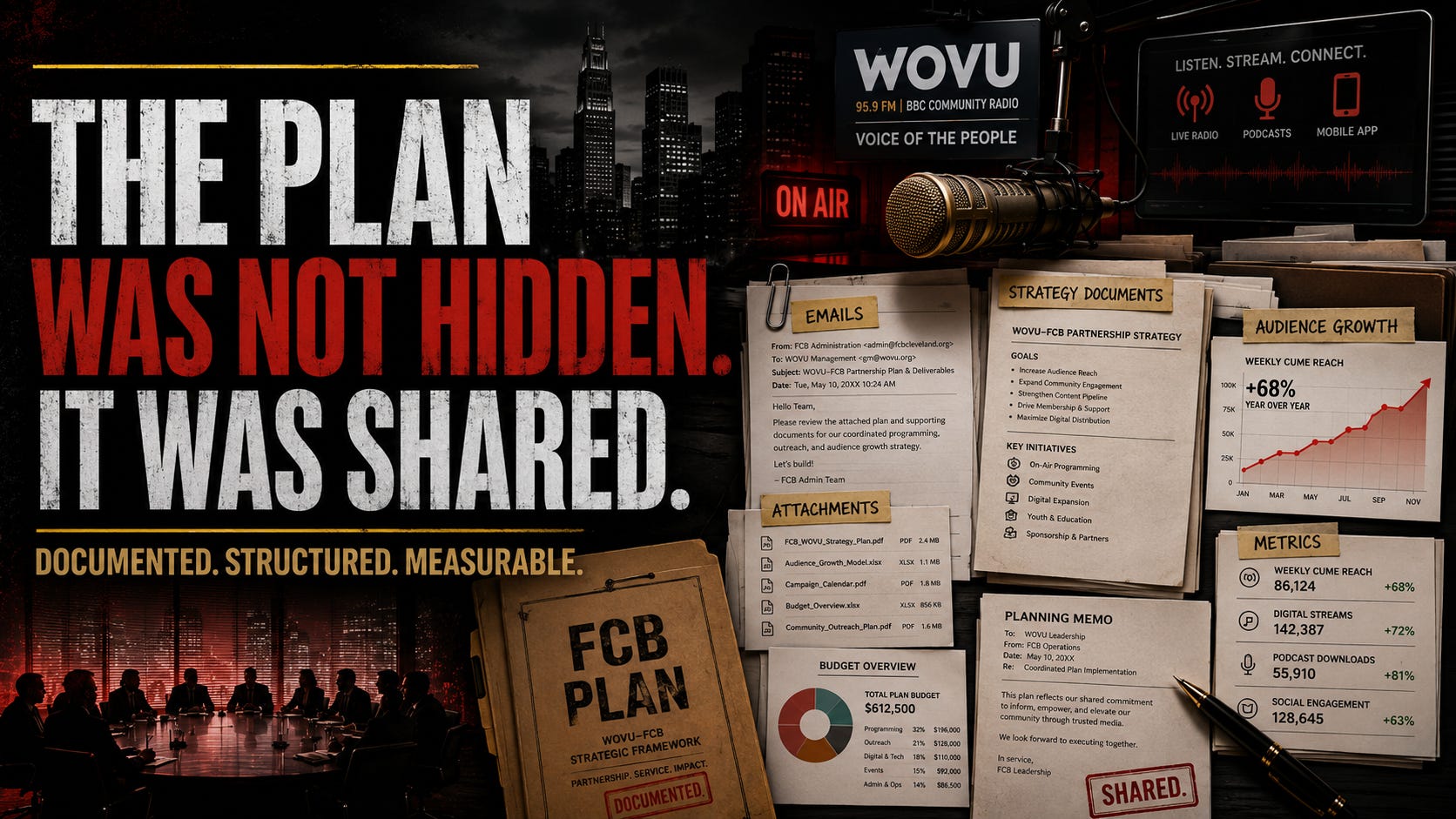
The Plan Was Not Hidden. It Was Shared.
One of the most important things about the WOVU-FCB relationship is that it was documented.
There was a plan.
There were strategy documents.
There were emails.
There were attachments.
There were discussions about audience growth, programming, digital access, continuity, underwriting, and station operations.
The FCB plan was not some vague promise. It was a structured approach to strengthening WOVU.
The plan focused on growing WOVU’s audience across terrestrial radio, digital streaming, and podcast platforms. It aimed to make the station more attractive to underwriters, sponsors, and advertisers. It proposed measurable, quantifiable listener growth. It emphasized hyperlocal engagement, expanded community outreach, stronger programming, digital expansion, and a more sustainable model.
That matters because BBC’s current narrative depends on making the relationship feel shadowy.
But documented plans are not shadows.
Emails are not shadows.
Budget discussions are not shadows.
Strategy documents are not shadows.
If anything, the paper trail shows that FCB was attempting to professionalize WOVU’s operations and make its growth measurable.
That is exactly what a funder, board, or public official should want from a community media asset.
WOVU could not survive long-term on good intentions alone. It needed metrics. It needed reach. It needed revenue strategy. It needed systems. It needed a partner that understood media.
FCB brought that framework.
The Board Cannot Have It Both Ways
BBC’s problem is not merely that it now disputes the agreement.
Parties dispute agreements every day.
BBC’s deeper problem is that it appears to want two contradictory stories to be true at the same time.
On one hand, BBC wants to say WOVU was a problem.
On the other hand, BBC wants to attack the person who found a solution.
On one hand, BBC wants to say the station was financially burdensome.
On the other hand, BBC wants to treat the effort to relieve that burden as suspicious.
On one hand, BBC benefited from FCB’s media work.
On the other hand, BBC now tries to discredit FCB’s involvement.
On one hand, BBC had board-level responsibility for WOVU.
On the other hand, BBC wants the public to believe Joy Johnson alone is responsible for everything connected to WOVU.
That is not a coherent position.
A board cannot ask an executive to solve an operational drain and then later use the attempted solution as evidence against her.
A board cannot accept professional media support and later pretend the partner had no legitimate role.
A board cannot allow a relationship to proceed, benefit from its work, and then attack it after leadership politics change.
That is not governance.
That is revision.
FCB Improved WOVU
The record shows that WOVU’s transformation under FCB was not theoretical.
FCB’s involvement shifted WOVU’s identity, reach, digital accessibility, programming strength, and public visibility. The station began moving from a traditional LPFM community station into a broader media platform with a clearer programming identity and measurable growth.
That matters.
Because BBC’s current posture requires the public to ignore what FCB actually did.
If FCB harmed WOVU, where is the proof that the station was stronger before FCB arrived?
If FCB was the problem, why did the station’s reach and visibility grow under FCB?
If FCB brought no value, why did WOVU’s digital accessibility, audience development, and programming identity improve?
If FCB was merely exploiting BBC, why was it producing strategies, plans, reports, programming improvements, and revenue opportunities?
The truth is that FCB did what BBC needed someone to do.
It treated WOVU like a media asset.
It looked at audience growth.
It looked at underwriting.
It looked at programming.
It looked at digital distribution.
It looked at brand identity.
It looked at sustainability.
That is what BBC should have been celebrating.
Instead, after the relationship became legally and politically inconvenient, BBC tried to turn the partner into the villain.
From Collaboration to Conflict
The key shift in this story did not happen when FCB arrived.
It happened after Joy Johnson was removed.
Before that, the WOVU-FCB relationship was part of a sustainability strategy. After Joy’s removal, the relationship became a battlefield.
That timing matters.
Because it suggests that the controversy around FCB was not simply about WOVU’s performance. It was about control, governance, and the post-Joy leadership environment.
After Joy was removed, David Roney and BBC’s new leadership began communicating with Darvio Morrow about WOVU finances, budget details, contractor payments, funding sources, and revenue tracking. Those communications show that FCB was not disappearing. FCB was responding. Darvio was providing information. BBC was trying to understand or reconstruct aspects of WOVU’s financial picture.
That is important because BBC later tried to present FCB as part of the problem.
But the email record points to a more complicated reality: BBC’s leadership was asking FCB for information about BBC’s own station and BBC-controlled financial systems.
If BBC controlled the bank accounts, the books, payment systems, and organizational finances, then FCB cannot be made responsible for internal confusion inside BBC.
A media partner is not the same thing as BBC’s treasurer.
A programming and consulting partner is not the same thing as BBC’s accounting department.
A contractor cannot control internal systems it does not administer.
That distinction matters because BBC’s later accusations appear designed to blur the line between FCB’s media role and BBC’s own governance responsibilities.
The February Break
According to FCB and Urban Voice Public Media’s complaint, Darvio Morrow notified David Roney on February 9, 2026, that Urban Voice Public Media had received its IRS determination letter. The next day, BBC suspended or ended FCB/UVPM’s station operations and refused to proceed with the FCC-related process.
That timeline is central.
Because if the Amendment created a framework for transfer or assignment after UVPM’s IRS determination, then BBC’s February 10 action appears to be the moment the dispute exploded.
And who was involved?
Not Joy Johnson.
Joy was gone.
This was a post-Joy decision.
The public should not miss that.
BBC’s present narrative may focus heavily on Joy, but the critical act that triggered litigation occurred after Joy’s removal, under BBC’s new leadership structure.
That makes the attempt to blame Joy even weaker.
If BBC believed the Amendment was invalid, it could have handled that position through orderly legal process, clear written correspondence, board minutes, contractual analysis, and appropriate counsel.
Instead, BBC suspended FCB/UVPM operations, denied the validity of the agreement, refused to proceed, and ended up in litigation.
That is not merely a WOVU story.
That is a governance story.
Jamie Parker and the Suspension
Jamie Parker’s role is significant here.
She was the BBC Board President when FCB/UVPM’s operations were suspended. She later became Interim Executive Director. Publicly available professional materials identify her as an Ohio attorney with experience in labor and employment law, mediation, compliance-risk mitigation, policy and procedure creation, human resources, and leadership-team conflict resolution.
That matters because BBC’s suspension of FCB/UVPM operations was not a casual administrative choice.
It was a serious action with legal consequences.
When a board president with legal training is involved in suspending a partner’s station operations, the public has a right to ask:
What process did BBC follow?
What contract provisions did BBC rely on?
What written notice was provided?
What board action authorized the suspension?
What legal risk did BBC evaluate?
What alternatives were considered?
Was the goal to protect WOVU — or to retake control after the Amendment trigger occurred?
Those are not personal attacks.
They are governance questions.
And they are especially important because BBC later failed to timely respond to the lawsuit that followed, then blamed internal confusion and Roney-related handling for that failure.
The same boardroom that suspended FCB later became the boardroom asking the court for relief from a missed litigation deadline.
That is why the WOVU story cannot be separated from the governance story.
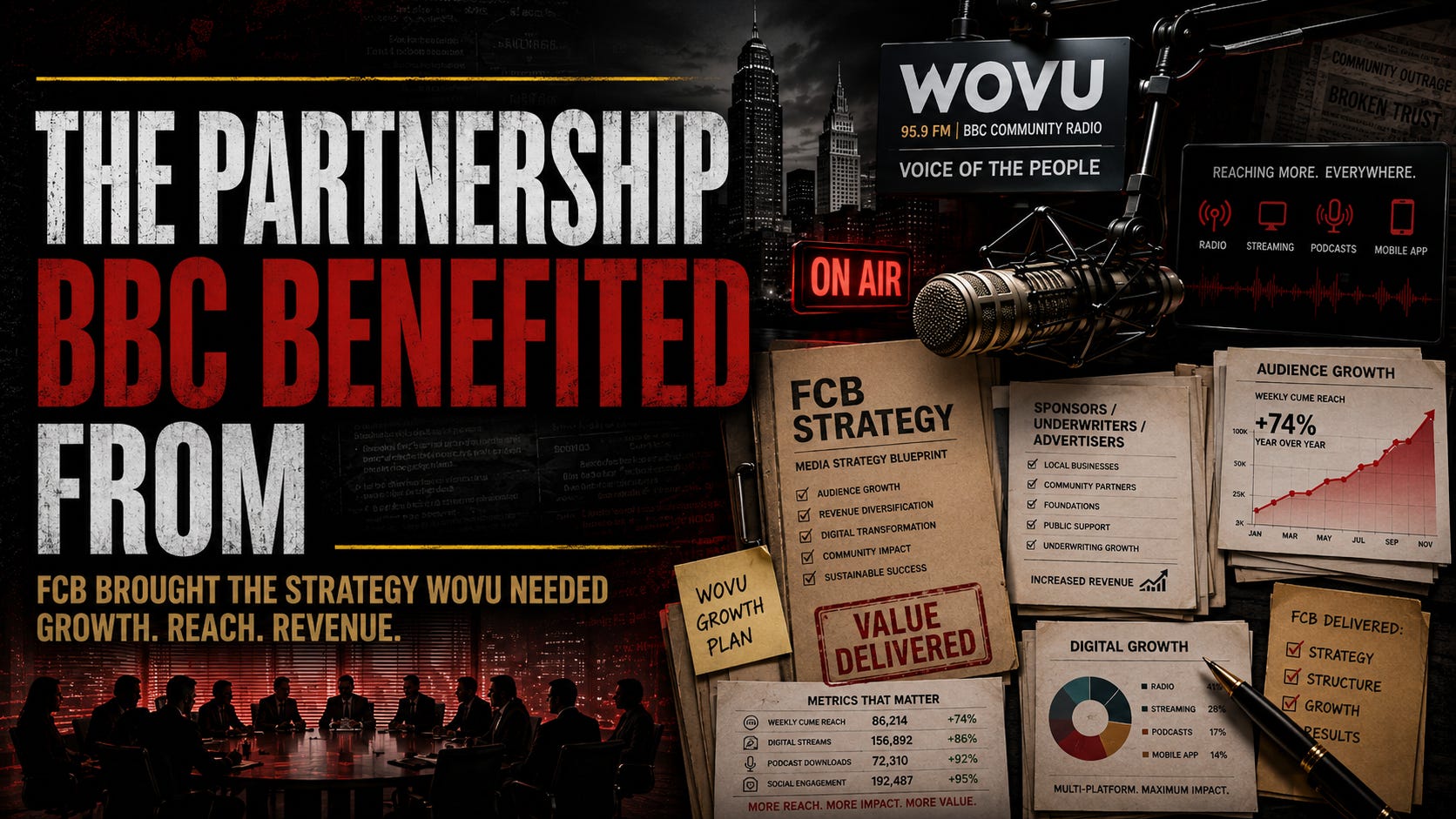
The Partnership BBC Benefited From
BBC’s current posture tries to make FCB sound like an outside force that damaged WOVU.
But that framing ignores the value BBC received.
FCB brought WOVU a stronger media strategy.
FCB helped position WOVU for digital growth.
FCB worked on expanding the station’s reach beyond the limitations of a low-power FM signal.
FCB brought programmatic identity and professional media discipline.
FCB helped move WOVU toward a model that could attract sponsors, underwriters, advertisers, and public attention.
FCB gave BBC something it did not have internally: a media operating strategy.
That matters because BBC cannot fairly accept the benefit of that strategy and then pretend the relationship was illegitimate once the dispute became inconvenient.
If BBC wanted WOVU to stop draining resources, then FCB’s work was directly aligned with BBC’s stated need.
If BBC wanted the station to grow, then FCB’s work was responsive.
If BBC wanted the station to be more attractive to funders and sponsors, then FCB’s measurable growth strategy mattered.
If BBC wanted WOVU to have a future, then FCB was part of building one.
The partnership was not something BBC should be embarrassed by.
The attempt to destroy it is what deserves scrutiny.
The Attack on FCB Protects BBC’s Board
Why would BBC try so hard to discredit FCB?
One possible answer is simple: because FCB’s record makes BBC’s governance failures harder to hide.
If FCB was improving WOVU, then BBC must explain why it suspended FCB.
If FCB had a valid agreement, then BBC must explain why it refused to honor it.
If FCB provided a solution to a board-recognized financial drain, then BBC must explain why it later attacked that solution.
If FCB communicated with post-Joy leadership, then BBC must explain why it paints FCB as evasive or improper.
If BBC controlled its own finances, then BBC must explain why it suggests FCB is responsible for financial confusion.
If the dispute escalated after Joy’s removal, then BBC must explain why Joy remains the center of its blame narrative.
That is the problem for BBC.
The more the record is examined, the less the FCB smear works.
The issue is not whether BBC has a right to defend itself in court. It does.
The issue is whether BBC is defending itself honestly.
A defense rooted in contract interpretation is one thing.
A defense that tries to damage reputations, distort timelines, imply misconduct, and erase the value of FCB’s work is something else.
WOVU Was Bigger Than BBC’s Boardroom
The tragedy of this dispute is that WOVU was supposed to be bigger than the boardroom politics surrounding it.
WOVU was supposed to serve the community.
It was supposed to uplift voices.
It was supposed to inform residents.
It was supposed to connect neighborhoods.
It was supposed to be a platform for culture, civic engagement, music, public accountability, and community pride.
That mission deserved serious stewardship.
But serious stewardship requires more than ownership.
It requires competence.
It requires planning.
It requires media expertise.
It requires financial discipline.
It requires board maturity.
It requires the humility to admit when outside expertise is needed.
That is what the FCB partnership represented.
BBC did not have to lose WOVU’s mission by partnering with FCB. It had the opportunity to strengthen that mission.
But instead of protecting the partnership, BBC’s post-Joy leadership escalated conflict and helped turn WOVU into the center of a lawsuit.
That is the public loss here.
A station that could have grown became a battleground.
A partnership that could have stabilized WOVU became a smear campaign.
A solution became the excuse for another round of blame.
The Amendment Fight
BBC now disputes the Amendment.
That is part of the legal fight.
But the public should understand what the Amendment does not erase.
It does not erase the original Agreement.
It does not erase BBC’s recognition that WOVU needed support.
It does not erase FCB’s work.
It does not erase WOVU’s growth under FCB.
It does not erase Darvio’s communications with post-Joy leadership.
It does not erase the fact that BBC suspended FCB/UVPM operations after UVPM received its IRS determination.
It does not erase BBC’s failure to timely answer the lawsuit.
It does not erase the board’s governance responsibilities.
And it does not turn every person associated with the WOVU solution into a wrongdoer.
BBC can litigate the Amendment.
But BBC should not be allowed to use the Amendment dispute to rewrite the entire history of the partnership.
The relationship began because WOVU needed help.
That remains true regardless of the litigation.
What Funders Should Ask
Any funder, public official, partner, or community stakeholder concerned about WOVU should ask BBC direct questions.
Did the board ask Joy Johnson to find a sustainable model for WOVU?
Was WOVU financially draining BBC resources?
What options did the board consider before FCB?
What due diligence did BBC conduct regarding FCB?
What did BBC approve regarding the original Agreement?
What value did FCB provide?
What measurable growth occurred under FCB?
What role did FCB play in programming, digital strategy, underwriting, and audience expansion?
Who decided to suspend FCB/UVPM operations?
What legal analysis supported that suspension?
What board vote authorized it?
What notice was provided?
Why did BBC fail to timely answer the lawsuit?
Why is BBC now attacking the people who helped create the WOVU solution?
Those questions are not hostile.
They are necessary.
Because WOVU was not a private toy for board politics.
It was a community asset.
And community assets require public accountability.
The Record Is Clear
The record points to a basic story.
BBC had a station it valued but struggled to sustain.
The board asked Joy Johnson to find a solution.
Joy pursued a relationship with FCB.
FCB brought media expertise, programming support, digital strategy, underwriting focus, audience-growth planning, and operational structure.
WOVU improved under FCB.
After Joy was removed, BBC’s new leadership challenged the relationship.
BBC suspended FCB/UVPM operations after the UVPM trigger event.
Litigation followed.
BBC missed its response deadline.
Then BBC tried to turn Joy, Darvio, FCB, UVPM, and Jerry Primm into the story.
But they are not the story.
The story is that BBC had a WOVU problem, received a WOVU solution, benefited from that solution, and then tried to destroy the partnership when control became inconvenient.
That is why Part IV matters.
Because before BBC can attack FCB, it must answer a simpler question:
Why did WOVU need FCB in the first place?
And once that question is answered honestly, the smear campaign begins to fall apart.
WOVU was not damaged by having a professional media strategy.
WOVU was damaged when governance politics overtook the mission.
The partnership BBC now attacks was the very partnership built to protect the station’s future.
That is the record.
And the record deserves to be read.